.png)


Khamenei Is Dead: Will Iran’s Islamic Republic Survive the US-Israel Strikes?

Updated: Mar 29
It was a question of when, not if. After weeks of the United States amassing a vast armada in the region and successive rounds of talks collapsing as a ruse to mask war plans, the axe finally fell on February 28th, when the U.S. and Israel launched coordinated strikes across Iran.

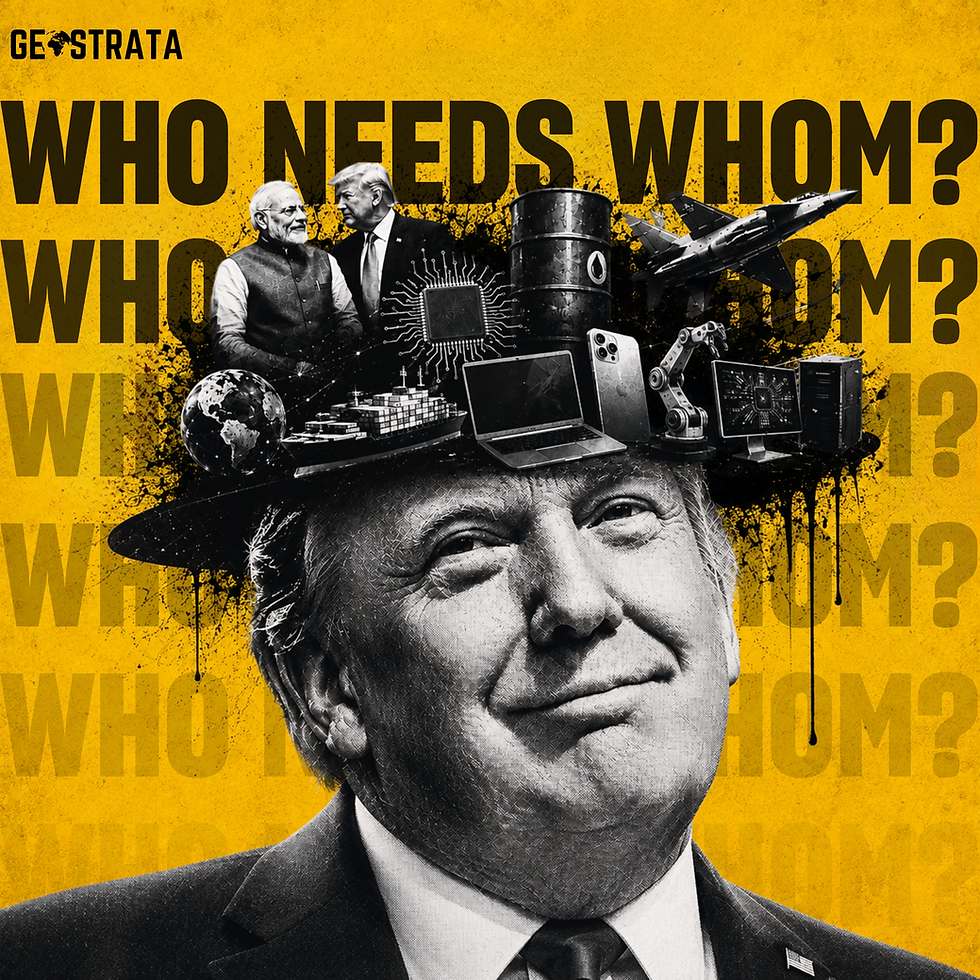
Illustration by The Geostrata
Soon after, U.S. President Donald Trump and Israeli Prime Minister Benjamin Netanyahu made clear that their objective went beyond obliterating Iran’s nuclear weapons sites or missile launchers to forcing regime change. Now, with the country’s supreme leader, Ali Khamenei, killed, they have edged closer to achieving that flashier goal. But can the Islamic Republic, whose very raison d'être is survival, be dismantled by decapitation alone? And what comes next?
NOTHING TO LOSE
As the attack unfolded across Iran, the first wave appeared to target both senior Iranian officials and its military bases. Bombing spread to hit the Islamic Revolutionary Guard Corps, its judiciary, the country’s intelligence services, its atomic-energy agency and other sites nationwide, including Chabahar port. They bore all the hallmarks of a comprehensive leadership-decapitation campaign.
Meanwhile, Iran wasted little time retaliating, striking not only Israel but also its Arab neighbours across the Persian Gulf. It fired a flurry of missiles directed at a wider range of targets, including American bases in Bahrain, Jordan, Kuwait, Qatar, Saudi Arabia and the United Arab Emirates. These marked the first exchanges of a war that would engulf much of the Middle East.
Vowing to avenge its supreme leader’s death, Iran has shown signs of expanding its targets. In doing so, Tehran appears to have concluded that chaos may be its strongest card, that only by making it an all-out war and throwing the region into a tailspin can it hope to defend itself. With little left to lose, the Islamic Republic, arguably at its weakest since its founding in 1979, sees victory in one thing: theocracy’s survival, no matter how battered or bruised. Where America and Israel seek regime change, Iran simply needs to endure.
COLLATERAL DAMAGE
Imagine you’re a Gulf leader who has spent months trying to dodge a regional war, urging both sides to stand down and even forbidding your ally, the U.S., from using your soil to mount an attack, only to get dragged in anyway.
America’s Gulf allies now find themselves in precisely that impossible situation. The war they long dreaded has come to the Middle East. As Iranian strikes plunge the region deeper into the conflict, the Gulf states have inevitably become collateral damage. Fear of exactly this escalation was one reason why they lobbied Trump to hold fire. Another was the belief that the U.S. might try to topple the Iranian regime altogether, tipping the country of 92 million people into the sort of chaos that swept Iraq after the 2003 American invasion.
For Iran, however, striking the Gulf carries a clear twofold logic. First, most of them host American bases or soldiers. Qatar, for example, houses the regional headquarters of U.S. Central Command; Bahrain is home to America’s Fifth Fleet. Second, for the Iranian regime, hitting the Gulf states hard enough could push them to pressure the White House to sue for peace.
Now, as the IRGC has vowed a “most ferocious offensive” to avenge Khamenei’s death, several locations in the UAE's Abu Dhabi and Dubai, Saudi Arabia's Riyadh, Kuwait and Oman, among others, have come under attack. Various casualties and injuries have been reported across the region. Gulf states have lived in fear of such scenes, as it is one thing to absorb strikes aimed at American bases, but attacks on their civilian infrastructure, energy installations and urban centres are something else entirely.

Map by The Geostrata
They are also bearing the economic brunt. Iran has shut down shipping through the Strait of Hormuz, a vital maritime artery through which around 20 per cent of global oil consumption passes. Should the conflict escalate further and Iranian proxies step up their attacks, as some have reportedly promised, there is a wide range of cities and energy infrastructure where they could wreak havoc. For a region that enjoys a reputation as an oasis of stability in a turbulent neighbourhood, missiles zooming overhead are decidedly bad for business.
What now? America’s Gulf allies are caught in a moment of great peril: If war cannot be avoided, should they choose sides? However, there appears to be no consensus yet. Some Gulf officials still hope diplomacy can be revived, while others think the die has already been cast. Perhaps, were the Israeli factor in these strikes not so pronounced, a broader alignment by the Gulf states with the U.S. might already be under consideration.
"TAKE OVER YOUR GOVERNMENT"
Trump, in his video address, turned to Iranians, saying, “When we are finished, take over your govt... this will be your only chance.” Israeli PM Netanyahu echoed him, saying the joint US-Israeli attack “will create the conditions for the brave Iranian people to take their destiny into their own hands" and "remove the yoke of tyranny".
In both speeches, what was notable was who they called on to achieve their goal. Because let’s not forget, in many ways, this is where it all began.
These calls came just two months after the country witnessed unprecedented mass protests against the Islamic Republic. With Trump hesitant to deploy troops on the ground and with air power alone rarely sufficient to bring about regime change, he has instead gambled on “the great, proud people of Iran” to topple their government themselves.
That raises harder questions: will the death of Khamenei be some kind of turning point for the Islamic Republic, or will the system absorb the shock? And for all the exhortations from Washington and Jerusalem, is an outright regime change likely, particularly one that depends on a society still weighed down by the legacy of recent brutal repression? If not, is Washington eyeing a softer, Venezuela-style decapitation?
THE SYSTEM AFTER THE MAN
Taking out Supreme Leader Ayatollah Ali Khamenei is not the same as regime change. Still, his departure has opened up the possibility for change. But what kind of change? As for now, Iran’s top national security official, Ali Larijani, has said an interim committee will govern the country until a new supreme leader is chosen.
With many top political and military leaders killed, the regime has taken a dramatic blow. America’s armada, along with the Israelis, is capable of launching hundreds of strike missions for days, perhaps weeks, to come. Despite all this, if the regime survives and doubles down on hardened ideological and nuclear rhetoric, it may find itself living on even more borrowed time. Their gamble that pursuing a nuclear and missiles programme would provide leverage in talks has repeatedly failed and has instead led to further destruction.
U.S. officials, according to experts, envision another path: Iran’s powerful Revolutionary Guards taking greater control over the country, much like a Venezuela-style outcome where America removes the head of the regime and then negotiates with remnants for a transition to a system less confrontational toward the U.S. But, for decades, Washington has been trying and failing to find moderate Iranian officials with whom to work. And after the ayatollah's assassination, there appear to be even fewer incentives for such figures to emerge.
As for a scenario that rides almost entirely on the ability of the Iranian people, largely unorganised and unarmed, to seize the moment: many analysts have expressed scepticism. This pre-emptive operation might catalyse these dynamics. But what cannot be overlooked is that the Islamic Republic is an ideological system with a multi-layered elite and base of support. Such regimes fall only when security forces fracture, elites defect, and streets mobilise at scale. Or when outsiders occupy territory and install successors. At present, there is little evidence of such fragmentation. Instead, the regime appears resilient.
Amid all this uncertainty, though, one thing is clear: whoever takes Khamenei’s place and how they come to power will shape the future of this conflict, Iran and even the broader Middle East.
WAR OF NECESSITY OR WAR OF CHOICE?
U.S. officials might imagine outcomes amenable to their interests. But America’s long record of Middle East interventions suggests history has not always been kind. The United States is very good at winning wars, but not very good at winning the peace, is a common critique.
Now that President Trump, arguably in the greatest foreign policy gamble of his presidency, has launched a war against a foe Washington has jousted with for decades, comparisons with the past have resurfaced, and with them the question of whether this conflict will follow a familiar arc.
History has shown us that the U.S. has frequently entered hostilities without thinking through how it will ultimately end them. When wars begin, the American crusader is often so engrossed in its initial righteous anger at overthrowing an evildoer that it pays scant regard to the consequences of its operations or the kind of peace that will follow.
Now, back to the present, Trump intends to sustain its assault on Iran for as long as it takes to render it incapable of posing a threat, giving mixed messaging on the war aims and its timeline. “Whatever the time is, it’s OK, whatever it takes,” the U.S. President said in his first public comments on the war. He has also declined to rule out sending ground troops into Iran. Meanwhile, Tehran’s remnant leadership also appears determined to foment regional chaos and says it is prepared for a long war.
As the operation progresses, if Iran fails to surrender, Trump could face a familiar dilemma: becoming bogged down in an ill-defined military operation to contain a weakened but still functional and hostile regime. And if he backs down, he risks appearing weak, a label the U.S. President has long tried to keep at arm’s length.
Here, one might recall George Kennan’s famous comparison of the U.S to “one of those prehistoric monsters with a body as long as this room and a brain the size of a pin.” Whether this proves true again remains to be seen.
BY GARIMA ARORA
TEAM GEOSTRATA


Comments