.png)


Dark Clouds over the Atlantic: The Illusion of an Unbreakable US-Europe Alliance

“There are no permanent friends or allies, only permanent interests.”
This quote by Lord Palmerston significantly underlines the fragile nature of relationships in the geopolitical arena, which is increasingly becoming more dynamic and complex in structure. The approach of one size fits all has become obsolete, and nations are embracing a more fluid framework in their pursuit of diplomatic outreach.

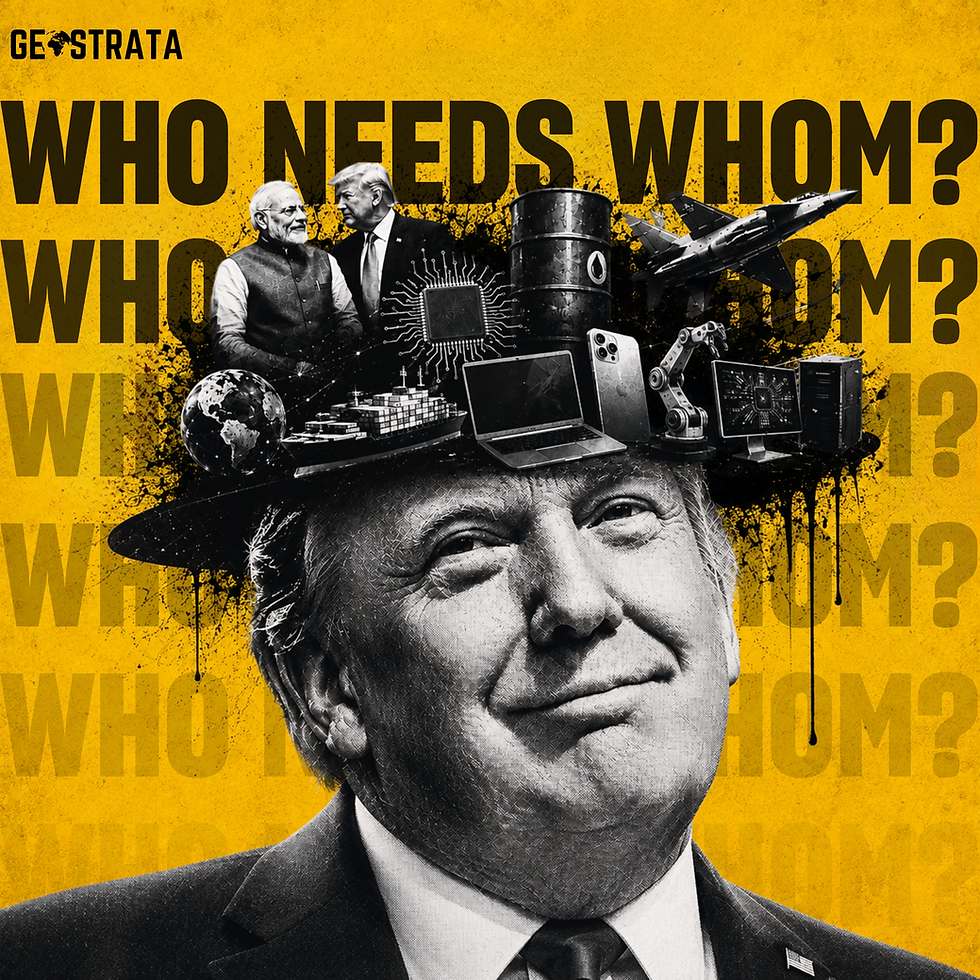
Illustration by The Geostrata
The 27-country European Union is the U.S.’s largest trading and investment partner. Moreover, according to a report published by the Pew Research Centre, two-thirds of Americans believe that the United States benefits from NATO membership. However, for the past few years, there has been a slow and gradual buildup in tensions and friction in engagement between the US and Europe. The stagnant war in Ukraine, imposition of high tariffs, possible annexation of the Danish territory of Greenland by the U.S., and the Iran war, delineate the current state of Transatlantic relations.
These developments are not isolated points of disagreement but reflect a broader pattern of misaligned priorities and eroding trust. The Ukraine conflict, for instance, has exposed differences in urgency, resource commitment, and long-term objectives, while trade disputes and tariff escalations signal a shift toward economic nationalism on both sides.
The Trump administration effectively views NATO as no longer a mutually beneficial alliance, but instead a liability, arguing that many member states fail to reciprocate U.S. commitments or meet proportional defence spending obligations. Though the withdrawal seems unlikely, the persistent criticism risks undermining the credibility of NATO as a collective security alliance.
U.S.'S RISKY BET ON IRAN
On 28th Feb, the United States, along with Israel, launched unprecedented attacks on Iran, and a decapitation strike, leading to the assassination of Iran’s supreme leader. It seems that the US is dragging itself into a war with no clear objectives in sight. Evident from the early remarks of Donald Trump at the outset of the war, the initial objective appeared to be regime change. Currently, the war continues to escalate, extending its focus toward the Strait of Hormuz, which remained open before the conflict but has now become a central strategic objective to secure.
Simultaneously, European countries are being pushed to the sidelines. They were not consulted in any meaningful way before the outbreak of this war; they do have a lot at stake in maintaining the stability of this region, and they do have obligations regarding alliances. The resulting shock in world oil prices has placed immense pressure on the European economy. A conflict far away from European borders has rapidly developed into direct economic and strategic challenges to the entire continent.
UKRAINE CHANGED EVERYTHING
The alliance performed well over the first two years after the start of the Russian full-scale invasion of Ukraine (February 24th, 2022). However, since then, there has been a change in attitude among all parties. For example, Washington seems fed up with what appears to be a never-ending conflict and an endless demand by Ukraine for military support. Meanwhile, many Europeans are becoming increasingly disenchanted with the U.S., which continues to treat the ongoing conflict as simply another piece of leverage to use against Moscow in other areas of foreign affairs.
These differences became even clearer during Trump's time in office. Trump openly proposed solutions to end the conflict. One proposal he offered was his "peace" plan, which included 28 points, presented publicly in late November 2025. Many observers of events surrounding this conflict, including many European leaders and some Ukrainian government officials, viewed these terms as greatly biased toward Russia.
The harsh truth is that Ukraine was meant to be the one conflict that would bring the West together. In reality, however, Ukraine has proven to be the testing ground where we see clearly how different interests can create deep fault lines that may eventually prove to be impossible to overcome.
WASHINGTON'S RIVAL, BRUSSELS' HEDGE
The Atlantic divide finds its strongest expression in China, a power that the U.S. treats as a threat to be contained and Europe as a partner to be carefully hedged. The open threats to annex Greenland and warnings of NATO withdrawal have left Europeans wary of Washington as a security partner. According to a Politico European Pulse survey, more Europeans see the U.S. as a threat than China.
Europe seeks new investment and supply-chain partners, and China is ready to fill the gap. China supplies around 70% of Europe’s rare earth imports, and dominates nearly every link in the clean energy supply chain. The Critical Raw Materials Act aims to fix it, but meaningful reductions in dependency are not expected before the 2030s.
Brussels continues its derisking policy of reducing critical dependencies in critical minerals, technology, and green tech without full decoupling. However, Europe’s reluctance to challenge America's hegemony and its hedging on derisking from China makes envisioning a shared future between Beijing and Brussels unlikely.
THE AUTONOMY GAP
In today's great power competition, economic interdependence has merged with security concerns. The United States, by employing tariffs and strict export control, protects its technological edge, particularly against China. Europe too is advancing its “strategic autonomy” to build resilience while upholding multilateral cooperation.
The European Commission issued a December 2025 communication on Strengthening EU Economic Security. This framework promotes de-risking supply chains and initiatives like the Chips Act, Critical Raw Materials Act, and “Buy European” preferences in procurement and defence. At the same time, it emphasises international partnerships with like-minded countries to set common standards and address shared vulnerabilities.
Whether this framework would be able to reduce Europe’s dependency on the United States will not only depend on Europe’s intent but capacity. American firms dominate European cloud infrastructure, defence procurement, and semiconductor supplies. Europe still lacks the industrial base to replace Washington altogether. Until it builds that base, strategic autonomy remains a policy document, not yet a reality.
THE TRUMP IMPRINT
The Trump administration’s approach has made the differences in outlook more apparent. Washington has questioned the value of NATO in its current form and has pushed for greater contributions from European allies, from the current 2.5% of GDP. While a complete withdrawal from the alliance does not appear likely, the repeated public criticisms have affected perceptions of reliability and collective security.
European leaders have taken note of this shift, even if they have not always stated it openly. The next American administration, whatever its stated preferences, will operate in a political environment where questions about burden-sharing and the costs of foreign commitments have already been raised at the highest level. Such views, once expressed publicly, tend to shape future policy outlook. This, more than any foreign policy shift, is what will force Europe to build what it has outsourced for decades: defence, supply chains, and the political will to act without American cover.
THE END OF AUTOMATIC ALIGNMENT
The Transatlantic relationship is not ending, but it clearly requires a careful and honest reassessment. The alliance is being renegotiated in real-time without either side acknowledging the same. The Ukraine conflict exposed the cracks, exacerbated by the war in Iran. The excessive tariffs by President Trump made the struggle within NATO economic, and the nationalists on both sides of the Atlantic made it political. What emerges after this period will not look like a post-war alliance built by Palmerston's successors.
The architecture of NATO, the G7, and the current international order was built for a world where America’s primacy was unquestioned and European dependence was assumed.
But now with the rise of a multipolar world, Washington's unchallenged primacy is eroding, and Europe is hedging. The question is not whether the transatlantic divide exists or not. But whether Europe and the U.S. have the strategic discipline to manage the divide before it manages them.
BY SALIQ BHAT
TEAM GEOSTRATA


This implies that there are no permanent allies, only tap tap shots permanent interests.