.png)


Between Optics and Influence: Pakistan’s Courier Diplomacy in the US-Iran Ceasefire

The US-Iran Ceasefire requires more investigation to show that Pakistan's alleged role as mediator is both exaggerated and misinterpreted. Islamabad presents itself as a diplomatic power, yet its actual work consists of serving as a liaison between major international players. The evaluation of ceasefire stability over the coming months requires this distinction between the two categories.

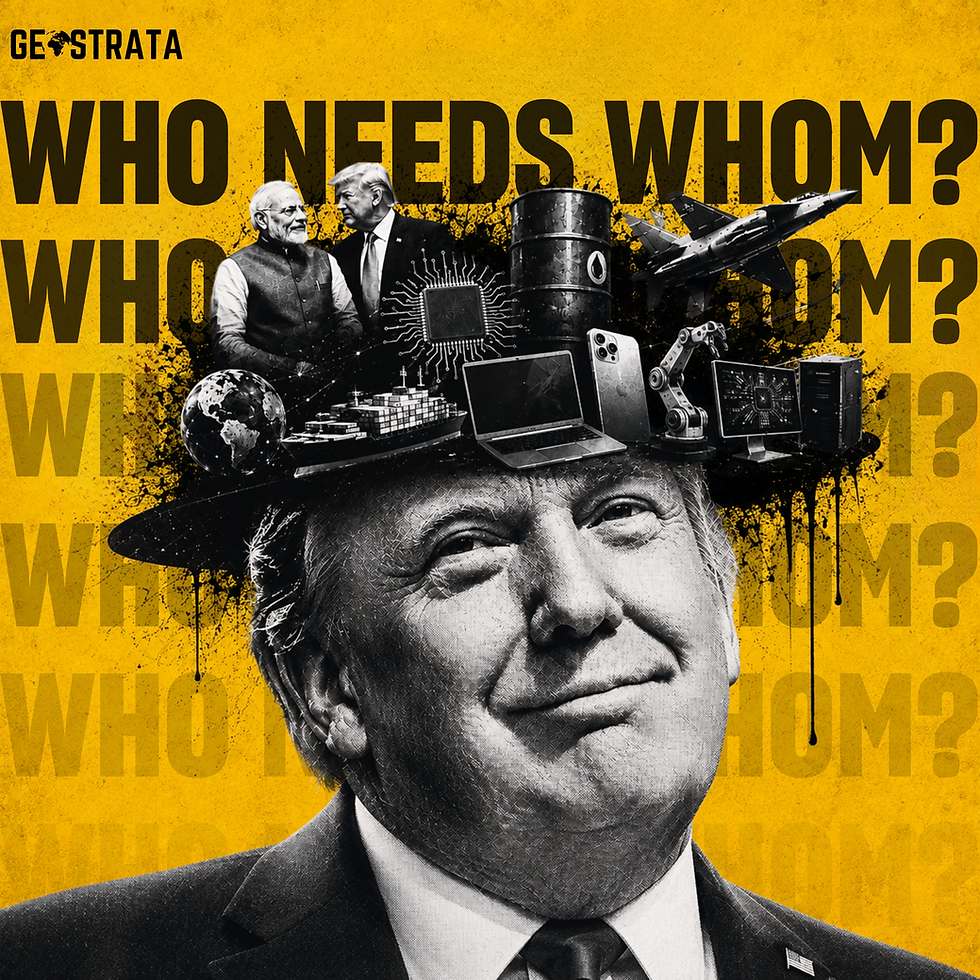
Illustration by The Geostrata
Pakistan’s conduct during the crisis was, by most accounts, tactically sharp. The country condemned all parties involved in escalating conflicts while it criticized U.S. military actions and Iranian Gulf attacks. The double-messaging system enabled Islamabad to establish its position between two opposing sides, yet the absence of Israel as a leading force in the Iranian invasion was notable. Pakistan's strategy appears as a hypocritical position while acting as a destabilizing force in South Asia with continuous proxy operations against the Republic of India.
The recent war against Afghanistan has produced tremendous destruction and damage, yet the emergence of Pakistan as a facilitator of dialogues reveals the paradox.
The leadership kept direct communication with Washington to maintain a diplomatic relationship that would not drive the United States away from Pakistan. The state used its balancing act to present itself as a power capable of unifying opposing factions.
At this stage of diplomatic work, Pakistan shows its complete power limitations because power dynamics control all diplomatic activities. The country lacks both economic strength and strategic power needed to create problems for Iran, control Israel, and determine U.S. military decisions.
The organization should not be considered a fundamental mediator because its functions extend beyond its current responsibilities. The entity functions according to guidelines established by dominant nations and adjusts its activities in response to international developments.
The United States and China maintain an ongoing relationship that serves as the primary force driving the ceasefire. Throughout the crisis, Beijing maintained a steady presence, which included condemning the escalation and engaging with regional stakeholders and calling for de-escalation.
The organization has chosen to avoid direct leadership because its strategic practices prefer to limit diplomatic endeavors through controlled risk management. China has chosen to pursue its objectives by directing results while maintaining an appearance of non-ownership.
The Pakistan government established itself as an effective facilitator through its actions during this situation. The pattern of events shows that Chinese officials and Pakistani officials held high-level meetings while Iranian officials visited Islamabad, and China and Pakistan released their joint peace agreement before the ceasefire. The different elements of the framework reached the final ceasefire terms because Islamabad reached out to other countries to strengthen its position.
Washington achieved an easy solution to its political problem through its use of Pakistan as an indirect connection to China. The United States would have jeopardized its competitive relationship with Beijing by openly working with China to settle the dispute.
The United States accessed Iranian expertise through Pakistan because it wanted to use Chinese power without showing active partnership. China used its position to maintain stability while it kept away from the unpredictable situations that came with its involvement in a dangerous battle.
The function of Pakistan in this situation operates as a diplomatic relay point instead of serving as a primary negotiation role. The organization operated as a message delivery service while maintaining contact points and enabling political protection for meetings that would have been hard to conduct. The organization lacks full control over the ceasefire because it possesses only partial authority over its operations, which reach beyond its current jurisdiction.
The basic situation creates significant effects that impact sustainable development. The indirect multilayered diplomatic process produces ceasefires, which become weak because their implementation depends on agencies with limited power to enforce them.
The existing situation exists because major powers have temporarily aligned their interests instead of creating binding agreements.
The truce will only be maintained until the parties involved start to develop different interests, which will make the current peace agreements unfit to sustain their relationship.
Pakistan has achieved diplomatic centrality through its operations, which follow established international rules. The country can maintain its dual approach to operations, yet it cannot gain total control of such a major conflict. The United States and China and Iran and Israel will determine the future of the ceasefire because they will decide between escalation and restraint through their strategic calculations which will decide between escalation and restraint.
With the collapse of Islamabad talks, the future looks dim for Pakistan's diplomatic muscles, and looking forward to the question of whether Pakistan can cater to the US and Iran or end up as one of the major failed facilitators of peace.
BY HARJEET SINGH
CENTRE FOR DIPLOMACY & INNOVATION
TEAM GEOSTRATA


Comments