.png)


From Aid to Anchor: Japan’s Strategic Turn in the Pacific

The Indo-Pacific region has emerged as the world’s new centre of gravity. Hosting nearly half of the world’s population and nearly two-thirds of the world's economy, the region’s stability is now synonymous with global prosperity. For decades, the Pacific region was seen primarily as a zone of economic cooperation, but it has now emerged as a critical theater for great power rivalry. Intensifying competition between the United States and China has transformed the region into a focal point of geopolitical contestation.
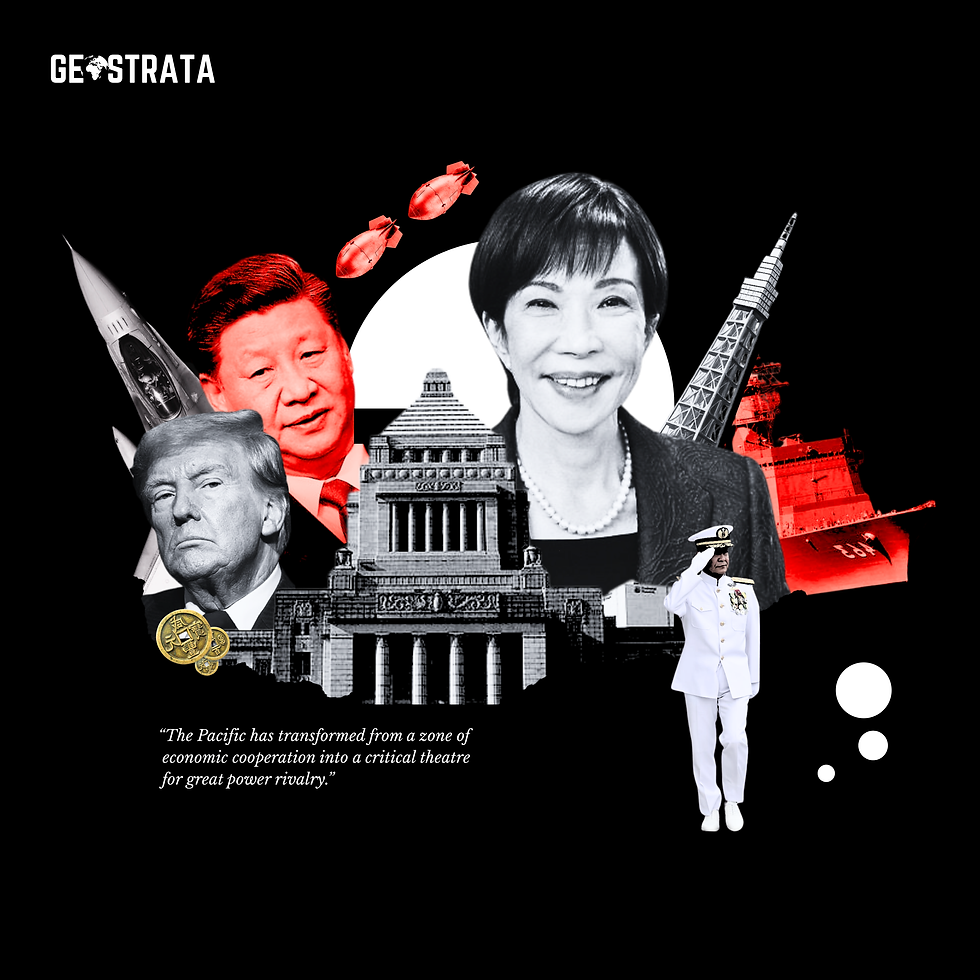
Illustration by The Geostrata
As the global strategic landscape undergoes an unprecedented strategic rewiring, marked by a shift from rules-based to transaction-based international order, Japan is fundamentally recalibrating its Pacific policy. At the heart of this transformation lies Tokyo’s shift from a strictly “pacifist” development ally to a proactive security anchor in the region.
Long constrained by the principles of Article 9 and its post-war “pacifist state” identity, Japan has traditionally relied on economic statecraft, particularly Official Development Assistance (ODA), to shape regional outcomes.
However, changing security dynamics and rising strategic pressures propelled Tokyo to rethink its approach. The article explores the evolution of Tokyo's policy from a development partner to a security provider, examining the reasons and actors associated with the shift and the implications on the regional order.
THE INDO-PACIFIC PIVOT: FROM ECONOMIC HUB TO STRATEGIC EPICENTRE
Due to the Pacific’s economic vitality and control over critical maritime chokepoints, the region has emerged as an arena of geopolitical contestation for major powers, especially China and the United States. In recent history, the US has actively pursued a strategy of alliance formation in the Pacific. Beijing, too, has emerged as an active player seeking to reshape power dynamics by weakening US-led alliances and intervening both politically and economically in the region.
From Tokyo’s lens, the dynamics of the Indo-Pacific have undergone a significant shift. The region today is marked by an assertive China, which poses a long-term structural challenge to Japanese security through its expanding regional footprint. In addition, North Korea, with rapid advancements in its nuclear and missile capabilities, presents an immediate security concern. Until recent times, Japan traditionally relied on the United States for security guarantees, but this reliance is now facing new uncertainties due to shifts in U.S. domestic politics.
Trump administration’s emphasis on equitable burden-sharing has now introduced a more transactional dimension to the alliance. In this context, Japan’s post-war pacifist approach is increasingly becoming untenable, thus compelling Tokyo to reassess its long-standing security posture in the Pacific.
FROM CHECKBOOK DIPLOMACY TO ITS STRATEGIC LIMITS: JAPAN'S ODA TRAJECTORY
After a major defeat in World War II, Japan embraced a new identity through its "Peace Constitution. At the same time, Japan's identification of Article 9 led to the country renouncing warfare from its arsenal of sovereign options and ending its imperial military infrastructure. In 1954, with the signing of the Colombo Plan, Tokyo established the Official Development Assistance (ODA) as an arm of Japan’s Ministry of Foreign Affairs.
The “Pacifist” approach helped Japan earn considerable trust and credibility among Pacific states. The JICA-led ODA continues to actively drive regional transformation by funding key infrastructure improvements and enhancing connectivity through comprehensive development initiatives. However, it should be noted that because of Japan's constitutional limitations, the ODA program has limited itself to projects of a non-military, peaceful nature.
While Japan’s “chequebook” diplomacy model proved to be effective in a relatively stable regional environment, its limitations are becoming increasingly evident amid the intensifying recalibration of power structures.
These increasing limitations show how economic statecraft and development assistance, though valuable, remain insufficient in addressing coercive tactics, maritime tensions, and hard security threats.
OPERATIONALISING SECURITY: THE RISE OF OSA
Japan's strategic shift began under the leadership of Prime Minister Shinzo Abe, who recognised the limitations of a strictly pacifist posture and sought to base Japan’s policy on geopolitical realism rather than traditional idealism. Since the amendment of Article 9 would have required a cumbersome process of attaining a two-thirds majority from both houses and a special public referendum, the government focused on “reinterpretation” of the article. The recontextualisation allowed Japan to gradually move beyond the constraints of its post-war security framework without triggering domestic backlash.
The shift became concrete in 2014, when the Japanese government again reinterpreted Article 9 to permit the exercise of collective self-defense. This meant that Japan could now use its military to defend allies if a situation posed a danger to Tokyo’s survival. By 2022, the revised National Security Strategy (NSS) introduced the Official Security Assistance (OSA) policy, marking a clear departure from its Traditional Developmental Aid (ODA).
Unlike traditional Official Development Assistance (ODA), which focuses only on economic growth and infrastructure support to allies, OSA is explicitly designed to enhance the defence and security capabilities of partner countries.
By using this framework, Japan continues to provide equipment, training, and strategic assistance to like-minded countries in the Pacific. Countries like the Philippines, Malaysia, Bangladesh, and Fiji have been some early recipients of the ODA, where Japan has contributed to enhancing maritime domain awareness and cybersecurity. The introduction of OSA shows Japan's willingness to evolve as a “third way” alternative development partner to China and the US.
ARCHITECT OF STABILITY: JAPAN AS A REGIONAL SECURITY ACTOR
Japan’s strategic transformation, from a pacifist economic actor to a proactive security participant, reflects a broader recalibration of power dynamics in the Pacific. For a long time, Japan’s pacifism emboldened China and North Korea, increasing security threats for the country.
However, modern Japan is actively involved in reassessing the security conditions in the region and establishing itself as a stabilizing force through initiatives such as the Free and Open Indo-Pacific (FOIP) and the Official Security Assistance (OSA). In times of strategic uncertainty and geopolitical upheaval, Japan is emerging not merely as a participant but as an active architect of regional stability. At the same time, it is essential to note how the country’s evolving role does not signal a departure from its pacifist principles, but a pragmatic adaptation of its principles to changing geopolitical realities.
BY KAVYANJALI SINGH TOMAR
TEAM GEOSTRATA



Comments