.png)


The Teesta Gambit: A Monetised Dispute

The Teesta has always been more than just a river. It became a source of livelihood for the thousands of villages that strung along its banks and the millions who farm its floodplains. For decades, its flow has been a part of contention between New Delhi and Dhaka. While Bangladesh sends diplomatic notes to India asking for accountability, India demands a fair share of the waters. Somewhere in the middle of this, China has stepped in.
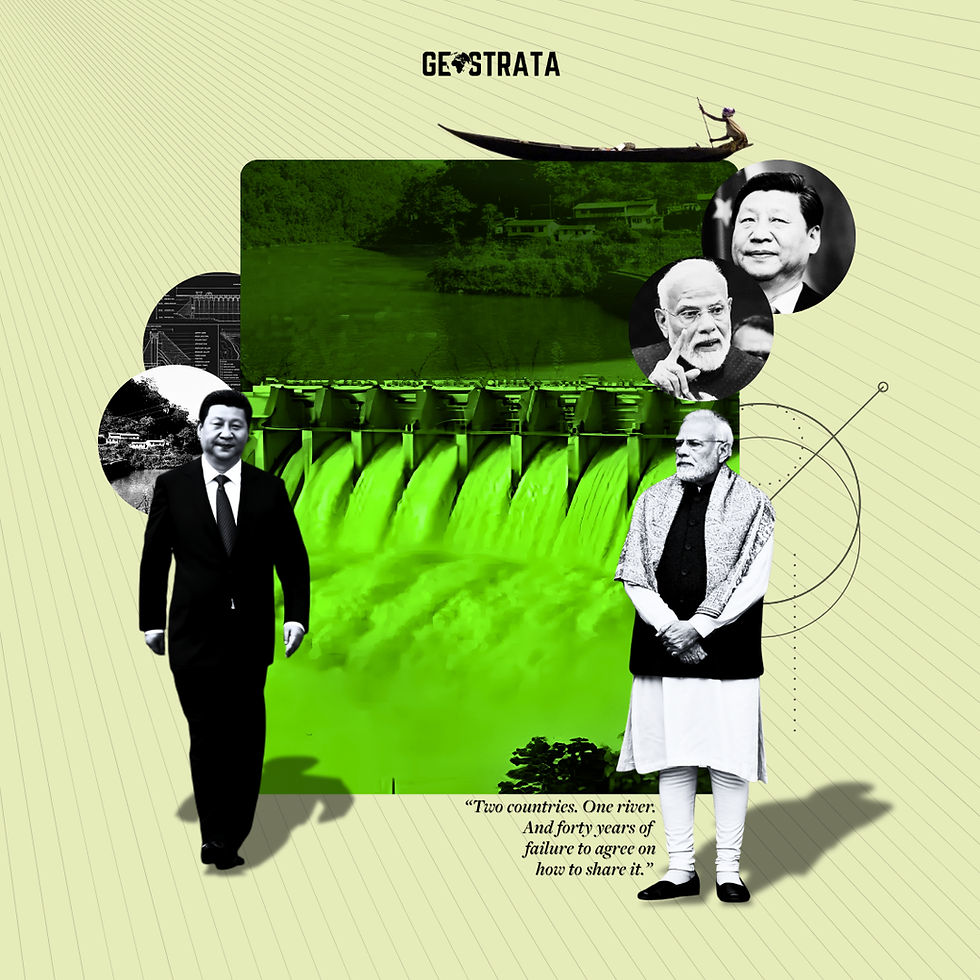
Illustration by The Geostrata
Two countries. One river. And forty years of failure to agree on how to share it.
The failed Ad hoc agreement, the interim solution, and even the Ganga Water Treaty have brought out challenging consequences for India to deal with. In March 2025, during Chief Adviser Muhammad Yunus's first state visit to Beijing, both countries formally launched the largest bilateral project between the two countries, worth 1 billion USD.
The Teesta River Comprehensive Management and Restoration Project (TRCMP) schemes to dredge, rehabilitate, and transform over 102 kms of riverway across Bangladesh’s most water- stressed north. For India, this is objectionable because this project is uncomfortably close to the Chicken’s Neck. Projects by the Chinese anywhere near the area are not an abstraction for Indian security; it is, in fact, a grave concern.
A WOUND THAT LEFT INDIA WAITING
To understand how China got here, we need to look at why India built and what it didn’t.
The Teesta is a glacier-fed, monsoon river that faces significant skewed seasonal flows. India, being the upper riparian state, has constructed an extensive network of infrastructure that gives it near-total control over those flows. The epicentre of this debate is the Gajoldoba Barrage (1985) situated in Jalpaiguri, West Bengal, which primarily regulates the river's downstream release into northern Bangladesh. Two additional pick-up barrages were made to divert water towards the areas in the west and east of India, one on the Mahananda at Phoolbari and the other on the Dauk at Chopra, respectively.
Further upstream, India has gone more advanced with the Teesta V Power Station at Dikchu, Sikkim, commissioned by the National Hydraulic Power Corporation (NHPC) in 2008, which is an 88.6-meter concrete gravity dam with a 17-kilometre headrace tunnel and three 510 MW turbines. Subsequently, among India's largest hydropower projects, it followed suit.
Of 47 projects originally proposed along the Teesta corridor, five are operational, and sixteen remain under consideration.
These mega constructions caused severe consequences for Bangladesh and nearly 21 million people, as the downstream region received less than 8 percent of the river's mean annual discharge between 2005 and 2010, with Dhaka repeatedly accusing India of withholding water during the lean season, leaving farmers in Gaibandha, Kurigram, Lalmonirhat, Nilphamari, and Rangpur miserable.
But these dams carry their own risks too. In October 2023, a Glacial Lake Outburst Flood (GLOF) in Sikkim destroyed the Chungthang dam (Teesta III), sending a catastrophic wall of water downstream and crippling the Teesta V station. The same upstream infrastructure that Bangladesh blames proved capable of unleashing devastating floods when it failed. The river, in other words, is unpredictable, and India controls it from the top.
CHINA SAW, CHINA CAME
Beijing did not invent the Teesta project; it had been on Bangladesh's development agenda since at least 2016. What changed after Hasina's exit in 2024 was the political will in Dhaka to accept that offer openly. After Tarique took office as the Prime Minister in 2026, the project moved even faster.
Back in 2016 under a MoU with PowerChina only the Preliminary Development Project Proposal (PDPP) was prepared by Bangladesh Water Development Board (BWDB) under the Ministry of Water Resources and main objectives were to manage the dry season flow, river training, land reclamation, flood controls through building new embankments and improvising the pre-existing, facilitation of navigation by dredging, and managing water storages though hydraulic structures.
Once PowerChina’s engineers are on the ground, the $725 million in Chinese loans are disbursed, and the infrastructure is built, this project becomes a fact and India's objections, strategic or hydrological, become harder to act on.
SO, WHAT'S THE PROBLEM?
The TRCMP aims to dredge the naturally braided river to 10 meters, with the current depth being 5 meters. But this river is also a braided river, one that splits into multiple shallow, shifting channels across a wide floodplain, like the Kosi or the Brahmaputra, and it cannot be controlled without adversely impacting the environment. Beyond this, alteration in a braided river can have drastic impacts, and thus it will lose its natural characteristics as well as ecosystems.
The likely result is intensifying floods, riverbank erosion, and water shortages during the lean season. Adding to the complexity will be the piling up of sediments if only a reservoir is built. So, rather than addressing the water shortages collaboratively, Bangladesh’s decision to involve China will only provoke and alienate India, serving Beijing's regional interests far more than Dhaka's water needs.
A LOSS FOR BOTH INDIA AND BANGLADESH
The simple result is the loss of a natural river. Both countries have legitimate claims on the river. Bangladesh needs the water, and India has structural and political constraints that have genuinely prevented resolution. West Bengal's political dynamics, not New Delhi's indifference alone, blocked the 2011 interim deal.
The dispute is real, and so are the grievances; neither side is simply the villain. But China has very strategically monetised this dispute by offering Bangladesh a “hand of help”.
Here, China did not come to just help; it came to fill the spaces of influence and perpetuate regional control through a well- structured plan and offered support, which Bangladesh wanted.
BY AYAT RIZVI
COVERING PEOPLE'S REPUBLIC OF CHINA
TEAM GEOSTRATA


Vừa mở v79 lên là thấy giao diện kiểu đồng bộ thật, bấm qua lại không bị lệch nhịp hay phải đoán xem nút nằm đâu. Nội dung cũng chia thành từng khối rõ ràng nên lướt nhanh vẫn nắm được ý chính, không bị ngợp chữ. Mình thích cái cách họ viết kiểu “ăn khớp” ngay từ đầu, đọc vài dòng là hiểu họ muốn hướng tới trải nghiệm liền mạch chứ không màu mè. Kéo xuống thấy các tiêu đề và box tách bạch, nhìn phát là biết phần nào là nội dung chính, phần nào chỉ là thông tin kèm theo.
The game FNAF PC becomes extremely funny when it is played with friends because all of them respond to surprises in their own way. There is one who calmly tells how to deal with the problem, and there is one who screams from any sudden noise.
Thấy bạn bè nhắc nhiều nên mình vào S666 lướt thử. Giao diện nhìn khá thoáng, chữ và từng phần nội dung được chia rõ nên xem nhanh không bị rối mắt. Mấy heading lớn cũng giúp nắm ý chính khá nhanh. Tổng thể bố cục gọn, các mục sắp xếp dễ theo dõi và click qua lại cũng khá mượt.