.png)


Political Shift in the Neighborhood: Analyzing India’s Emerging Power Dynamics

“As the global dynamics evolve, the neighbourhood around New Delhi has gained momentum to strengthen and modernise its democratic systems.” After the 2022 regime change in Sri Lanka, two other nation-states, Bangladesh and Nepal, have now undergone the same by establishing new governments. This political shift in India's neighbourhood has brought the opportunity for New Delhi to reset its ties and emerge as a more trusted partner in the subcontinent.
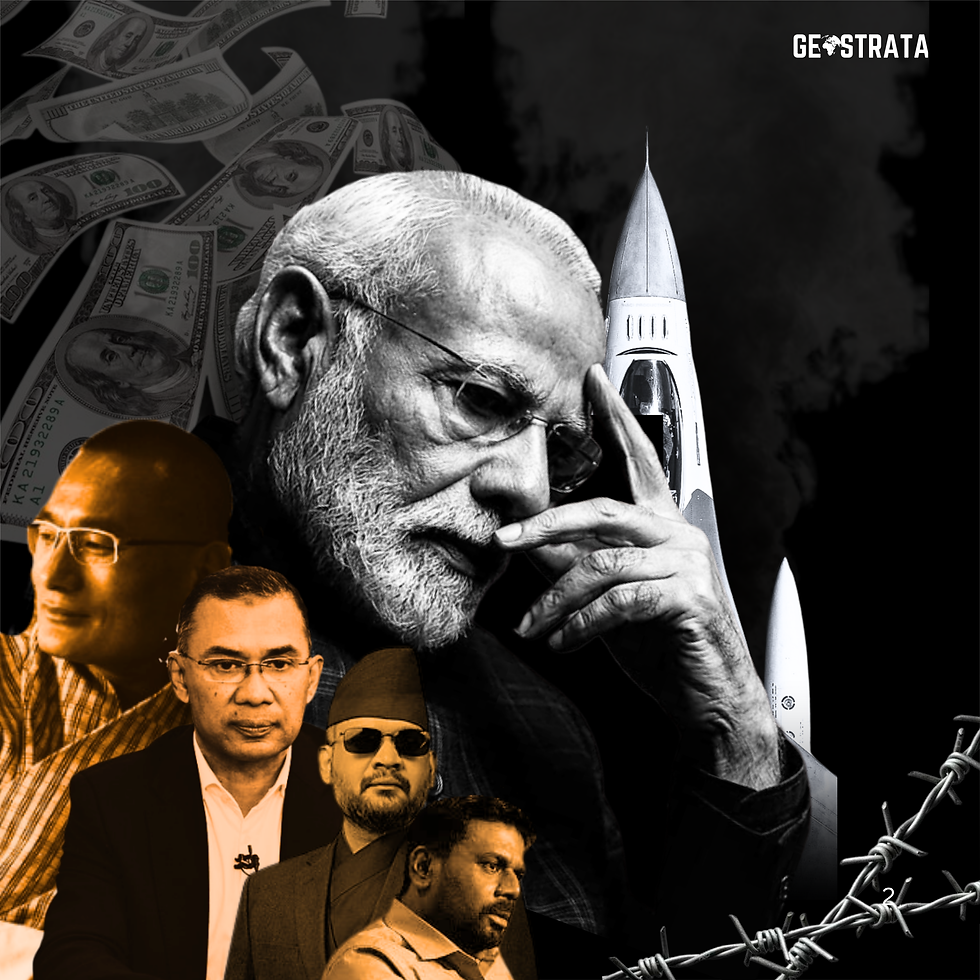
Illustration by The Geostrata
The new governments in these countries are of a new generation, preferring young leadership with a young mindset. After years of dependency, Dhaka, Kathmandu, and Colombo are now seeking “partnership,” based on equality and shared interest. All three new governments have prioritised strengthening their ties with New Delhi. India has already assisted in Colombo with financial and humanitarian aid during Sri Lanka’s economic crisis of 2022 and has achieved stability and normalisation in its ties. This is an opportune moment for New Delhi to reinforce its “Neighbourhood First” policy to strengthen ties with its neighbours and reaffirm its leadership role in the region.
INDIA'S SAGAR BANDHU - SRI LANKA
India was the first responder in the 2022 crisis in Sri Lanka, providing bilateral assistance to ensure economic stability and prevent total financial collapse. New Delhi provided financial assistance of a $4 billion swap by the Reserve Bank of India to the Central Bank of Sri Lanka, along with $1 million for food, medicines, fuel, and other essentials. India was the first to provide official backing to Sri Lanka at the International Monetary Fund (IMF) for its $2.9 billion bailout package. This led to a stabilised economy and recovery from major collapses. The GDP rebounded with 4.5 % growth in 2024, reduced inflation from 70% to single digits, and restored essentials like food and fuel.
This extensive emergency assistance laid a foundation for a partnership that will outlast any political shifts in the country, with India emerging as a decisive regional leader during Sri Lanka’s economic crisis. As Colombo struggled with rising Chinese loans and other investment projects like Colombo Port City and leasing of the strategic Hambantota Port due to repayment inability, India emerged as a capable, trusted partner. It exerted New Delhi in an emerging role of leadership in South Asia, while effectively counterbalancing China’s expanding influence in the island nation.
TRADITIONAL PARTNER - NEPAL
Nepal is a traditional partner of India in the region, with not only economic ties but also deep shared cultural and historical ties. In recent years, the democratic government of Nepal was seen to be inclined more towards China, which caused resentment in India, as Nepal is in a strategic location for India. The new government in Kathmandu emerged as a result of the decline of traditional parties, with an anti-establishment approach and youth-driven leadership. Kathmandu has signalled a positive approach towards India, as the newly appointed Prime Minister, Balendra Shah, stated,
“Eager to work closely with India to advance multifaceted relations for common prosperity."
This opens the doors for New Delhi for a revamped relationship with Kathmandu on the basis of shared interests in diverse sectors. As historical allies, the relationship between the two will be one of better cooperation and trust, but the real challenge for India lies in a similar approach by Nepal towards China. While Nepal’s renewed foreign policy approach reflects efforts for balanced and pragmatic ties with both India and China, Beijing’s presence in our immediate neighbourhood will affect India’s internal security, as there has been an attempt by Nepal to assert a claim over the Indian territory of Kalapani, Lipulekh, and Limpiyadhura in Uttarakhand.
The connecting link is China’s printing of all of Nepal’s currency, which was printed by India for decades. It was due to the Indian printers’ inability to depict disputed territories as part of Nepal. Beijing’s entry in the business reflects its ambitions towards New Delhi and support for Kathmandu’s claims.
Therefore, India has to strategically navigate its ties with Nepal, mainly based on shared interests. As Kathmandu’s approach is more practical, outcome-centred, and respectful, New Delhi should engage with equality and mutual respect as a trusted partner in the region.
BANGLADESH - VITAL FOR REGIONAL SECURITY
Tarique Rahman of the Bangladesh Nationalist Party (BNP) takes charge as the new Prime Minister of Bangladesh, with an approach of “Bangladesh First." Lok Sabha Speaker Om Birla, attending the swearing-in ceremony of Rahman, indicates New Delhi’s move respecting democracy in the nation and hopes for rebuilding trust following the volatile interim government tenure.
The tenure during Sheikh Hasina’s government in Bangladesh experienced a “Golden Chapter” in relations with India. Her government had prioritised strong ties with New Delhi, with enhanced partnerships in energy, connectivity, defence, the economy and trade. Bangladesh is India’s largest trade partner in South Asia, with bilateral trade reaching over $15 billion in 2024, and India exporting electricity to Bangladesh with projects over 1,000 MW. Therefore, the new government in Dhaka must maintain stable relations with New Delhi, as it is always beneficial to them.
However, the recent visit of the Foreign Minister of Bangladesh to India has concluded on a productive note. Foreign Minister Dr Khalilur Rahman has expressed a desire for a “positive start” with India to ensure stability and tackle longstanding challenges. New Delhi is also helping Dhaka tackle fuel shortages by increasing the supply of diesel and fertilisers in response to their request. There will be a leadership summit in the future, with Prime Minister Tarique Rahman visiting India on the invitation of Prime Minister Narendra Modi.
Bangladesh remains a crucial neighbour for India in terms of security. In recent times, India has seen a significant increase in illegal migration from the Bengal border, which is creating serious threats to the internal security of India. Also, there were events of violence against Hindu minorities in Bangladesh during the interim Yunus government’s tenure, which sparked resentment amongst the people and the government of India. Hence, it remains vital for New Delhi to reset ties with Dhaka to ensure internal security and regional stability.
In the South Asian regional state system, India holds a pivotal position due to its geopolitical condition in the region, aspiring leadership, and dominance. After the 1971-72 India-Pakistan conflict and the formation of Bangladesh, India’s power status in South Asia gained acceptance and legitimacy.
New Delhi’s rise as an emerging power is closely tied to the character of its neighbours, which plays a decisive role in legitimising its position in the regional and global system. As the neighbours are increasingly embracing democratic and forward-looking young progressive mindsets, India needs to engage with an upgraded, prominent partner approach. After all, it is these neighbours whose perceptions and cooperation ultimately validate India’s claim to power in the region.
BY GARGEE DESHPANDE
COVERING MINISTRY OF EXTERNAL AFFAIRS
TEAM GEOSTRATA



By the way, speaking of good UI and smooth animations, I was just looking at how 7bitcasino.com/games/gameart/plinko is built, and I’m honestly impressed. Everything loads instantly, the transitions don't stutter at all, and it doesn't drain my battery like crazy. It’s so hard to find decent optimization these days when there are so many elements on the screen. The devs actually did a great job making it feel responsive.
OrbitsIQ’s E-SSA breakthrough really shows how smarter connections can power remote tech—kind of like how a good Last War guide helps players coordinate strategies and survive tough environments. Exciting to see both fields level up!
I heard about this through a comment under a post where people were sharing tips. I followed the link to https://affordablewastemanagement.co.uk/commercial-waste-services-leeds/ and spent some time exploring it. The information felt clear and useful, so I decided to give it a try. It ended up saving me time and making things less stressful. It’s a small improvement, but definitely noticeable in daily life.