.png)


Balancing Acts: India’s Multi-Vector Diplomacy in 2025

India’s multi‑vector foreign policy in 2025 reflects a refined combination of adaptability and strategic depth in an increasingly complex world. In this new order, India carefully balances among the United States, China, and Russia while maintaining its strong influence within its South Asian neighbourhood.

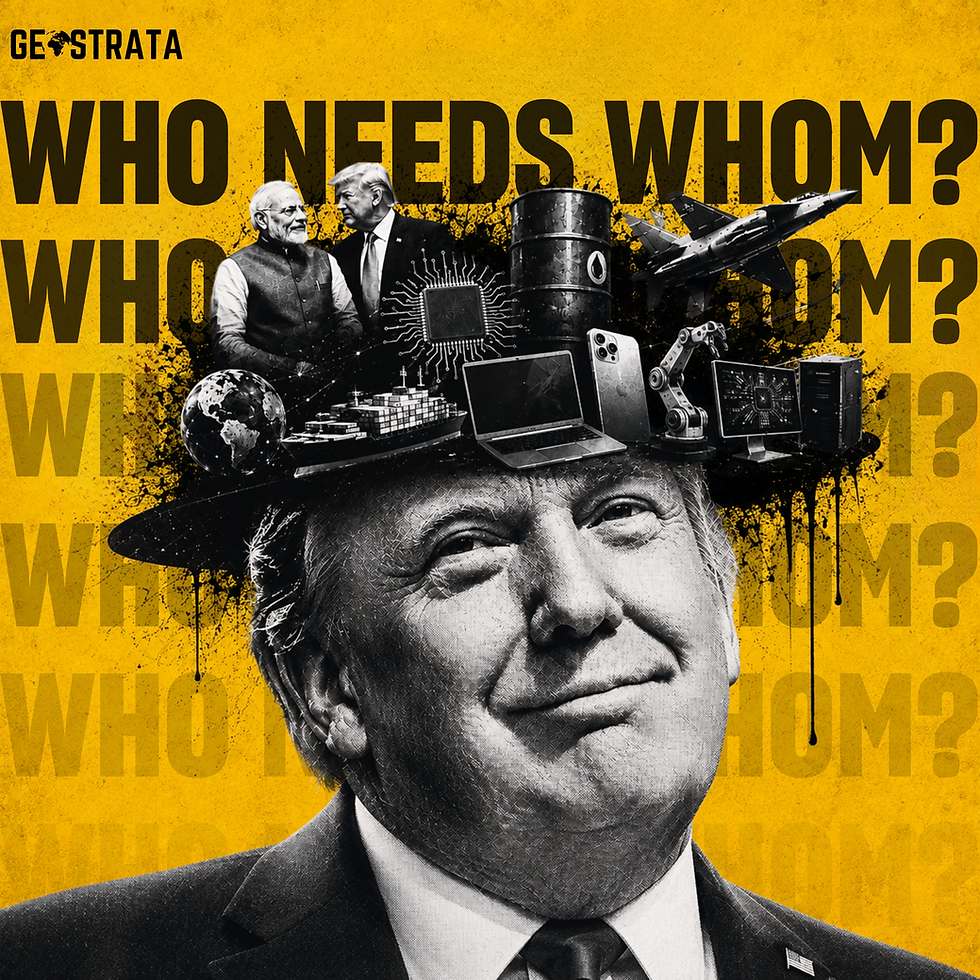
Illustration by The Geostrata
The identified strategy, based on the belief in strategic autonomy, allows New Delhi to maneuver in unforeseen crises and take opportunities, which is the core of the concept of global ambition and national interest that India claims.
STRATEGIC AUTONOMY (THE PRINCIPLE)
India’s foreign policy today is driven by the aim to maintain strategic independence. It now focuses on its own interests rather than following any global power. This means India works with different countries where needed but avoids taking sides in global rivalries.
By abstaining from certain UN votes and continuing to import Russian energy despite Western pressure, India demonstrates that it acts in accordance with its own priorities. It also plays a constructive global role, calling for more Global South representation in world bodies and helping bring the African Union into the G20. As a result, India is positioning itself as a bridge-builder and agenda-setter in a divided world.
UNITED STATES (COOPERATION AND COMPETITION)
Ties with the United States remain a cornerstone of India’s diplomacy but face new challenges in 2025. Business and security cooperation coexist with friction, especially on the economic and trade front. The past years have been characterised by a series of tariffs and retaliatory measures, many of which were due to the Trump administration’s opposition to Indian energy transactions with Russia.
India has stood firm, despite threats of action and speculation surrounding defence procurement freezes, using various mechanisms of repair in the form of high-level summits and strategic discussions. Despite these disparities, bilateral projects like the US–India COMPACT and joint NASA–ISRO missions show that technological and scientific cooperation remains a vital issue.
The relationship continues in frameworks such as the Quad in the area of defence and Indo-Pacific security, although there is some scepticism over the rate and extent of cooperation. The absence of external arbitration in regional conflict situations and India’s ambition to increase trade to 500 billion dollars by 2030 reflect its approach of staying active in the long term while firmly asserting its sovereign decision-making.
CHINA (COMPETITION OR COOPERATION)
The attitude towards China has entered a new, fragile stage, characterised by competitiveness and discriminatory relations. A cautious recalibration has been developed following post-pandemic tensions and unresolved border issues, the acute manifestation of which occurred immediately after the incident in the Galwan Valley.
The SCO Summit in Tianjin in 2025 was a major diplomatic reset, which included direct interactions between Prime Minister Modi and President Xi Jinping. Such conferences helped to restore flights, cross-border trade and people-to-people relations, with an emphasis on readiness to stabilise bilateral ties.
Economic sectors of serious importance, such as technology and rare earths, have opened new conversations as they work to establish corporate cooperation, including in the field of electric vehicles. Security issues are here to stay, especially along the Himalayan front and at sea, but the three-mutual theory promoted by India, namely mutual respect, mutual sensitivity and mutual interests, continues to be the rule of normalisation. Indian policy towards China is a balance between vigilance, developmental interests and strategic hedging, as it has understood that it can engage without compromising important security interests.
RUSSIA (SURVIVING STRATEGIC DEPTH)
The Russian alliance is one of the most consistent diplomatic axes of India, which has been tested but held. India maintains and strengthens its strategic relationship with Moscow in the face of mounting Western sanctions and international realignments. Russia remains the biggest defence supplier to India, providing high-tech equipment such as BrahMos missiles, S-400s and nuclear submarines, while cooperation also extends to the space field.
Even as India diversifies its procurement, the level of defence trade, which constitutes over a third of India’s imports, attests to the centrality of Moscow despite diversification. Commercial relations have also increased bilaterally, with Russian energy contributing over forty per cent of India’s crude oil imports, insulating the country against fluctuations in global oil markets.
Notably, the two countries show deference to each other’s strategic independence, trading increasingly in national currencies, and concentrating on pragmatic connectivity campaigns such as the International North-South Transport Corridor. This flexible alliance enables both parties to counter pressure from external actors and keep their bilateral agenda intact, encompassing defence cooperation, scientific exchange, and assistance on the international stage through forums such as BRICS and the SCO.
SOUTH ASIAN NEIGHBOURHOOD (STRIKING A BALANCE BETWEEN LEADERSHIP AND SENSITIVITY)
India demonstrates leadership in South Asia by its approach of maintaining a balance between assertiveness and cooperation, and inclusion in its strategy of Neighbourhood First. India is determined to promote regionalism through regional bodies like SAARC, BIMSTEC and BBIN, with ambitious cross-border infrastructure agendas to enhance trade, energy exchange and mutual prosperity. Such adaptable regional policy can be seen in various types of joint projects: disaster drills and joint military training, technological improvements in connectivity and education.
India adopts a highly sensitive diplomatic position that is concerned with the sovereignty and developmental issues of its smaller neighbours, and seeks trust and cooperation rather than dominance.
Issues such as organisational stagnation and foreign influence continue to dominate the area, yet New Delhi’s interest in regional development is reflected in practical steps and open communication. Combined with an economic charm offensive to gain trust and foster growth in a region marked by China’s expanding footprint, India’s efforts also extend to managing collective security through counter-terrorism initiatives and intelligence sharing.
ECONOMIC AND DEFENCE PARTNERSHIPS (DEVELOPING RESILIENCE AND FLEXIBILITY)
At the centre of the multi-vector policy of India is the quest for economic resilience and self-reliance in defence. The threat of protectionism, which is currently being manifested in the continued rise in tariffs, has prompted India to focus on local innovation, diversification of exports, and GST policy reforms to stimulate the main industries.
The number of defence alliances has proliferated and has grown to focus on the concept of indigenisation, with the government funding sophisticated indigenous systems such as Tejas fighter jets and the INS Vikrant aircraft carrier.
This technological and economic base is strengthened by a significant increase in the defence budget in India and the renewed emphasis on ensuring strategic supply chains. These initiatives mean that India can be flexible in its actions, protect its sovereignty and retain its operational autonomy, even as it builds relationships with an increasingly diverse set of partners: American, Russian, French and Israeli.
AN INTERNATIONAL POSITION (FROM A PARTICIPANT TO A FORMULATOR)
The vision of India of multipolarity and inclusive global governance is becoming more and more assertive on the global stage. India advocates issue-oriented coalitions and consensus solutions to problems such as global warming, cyberspace governance, and trade liberalisation. India leads by example with its cross-bloc collaboration through initiatives such as the International Solar Alliance and the Coalition for Disaster Resilient Infrastructure partnership.
Its advocacy of permanent G20 membership for the African Union underscores the fact that the country invests in giving a voice to developing countries, making it both a representational leader and a reformist. India regards multilateralism as a place to influence the rules of the game, rather than as an observer of the game, a clear example of a move from transactional diplomacy to transformative statecraft.
CONCLUSION (A SELF-CONFIDENT, IRREPLACABLE PERFORMER)
Finally, the multi-vector foreign policy of India in 2025 turns out to be a subtle and stable model, as opinionated as the leaders of the country are pragmatic, and as the citizens dream about it. By striking a balance in the relationships with major powers, advancing inclusive economic and security alliances, and basing its policy on carefully maintained independence, India is presenting itself as a self-assured and irreplaceable player in world politics.
The effectiveness of this foreign policy strategy will still lie in the capacity of New Delhi to foresee international changes, alleviate threats, and pursue its interests, never arbitrarily and never to the detriment of its sovereignty and integrity.
BY POSHIKA MUKKU
TEAM GEOSTRATA


Comments