.png)


The New Age Rajmandala: Ari & Mitra in a New World

Over the course of history, as regions began to reflect individual power, warfare became inevitable. It became an accepted reality for society and a governing principle for the state. Across successive eras, warfare became synonymous with a kingdom's might, and adapting to new tactics became a timeless pattern.
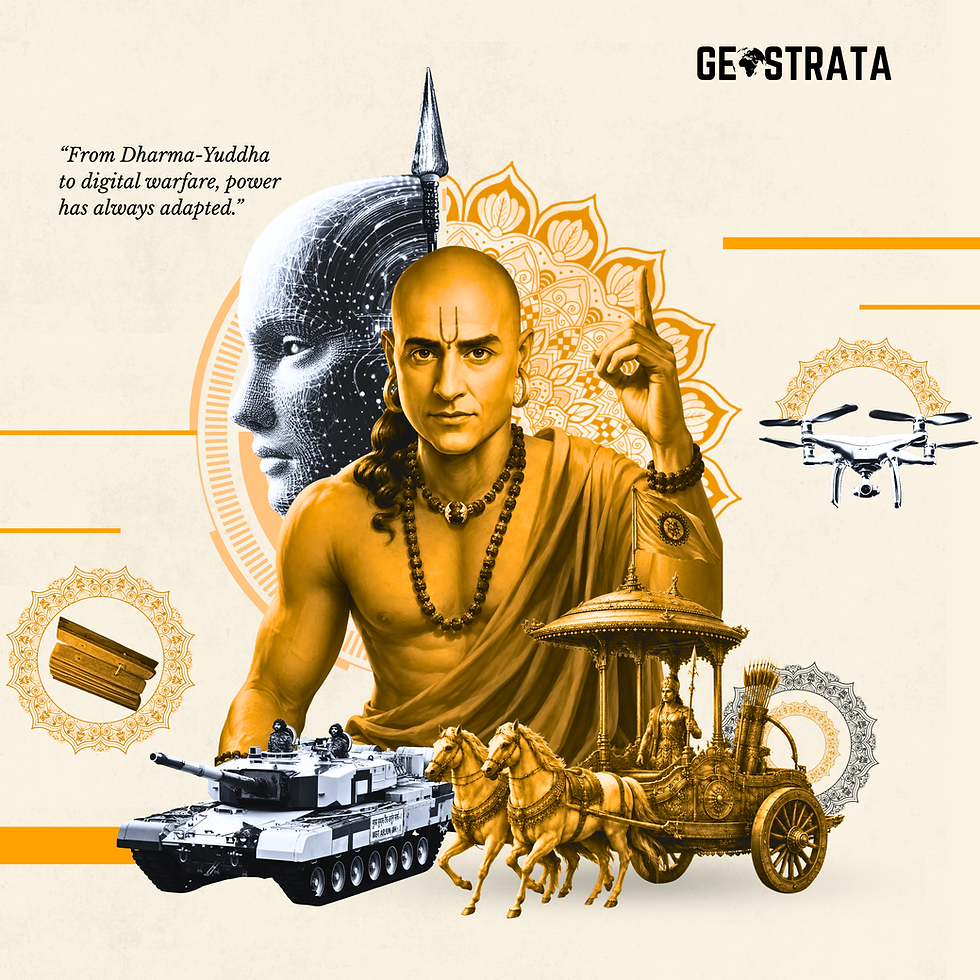
Illustration by The Geostrata
As Chanakya cited in the Arthashastra, “He shall act as occasion demands.” India has diligently followed this principle throughout its timeline. From the Vedic era to the contemporary times, India has endured a dramatic evolution in warfare from spears, maces, and codes of honour (Dharma-yudhha) in Vedic times to the Chaturanga system and Arthashastra-based approach during the Mauryan period, and finally landing on the hybrid warfare and grey zone conflict strategies by bypassing naval and guerrilla warfare of medieval times. This made warfare less ritualised and more about territorial control.
With this new era of revolutionised warfare, the enduring relevance of India's ancient strategic thought, particularly Kautaliya's Arthashastra, remains evident, more specifically the Rajmandala theory. While Chanakya conceptualised statecraft as inherently dynamic and fluid, India's strategic approach continues to reflect the adaptability of Chanakyan statecraft principles to present geopolitical realities and advanced warfare.
WHAT IS THIS NEW WARFARE?
In the present geopolitical scenario, the classic definition of warfare has dissolved, and the structure of global power where alliances and rivals could be easily mapped geographically no longer exists. Now they are increasingly defined by intangible data flows, information ecosystems, and narrative control. With the two epoch-making changes being AI in warfare and information warfare itself.
AI in contemporary warfare is increasingly reconfigurable; AI-enabled weapons are now reshaping battlefields, and it's a groundbreaking milestone in military history. It is transforming military strategies, operations, and capabilities.
It is even referred to as “the Oppenheimer moment of our generation.”
There has been an induction of “autonomous weapons and systems,” which includes unmanned vehicles and drones along with lethal Autonomous Weapons Systems (LAWS) and ISR (data analysis, pattern recognition, and target identification). These AI-powered autonomous weapons can identify, target, and engage enemy combatants with little to no human control.
More importantly, in the 21st century, warfare extends beyond physical battlefields and operates in the digital and cognitive domains, targeting how people think and respond rather than territorial control. Its primary objective is to shape perceptions and interpretations of events, often making perception more influential than ground realities.
In contemporary geopolitics, thus, the ability to control narratives often becomes as important as military strength, as global opinion can influence diplomatic pressure, sanctions, and legitimacy.
In fact, with this comes manipulation and distortion of truth mainly via deepfakes. Deepfakes can be utilised as part of cyber warfare campaigns to target critical infrastructure and disrupt government operations. In current times, information warfare is no longer limited to states. ISIS (Islamic State of Iraq and Syria) is the first organisation that has used social media as a force multiplier.
The organisation has developed several applications such as “The Dawn of Glad Tidings” or “Nasher” to securely share information among its members.
ISIS originally used Twitter very aggressively to attract recruits, and recently even launched a mobile application for the same. When viewed from Chanakya's lens, modern information warfare illustrates how the logic of shifting alliances and indirect strategy now extends beyond states, enabling non-state actors (ISIS) to exploit digital ecosystems and thereby build a psychological influence.
SYNTHESIS OF RAJMANDALA & NEW WARFARE TACTICS
The concepts of “Ari,” i.e. enemy and “Mitra,” i.e. ally, are central to the understanding of Rajmandala theory. According to the traditional understanding of this doctrine, any “state” which acts in favour of the Vijigishu becomes an ally/friend/Mitra and vice versa. However, with the inclusion of new warfare tactics, the understanding of these terms has crossed the traditional benchmark and has encompassed different dimensions in a strategic sense.
In this context, Pakistan represents India's proximate strategic challenge, while Afghanistan has emerged as a strategic partner. This same framework can also be observed in the broader strategic rivalry between India and China. Thus, anything that acts up based on our convenience can be easily given a tag of friend or foe.
As per this understanding, the usage of information, AI, and psychological narrative building is highly convenient during warfare. It also forms the base of modern-day warfare. This has made the concept of ARI and MITRA less territorial and more functional. The increasingly dynamic nature of AI and information technology, both in warfare, necessitates a reinterpretation of Chanakya’s Rajmandala theory within a modern strategic context and geopolitical reality. Now, Chanakya’s doctrine is no longer seen within the parameters of centuries-old statecraft and military paradigms; it finds itself between the cross-section of next-gen warfare mechanisms and digitally enabled operational methods.
As Chanakya emphasises the “strategic usage of misinformation,” this can serve as a force multiplier, at times proving to be more advantageous than allied assistance. He explicitly supports deception in war when it serves state security. Information can be used as a strategic weapon, a tool of governance, and a means of strategic advantage over rivals. The increasing use of IT has mainly acted in favour of nations, mainly to weaken adversaries and stabilise state power.
Thus, the true determinant of Ari-Mitra dichotomy lies not in declared alliances or territorial loyalties but in behaviour where control over information, perception, and technological leverage defines who stands as an ally or who emerges as an adversary.
THE EXISTENCE OF OVERLAPPING MANDALAS
The concept of a mandala in itself is a central pillar for this entire doctrine. Kautilya explains it as a circle of friends and foes that surrounds the Vijigishu (conqueror state). He envisioned a rigid, role-bound model of mandalas in the Arthashastra. Conversely, modern-day geopolitics operates through a system of overlapping and fluid strategic webs where state alignments are neither static nor exclusive.
In the current global realm, taking examples of two widespread conflicts: the Russia-Ukraine conflict and the Iran-US conflict.
These instances reflect how a single state can actively occupy multiple mandala positions at once. Turkey supplies arms and ammunition, mainly drones to Ukraine in the Russia-Ukraine war, and, at the same time, maintains economic and diplomatic ties with Russia and even positions itself as a mediator. However, in Syria, Turkey itself is a direct kinetic actor pursuing its own security interests. Thus, the role of Turkey shifts simultaneously from an ally, and an intermediary to a principal aggressor.
In a similar fashion, Iran is involved in multiple overlapping conflicts, somewhere directly or indirectly through proxy networks (Hezbollah or militias in Iraq/Syria/Lebanon). It acts as a main aggressor in the current Middle Eastern conflict, and at the same time, it deepens military and economic ties with Russia amid the Ukraine war, which is playing in the background. Thus, Iran emerges as a kinetic actor in one hand and a strategic collaborator in another.
Therefore, a single state today may be an adversary in one conflict, a collaborator in another, and a mediator in the third, capturing the very essence of overlapping mandalas in modern geopolitics.
Thus, even as warfare expands into domains of AI, cyber capabilities, and information manipulation, it represents a profound shift in form, but the underlying essence remains anchored in principles long dictated in the Arthashastra. The principles enshrined in that ancient treatise continue to echo. The tools of war may change, but the strategy remains constant, and that's what makes this doctrine timeless and age-defying.
BY YUVNA
TEAM GEOSTRATA


Understanding grammar concepts like Upsarg ke bhed helps in building strong Hindi language skills. It explains how prefixes change the meanings of words in a structured way for learners.
Karak Chinh plays an important role in written language as it helps in structuring sentences clearly, improving meaning, and making communication more accurate and understandable for readers in context.
Vachan grammar represents a vow or promise that holds importance in communication. It helps express commitment, responsibility, and clarity in language usage and daily conversations.
Kriya ke bhed in Hindi grammar help us understand different types of actions used in sentences, making language learning easier and improving overall communication skills in daily writing and speaking.