.png)


Dragon at the Source: China's Medog Dam and India's Struggle for Water Security

Updated: Mar 29
The most recent round of military hostilities in the India-Pakistan conflict indicates a pattern of enduring hostility, suggesting that the focus remains on confrontation rather than attempting to reconcile past disagreements. The Indus Water Treaty (IWT) remains one of the major flashpoints in their tenuous history.
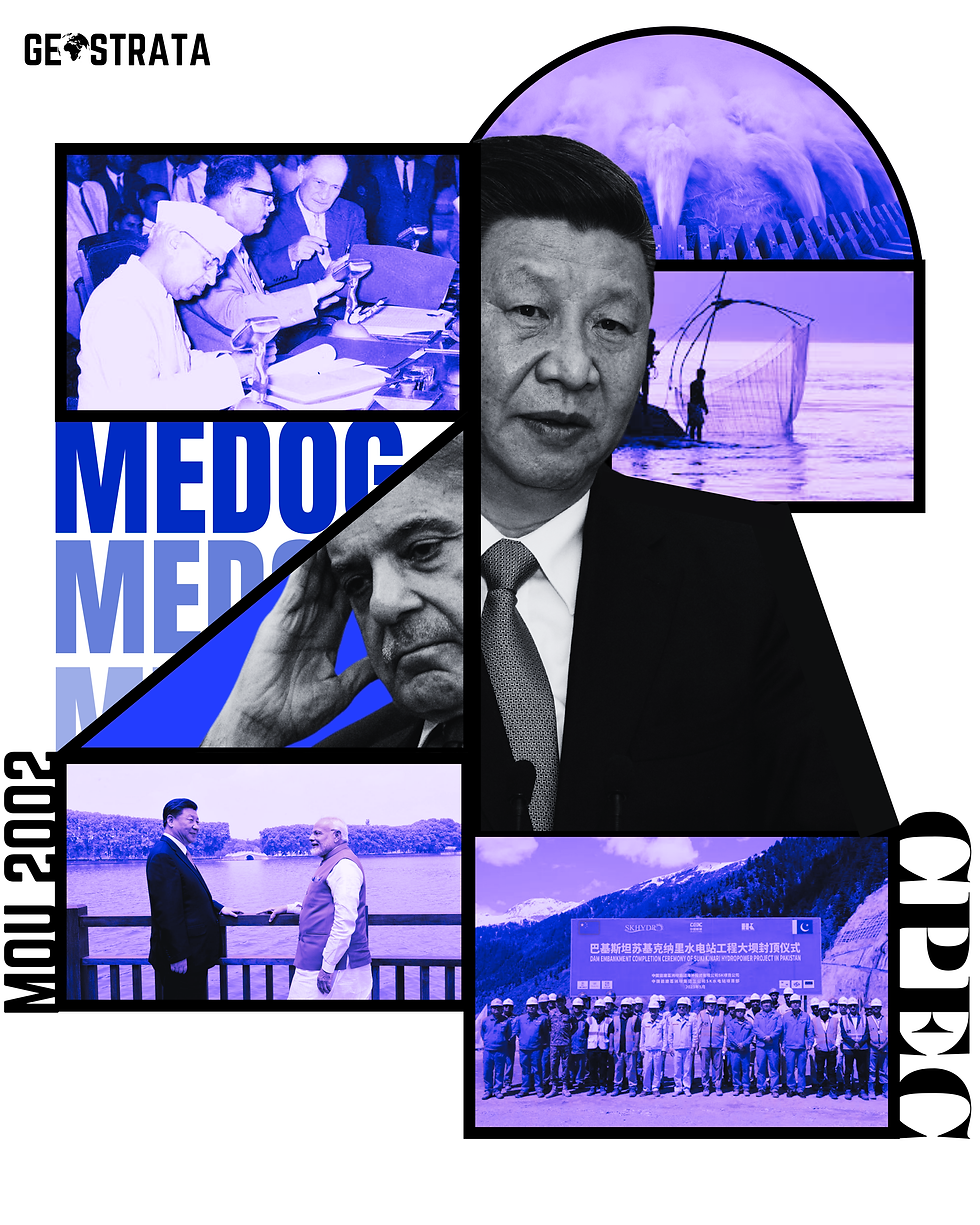
Illustration by The Geostrata
Signed in 1960 to mediate disputes over the use of the Indus River System, the Treaty allocates limited non-consumptive rights over the three eastern rivers (the Ravi, Beas, and Sutlej) to India, and exclusive rights over the three western ones (the Indus, Jhelum, and Chenab) to Pakistan.
Pakistan receives very little rainfall, making the Indus the only perennial source of freshwater for its people; about 90% of Pakistan’s agriculture is dependent on the river.
India officially suspended the Treaty on the 23rd of April 2025, in direct response to the Pahalgam Attack, closing the Baglihar Dam on the Chenab and cutting off the Indus’s flow into Pakistan.
Recent reports suggest that the significant drop in water levels of the Indus and Jhelum rivers will have a detrimental effect on Pakistan’s summer agricultural yields. As of early June, the Mangla Dam on the Jhelum and the Tarbela Dam on the Indus were down to about 50% of their total storage capacity. In late May, Pakistani Prime Minister Shehbaz Sharif warned India that their decision to halt Indus Waters would have dire consequences; China decisively acted on Pakistan’s behalf by blocking the flow of the river through its Yarlung Tsangpo dam project on the Brahmaputra River.
Adding weight to such claims, Victor Zhikai Gao, Vice President of the Centre for China and Globalisation in Beijing, remarked in an interview with India Today that “one should not treat others in ways they would not like to be treated” — a statement seen as a veiled criticism of India.
However, Himanta Biswa Sarma, Chief Minister of Assam, called the China-Pakistan Alliance’s bluff, presenting hydrological data on the social media platform X (Formerly Twitter) that demarcates Indian control over 65–70% of the Brahmaputra’s flow, compared to the 30–35% that China oversees. He thus asserted that any obstruction caused by China would probably reduce flood risks in Assam, thus working more as a boon than a curse for India. However, despite these public reassurances, experts had their own set of concerns.
On the 25th of December 2024, China approved the construction of the Mòtuō Shuǐdiànzhàn (墨脱水电站) or Medog Dam, a proposed hydropower project on the Yarlung Tsangpo - the upper course of the Brahmaputra - in Tibet. Estimated to produce approximately 300 billion kilowatt-hours of energy annually - more than three times the output of the Three Gorges Dam - the Medog Dam will be the largest hydroelectric project in the world.
This project will not only obstruct the Brahmaputra, but may also cause flash floods, resulting in irreversible ecosystems and sediment changes that could damage the river’s biodiversity and agriculture downstream (i.e. in India). While Beijing is expected to incur construction costs of between $100 and $137 billion, the potential negative externalities threatening India and Bangladesh are difficult to quantify.
While Assam and Arunachal Pradesh already face seasonal flooding from the Brahmaputra, the dam will exacerbate the magnitude of this hazard as well as harming agrarian livelihoods by trapping silt upstream, depriving much of North-east India and Bangladesh of fertile soil.
From a geopolitical lense, China's dominance of the Upper Brahmaputra gives it strategic leverage vis-a-vis the management of cross-border water resources and disputes over parts of Arunachal Pradesh, that both China and India claim. Although China hasn't explicitly admitted to its ability to potentially weaponize the Medog Dam, it is important to note that this project allows Beijing to easily manipulate the flow of the Brahmaputra during periods of bilateral disagreements with India.
While the Indian Ministry of External Affairs (MEA) has officially stated that India “remains engaged” with China on transboundary river matters, the absence of a water-sharing agreement provides New Delhi with very limited options. India has thus pushed for the renewal of the 2002 Memorandum of Understanding (MoU) - on Brahmaputra hydrological data - which lapsed in 2023.
India is also attempting to combat China’s advantage by advancing the 11 GW Siang Upper Multipurpose Project in Arunachal Pradesh and strengthening its local water storage and power supply infrastructure with projects on the Dibang and Subansiri Rivers, and other major hydropower infrastructure in the North-East.
In addition, the Central Water Commission and ISRO have developed AI-based flood forecasting systems and satellite-based monitoring to enhance real-time river monitoring; several early-warning systems have been installed in Assam's flood-prone areas to minimise both human and economic losses during the monsoons.
India is also pursuing diplomatic relations with nations like Bangladesh, Nepal, and Bhutan to ink a regional transboundary river management agreement and has presented this question before the UN and BIMSTEC in an effort to establish a regional platform to ensure fair and sustainable water use and challenge Chinese projects like the Medog Dam.
India's decision to suspend the IWT has faced a similar challenge in the geopolitical and environmental implications posed by China’s projects. While being upriver of Pakistan affords India an advantageous position vis-à-vis the IWT, the roles are reversed in the east, given China’s hegemony over the headwaters of the Brahmaputra. India must thus implement a comprehensive plan to boost infrastructural development, improve data monitoring, and foster regional cooperation to guarantee long-term security and stability as nations turn to the manipulation of resource control to achieve strategic advantages over their rivals.
BY MISHTHI SAXENA
COVERING PEOPLE'S REPUBLIC OF CHINA
TEAM GEOSTRATA


Whether you’re signing up for a new game or rebranding your profile, a good name generator can save you from hours of thinking. I found this one quite useful for generating clean and unique options.