.png)


Digital Silk Road: How the Sky is Ending the "Landlocked" Era

Throughout history, geography has influenced the fate of empires. For many centuries, lands that lack coasts have been described as landlocked or held captive to the land due to the need to pay tolls to pass through the territory of their neighbour country to access an ocean to use for shipping goods out of their country. The depiction of landlocked territories as prisoners or land-bound will soon change in the near future; when the new Silk Road is completed in April 2026, these nations will be connected to the rest of the world.
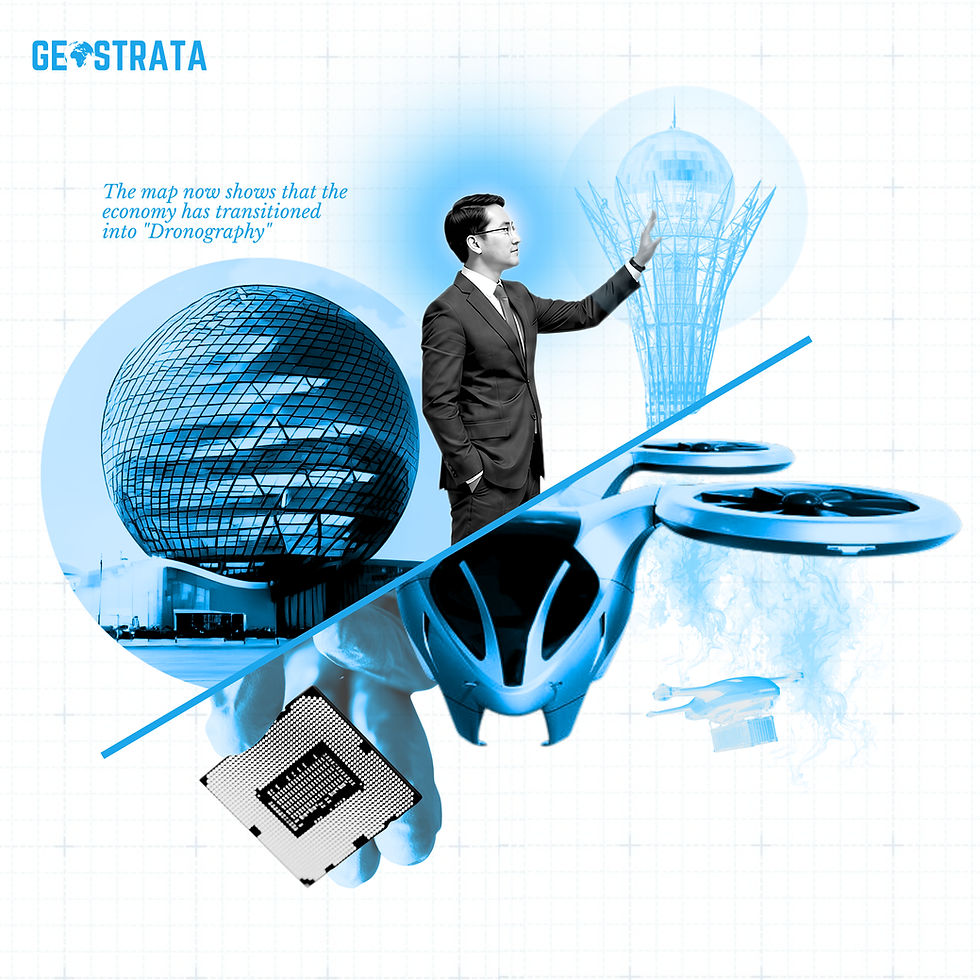
Illustration by The Geostrata
But as of April 2026, the map is being redrawn. From the steppes of Central Asia to the high-tech hubs of Astana, a new "Digital Silk Road" is quietly ending the era of geographical isolation.
THE 2Q2026 LEAP: FROM ROADS TO SKY-PORTS
The tipping point occurred on March 31st, 2026, when Zhaslan Madiyev, Kazakhstan’s Minister for Artificial Intelligence and Digital Development, announced a national move toward autonomous logistics systems across the country. While other nations are focused on blockaded seabeds and the unstable conditions in the Strait of Hormuz, which have caused a decline in maritime traffic around the world, Kazakhstan is developing pilot projects to deploy heavy-lift cargo drones for autonomous transport systems by the second quarter of 2026.
The cargo drones being developed are not small package delivery-style flying units. We are now entering an age of major industrial-grade, non-piloted, robot-operated versions of these machines.
Using autonomous aircraft will provide a means to move high-value products such as semiconductors or highly-specialised pharmaceuticals, and rare earth components, as well as allow them to be shipped from inland factories directly to world distribution points without stopping at borders to process the shipment through customs. This will also provide countries that are landlocked with a means to have an ocean-like flow of cargo without having an ocean.
THE MECHANICS OF THE VERTICAL SILK ROAD
To comprehend the reason why this is seen as a "revolutionary" change as opposed to just an emerging "trend" we should take into consideration today's technology of 2026. The limitations of range associated with traditional battery-operated drones have altered due to the recent development of hydrogen-powered drones; results now indicate that large capacity drones such as the Griffith 300 and hovercraft or hybrid Vertical Take-Off and Landing (VTOLs) can transport up to 200+ kg and travel several hundred km.
This new capability enables landlocked nations to successfully sidestep or circumvent "broken" infrastructure located within the boundaries of their neighbouring countries. When traditional methods, i.e., trains, are rendered unusable due to geopolitical conflicts, landslides or similar events, the alternative means of transport, i.e., air, that will be used, via the Digital Silk Road, will allow these very nations to take advantage of transhipment opportunities using short-distance aerial air cargo services provided through the corridor.
Kazakhstan is now testing and analysing corridor transhipment routes, in conjunction with international technology firms, in apertures, i.e., hubs located in Almaty, Kazakhstan and in the Akmola region that are similar to 21st-century dry ports.
SOVEREIGNTY IN THE "MID-ALTITUDE"
The emergence of mid-altitude sovereignty in modern aerial strategy has caused countries with no sea access to understand that remaining within the airspace is their only truly "open" option, as 97% of regional maritime traffic has collapsed at major choke points. Thus, the incredible potential freedom of flight provides not only freedom from restrictions but also provides a need for unique security considerations for both the "digital silk road" and the aircraft themselves as well as for the developing nations in Central Asia.
Similarly to India's “Mission Sudarshan Chakra,” a system of drone protection against multi-vector threats and swarm drone launches, the same AI-supported networked architecture for monitoring the civil airspace allows Central Asian countries to see "airspace" as more than just a "transit nation" for Russian and Chinese nations; and they can utilise "airspace" as a sovereign economic asset through a similar airspace management model.
THE ECONOMIC RIPPLE: BYPASSING THE MIDDLEMAN
Historically, landlocked nations have experienced an approximately 20% loss of GDP due to transit fees to their coastal neighbours and also because of “gatekeeper” fees charged by these coastal nations. The Digital Silk Road eliminates the need for middlemen to transport goods from one location to another.
A manufacturer in Astana, Kazakhstan, can now ship their high-value components directly to a distribution centre located in Mumbai and Marseille via point-to-point drone transport without ever transferring their goods on the rails of another country.
This is especially important for the critical minerals market because the world has an insatiable need for lithium, cobalt and copper. The countries that contain reserves of these minerals, Kazakhstan and Mongolia, for example, can utilise air corridors to export their refined materials, thereby eliminating regional land-war risks from their supply chains.
THE "DRONOGRAPHY" OF 2026
The map now shows that the economy has transitioned into "Dronography", or how much a country has wealth based upon how clear its clouds and how advanced its digital infrastructures. For landlocked countries, maintaining independent air corridors is the highest form of strategic independence.
We are nearing the end of "the coastal monopoly". The year 2026 will see that being landlocked is no longer a geographical disadvantage; it will be a digital opportunity, and thus begins the vertical race to success, and for the victor, he or she will understand that the most important border is not the one on the ground. Still, rather, it is the one above all of our heads.
BY MUSKAN GUPTA TEAM GEOSTRATA



That observation aligns with how many analysts now view influence operations globally: the goal is often to weaken confidence in institutions rather than fix blurry pictures online free persuade everyone toward one ideological position. The emphasis on exploiting existing social divisions rather than inventing entirely new ones is also an important and realistic point.
One of the strongest points in the article is the discussion of China’s “Three Warfares” doctrine—public opinion warfare, psychological warfare, and legal warfare—which has been part of PLA strategic thinking for years. The article argues that modern apagar detalhe em foto cognitive warfare rarely tries to force people into believing one specific narrative. Instead, it often aims to generate confusion, polarization, distrust, and information overload so that societies become less capable of forming coherent collective responses