.png)


The Blue Shirt Society: Fascism, Nationalism and Authoritarianism in Republican China

The Blue Shirt Regiment (BSS), also known as the Blue Shirts Society (Lanyishe 蓝衣社), was a nationalist paramilitary organisation in China. It emerged on March 1, 1932, as a faction within the Kuomintang (KMT), the Nationalist Party. The BSS was composed mainly of graduates from the Huangpu (Whampoa) Military Academy, young men aged twenty to thirty, many of whom had overseas education and had pledged unquestioned loyalty to Chiang Kai-shek.
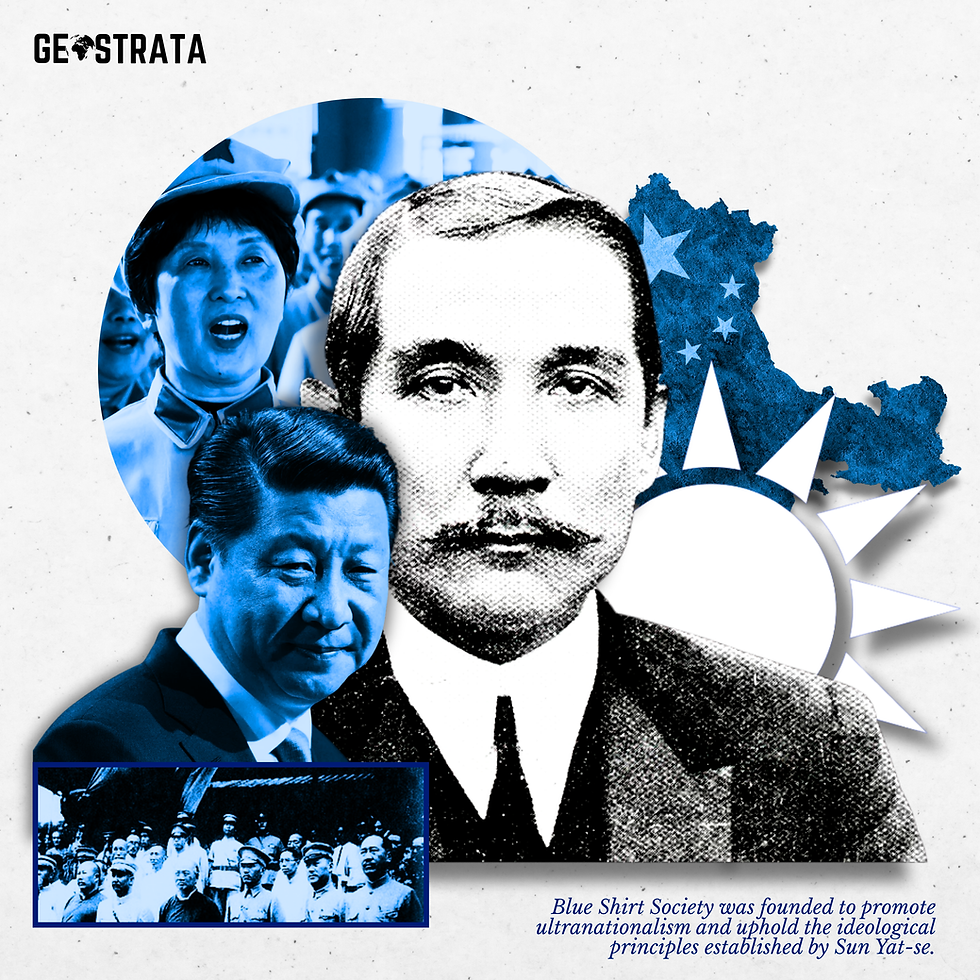
Illustration by The Geostrata
According to the Berkshire Encyclopedia of China, “they operated behind the formal KMT structure,” yet had significant influence in the military, police, and public security sectors.
IDEOLOGICAL FOUNDATIONS AND POLITICAL GOALS
The group was founded to promote ultranationalism and uphold the ideological principles established by Sun Yat-sen, notably the Three Principles of the People. The Blue Shirts gained significant influence over military, political, and economic spheres during external threats from Japan and internal conflicts with rival factions, most notably the Chinese Communist Party (CCP).
The founders were about twenty individuals, including figures such as T'eng Chieh, Ho Chung-han, K'ang Che, Feng T'i, Teng Wen-i, Cheng Chiai-min, Chiu K'ai-chi, and Kan Kuo-hsun. They came from diverse class backgrounds, ranging from landlords to middle peasants and poor tenant farmers. At the same time, their provincial origins also varied. The majority hailed from the provinces along the Yangtze River, particularly Hunan.
WAS IT FASCIST? A SCHOLARLY DEBATE
Scholars have debated whether the BSR should be considered a fascist movement. According to Zarrow, in the book China in War and Revolution, argues that the Blue Shirts “adopted the term fuhrer to describe Chiang” and believed in “power for its own sake,” with open admiration for European fascism. They sought to “combine nationalism, fascism, and collectivism”.
Some scholars contend that the Blue Shirts were not a mass fascist party in Europe.
Their power did not stem from popular mobilisation, but rather from their infiltration of state institutions, particularly the police, military, and education sectors.
Historian William Kirby points out that “fascism meant different things in different contexts,” and in China, it was often associated with bureaucratic authoritarianism rather than mass politics.
INTERNAL CONTRADICTIONS AND STRATEGIC LIMITATIONS
As Elkins notes, by late 1936, “the anti-Japanese tendency within the Blue Shirts gained predominance over the anti-Communist one,” revealing an internal contradiction that the Communist Party deliberately exploited by inviting “honest young people from among the Kuomintang and the Blue Shirt League” to join a united front government. These fractures, combined with the group’s elite, bureaucratic character and failure to galvanise popular support, accelerated their political marginalisation.
CHIANG KAI-SHEK'S ROLE AND THE NEW LIFE MOVEMENT
Zarrow also highlights contradictions in Chiang’s ideological agenda. While he endorsed Blue Shirts' ideas about discipline and anti-communism, he was wary of their extremism. His “New Life Movement,” although supported by the Blue Shirts, emphasised Confucian moralism, which conflicted with the Blue Shirts’ radical call for reshaping Chinese society through force.
IDEOLOGICAL PARALLELS TO CHINESE IMPERIAL THOUGHT
In The Everlasting Empire, Yuri Pines outlines how enduring concepts of centralised moral authority and civilisational hierarchy shaped Chinese imperial ideology structures. We saw how BSR attempted to modernise under a fascist guise.
“Initially, the Blue Shirts openly agitated to make Chiang Kai-shek a fascist dictator… ‘We must have our leader,’ they cried, without him, we cannot solve our national problem, we must have our Hitler."
MILITARY ENGAGEMENTS AND WARTIME INFLUENCE
The Nationalist Air Force included elements from the Blue Shirt Regiment. It was active during the Central Plains War of 1930. They contributed to military operations by bombing cities, directing artillery, and observing the defensive positions of warlord armies, ultimately facilitating a quicker victory for Chiang Kai-shek's government.
By 1935, the Blue Shirts had gained significant influence. Zarrow estimates they had half a million members, with tentacles in the Boy Scouts, education, the police, and even assassination squads.
The KMT became more authoritarian and militarised. While Chiang held back power to prevent internal coups.
Following the Battle of Wuhan in 1938, the Chinese Army, including the Blue Shirt Regiment, shifted tactics to avoid large-scale confrontations with the Japanese. Chiang's strategy aimed to preserve military forces rather than engage directly. As external pressures mounted for offensive operations, this caution proved significant as the war transitioned into a period of devastating civil conflict and the subsequent struggle for national unification in the years following Japan's defeat.
Throughout these operations, the Blue Shirt Regiment exemplified the intersection of military engagement and political ideology within the KMT. It contributed to both the defence of the Republic of China and the enforcement of its policies during a tumultuous era in Chinese history.
DECLINE AND TRANSFORMATION
The BSS was formally dissolved in March 1938 under pressure from the Second United Front, which required cooperation with the Chinese Communists against Japan. However, as Law Yuk-fun notes, its ideological legacy endured, and many members transitioned into the “Three People’s Principle Youth Corps,” founded in May 1938 to continue nationalist mobilisation under a softer guise.
LEGACY AND HISTORICAL SIGNIFICANCE
The primary objectives of the Blue Shirts Society included the promotion of national unity, implementing corporatist principles, and transforming society. It was according to the Three Principles of the People, which are nationalism, democracy, and people's livelihood. These goals were articulated in the constitution adopted by the society, which underscored its commitment to radical societal change.
The legacy of the Blue Shirt Regiment in China is multifaceted, reflecting its impact on historical narratives and contemporary political discourse. It was formed as a paramilitary group associated with the Kuomintang (Nationalist Party). The Blue Shirts played a significant role in the political landscape of early 20th-century China, particularly during the tumultuous years leading up to and following the Chinese Civil War.
CONCLUSION: IDEOLOGICAL EXPERIMENT OR POLITICAL MISCALCULATION?
Elkins argues that the Blue Shirts failed not just because of ideological incoherence (as Zarrow emphasises) but also due to structural limitations of China’s comprador capitalist class. They could not independently generate a sustainable fascist movement, and their
“middle way” dissolved under pressure from imperial Japan and the revolutionary CCP.
In a secret 1932 speech attributed to Chiang Kai-shek, he downplayed the Japanese threat and re-centered the focus on internal spiritual revival.
“Our present problem is not the Japanese… The important problem is that of national existence. To save China from destruction, we must revive our national spirit… If we want our revolution [to be] a success, we must create a party dictatorship.”
Zarrow’s more cultural-political analysis points to the failure to mobilise mass participation, Chiang’s Confucian turn with the New Life Movement, and the BSR's elite character. Where Elkins sees class betrayal, Zarrow sees ideological unsustainability.
Together, these works highlight that the Blue Shirt Society was both an ideological and class experiment in authoritarian modernisation, ultimately swept away by geopolitical forces and grassroots revolution.
BY SHRIYANSHU SATYAM
COVERING PEOPLE'S REPUBLIC OF CHINA
TEAM GEOSTRATA


Comments