.png)


India’s 2026 BRICS Presidency: Reshaping BRICS for a Fragmented World

Updated: Mar 30
The world has entered the second quarter of the 21st century in a very chaotic way. Every other region around the globe is engaged in some form of conflict. In such a global crisis, nations tend to refrain from direct intervention, preferring to express their concerns through statements while sitting on the sidelines.

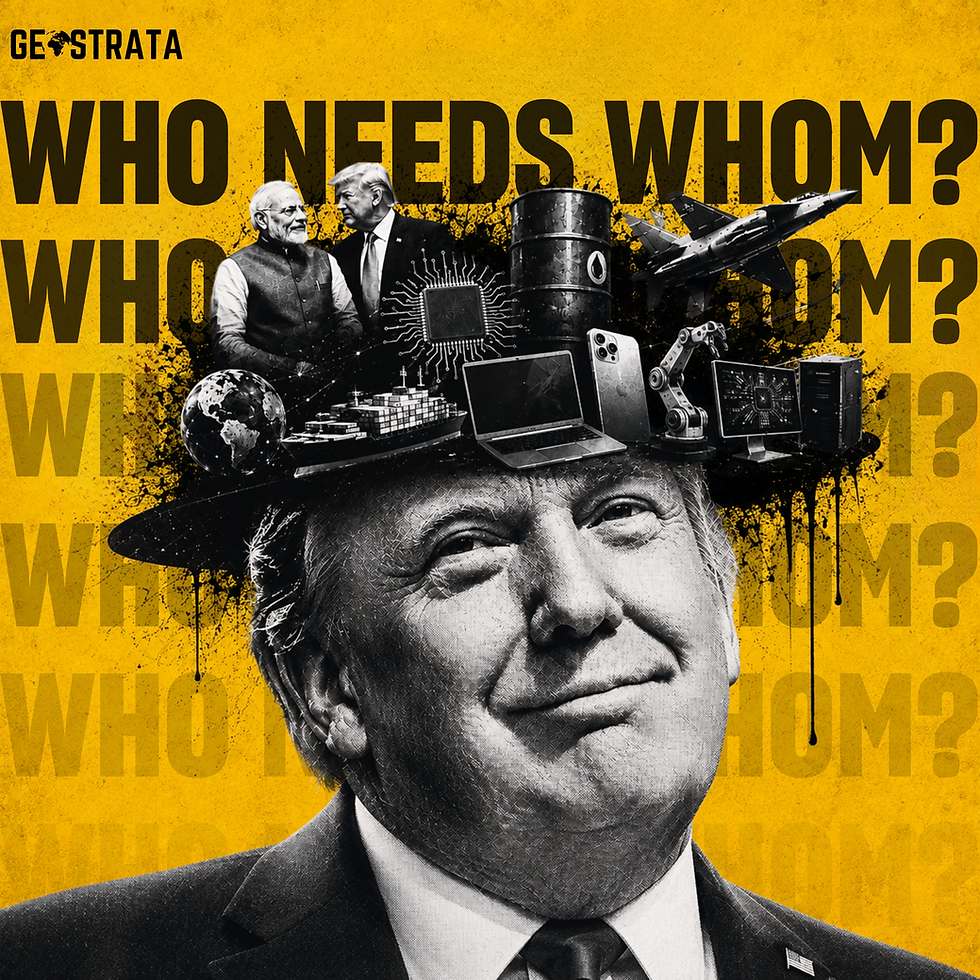
Illustration by The Geostrata
With respect to the American intervention in Venezuela, the United Nations has only condemned the act and urged the parties to “observe” maximum restraint, respecting the UN Charter and the human rights of citizens. As the world order shifts to multilateralism, multilateral organisations play a crucial role in solving global matters. With such turbulence on the geopolitical stage, India has taken responsibility for one of these emerging multilateral groupings, the BRICS, this year.
FROM INNOVATION TO INCLUSIVITY: INDIA'S VISION FOR THIS YEAR
India has formally assumed the presidency of BRICS for the year 2026. The last time India chaired the BRICS was in 2021, which was the 15th anniversary of the grouping, where, owing to the pandemic, most meetings were held virtually. India has planned over 100 meetings this year in around 60 cities in the country. Under its 2021 presidency, India has proposed the contemporary need for reforms in the multilateral system, including deeper counter-terror cooperation and technological partnership for achieving the SDGs. The year had focused on strengthening intra-BRICS cooperation and had an agenda in accordance with it.
In 2026, India has decided to expand its scope of priorities, not limited to the BRICS nations. PM Shri Narendra Modi has formulated the key priorities for the 2026 presidency in the BRICS Summit of July 2025 in Rio de Janeiro, Brazil. He has redefined the BRICS as ‘Building Resilience and Innovation for Cooperation and Sustainability’. With the successful G20 presidency, India aims to focus on the concerns of the Global South and promote the principle of inclusivity within the BRICS grouping, where reforms in global governance remain at the core of its agenda.
Under its leadership, India will be advancing deeper cooperation in the economic, financial, technological, and environmental domains. New Delhi intends to support the New Development Bank to finance sustainable infrastructure and development projects, and will prioritise pushing for more intra-BRICS trade and investment. In the technological sector, India emphasises Digital Public Infrastructure (DPI) and inclusive governance of AI.
For this purpose, India has highlighted its Aadhar-linked UPI, a secure digital finance model and urged nations to collaborate in building an inclusive digital finance ecosystem, more suitable for developing nations. It is also advocating collaborative AI governance, promoting the development of domestic AI models and ethical frameworks. India’s BRICS 2026 agenda also includes the contemporary crucial issue of climate change.
It advocates capacity building and encourages coordinated action on green technology and sustainable infrastructure. Under maritime cooperation and the Blue Economy, India encourages joint initiatives for port connectivity, maritime trade, and technology sharing among the BRICS nations.
THE BALANCING ACT: MANAGING ALLIES INSIDE AND OUTSIDE THE BRICS
In its presidential year, India has to coordinate masterfully with its diverse partners and build consensus among them. The BRICS, which constitutes 49.5% of the global population, 40% of the global GDP, and 26% of the global trade, has always been viewed as a threat to the West-led global order by the United States.
The BRICS members’ local currency trade settlement mechanisms have created a challenge for New Delhi in balancing its relationship with one of its important strategic partners, the United States. While US President Trump views it as a de-dollarisation move, its purpose and implications differ across countries.
While Iran and Russia’s use of the mechanism is largely driven by their need to bypass US sanctions, China views it as a part of its broader ambition to emerge as an alternative in the global economic system. For India, it has its own approach to diversifying its forex portfolio and getting into regional trading arrangements. India now faces the responsibility under its leadership to convey that the BRICS nations are more focused on a diversified international monetary system, rather than pursuing an anti-West approach to global order.
At present, India is facing a delicate challenge in navigating its relationship with the United States. After heavy U.S. tariffs for the better part of 2025 on its oil purchases from Russia, a BRICS member, and the delayed trade deal, the United States and India have reached a framework for an interim agreement for their Bilateral Trade Agreement, initiated in February 2025.
Washington has reduced the 25% reciprocal tariffs on India to 18%, while removing the additional 25% imposed on the purchase of Russian oil. Throughout the negotiations, India has maintained a clear and consistent approach to protecting its national interest while strengthening ties with a key global partner.
New Delhi has safeguarded its most vulnerable sector of the domestic industries, like agriculture and dairy, which could destabilise rural incomes, by restricting large-scale American imports. At the same time, it aims to secure market access that encourages American companies to manufacture in India rather than simply exporting to the Indian market.
India also prioritises better access for its sectors that hold a competitive advantage, like pharmaceuticals, information technology services, leather and footwear, and textiles. Rather than pursuing liberalisation, India has carefully evaluated trade commitments to ensure economic protection, domestic growth, and all while sustaining strong economic and strategic ties with the United States. In doing so, New Delhi has carefully balanced its partnership with Washington alongside its other global partners while safeguarding its national interests.
Another challenge for India is to maintain the cooperation, trust, and unity among the member nations. With the expanded format for grouping, the members hold diverse perspectives and strategic priorities, reflected in their differing positions on key international issues. For instance, the question of Somaliland illustrates this divergence explicitly.
While India has not formally recognised Somaliland as an independent state, the UAE has remained ambivalent due to its significant investment in the Berbera region, and Ethiopia, being a landlocked nation, has expressed support driven by its strategic interest in securing maritime access.
Another such event occurred during ‘Will for Peace 2026’ BRICS Plus maritime exercise in South Africa, where Iran was told to withdraw at the last minute by South Africa, amid Washington’s tariff threats on doing business with Iran. Under these conditions, India will need to adopt a balanced diplomatic approach to ensure functional unity, consensus-based decisions, and the mutual interests of member nations.
2026: A LEADERSHIP TEST
India’s BRICS presidency offers a practical opportunity to present its diplomatic and institutional strengths on the global stage yet again. New Delhi can follow a results-oriented approach to encourage and strengthen the Global South. The inclusion of new members, such as Ethiopia and Egypt, reflects a growing demand among developing countries for an alternative to the traditional Western-dominated development frameworks.
Engagement with these countries through development partnerships, capacity building, and multilateral cooperation is set to bolster India’s diplomatic capital.
The BRICS leadership presents an opportunity for India to shape the agenda in accordance with the emerging needs of the Global South, rather than being influenced by developed nations. This opportunity will help India reinforce its role as a responsible and constructive stakeholder in the evolving multipolar world.
Withstanding the contemporary geopolitical challenges, New Delhi should focus on building a BRICS narrative based on pluralism, sovereignty, and global responsibility that resonates equally with both the Global South and the developed West. India, with its rich history, ancient civilisational ethos, and institutional capacity, must use the platform to re-establish itself as Vishwaguru and infuse its civilisational value of Vasudhaiva Kutumbakam, which the world needs the most today.
BY GARGEE DESHPANDE
COVERING MINISTRY OF EXTERNAL AFFAIRS
TEAM GEOSTRATA


Really interesting read on India's 2026 BRICS presidency and its focus on the Global South. I've been thinking a lot about how digital tools can make creative work more accessible, which is what we're building at PixelBeads — turning any photo into a printable perler bead or pixel art pattern right in the browser. https://www.pixelbeads.io/
Great piece on India's 2026 BRICS Presidency and its focus on the Global South. The point about building on the G20 presidency really resonates, especially with how fragmented global cooperation feels right now. I've been following similar shifts in media and tech, and tools like subtitlegenerator.net (https://www.subtitlegenerator.net/) show how AI can help bridge language gaps across regions.
Even though I'm just an average person who doesn't know much about complex global chess games, reading this makes it clear that 2026 is going to be a massive year for international politics. Standing before these grand global strategies, you really realize how tiny we are. Guess I'll just stick to my own little routine—getting off work, catching up on current affairs through your posts, and then unwinding on the couch with some free games on minigame. Thanks for the knowledge boost!
Throughout Saint Lucia, listings of houses for sale st lucia range from compact cottages to spacious family villas.
Households across Miami frequently advertise nanny jobs miami when looking for reliable childcare professionals.