.png)


Space as a Warfighting Domain: Challenges, Threats, and the Road Ahead

Updated: Oct 17, 2025
“Space is the ultimate high-ground. We must secure it now or risk being left blind.” This statement was made by Air Marshal Ashutosh Dixit, Chief of Integrated Defence Staff, at the Surveillance and Electro Optics India seminar in June 2025 at New Delhi.
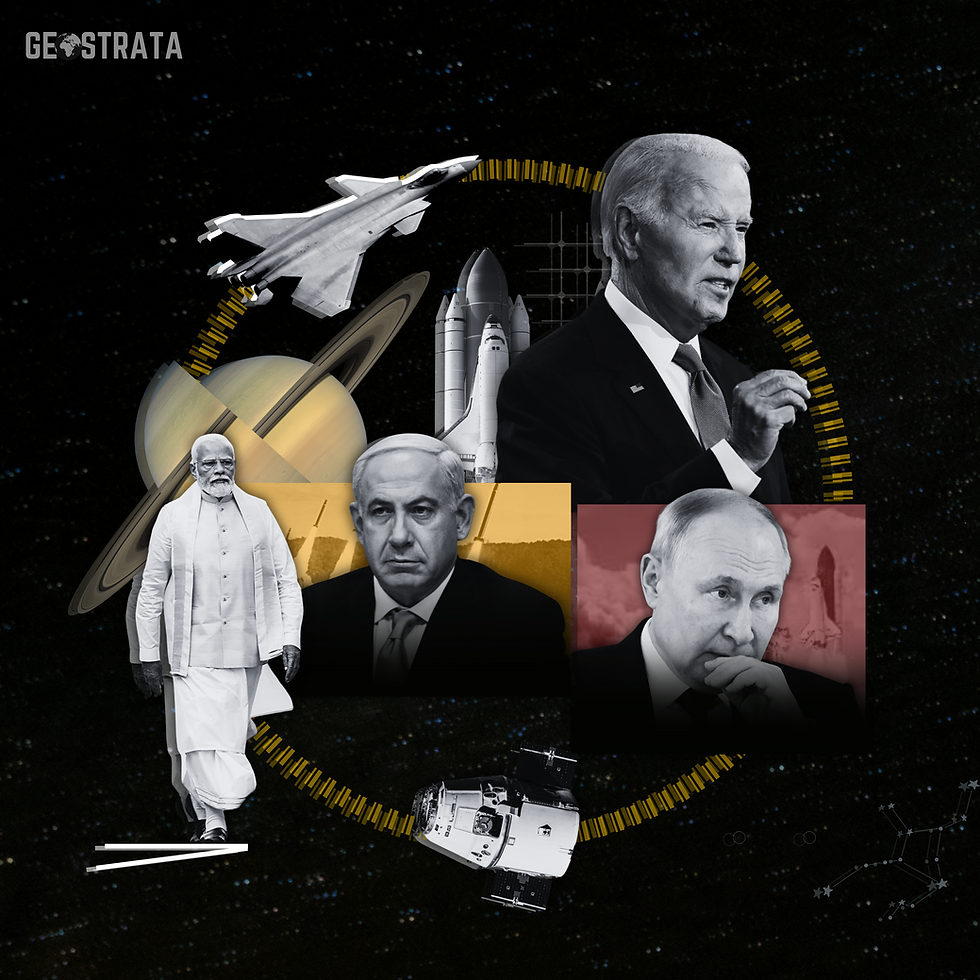
Illustration by The Geostrata
His words are reflective of a growing trend in the world–space as no longer a combat supporting domain but a warfighting one. Space has always been viewed as the final frontier in warfare. The first human-made satellite, the Soviet Union’s Sputnik, was thought to be a spy satellite by the United States, sparking the space race that led to a decades-long struggle between the United States and the Soviet Union. The first ‘spy’ satellite was launched in 1960 by the United States, a mere two years after the first US satellite.
THE RELIANCE ON SPACE
For modern militaries, satellites are critical for communications, data transfer, reconnaissance, and navigation. Without space-based assets, many advanced weapons such as Intercontinental Ballistic Missiles (ICBMs), cruise missiles, and precision-guided munitions would lose their accuracy and effectiveness. GPS-guided weapons rely solely on GPS satellites for navigation, and missile early warning systems depend on infrared tracking satellites to detect launches and track ICBMs.
From the high ground of space, satellites provide a vantage point unmatched in warfare—without them, modern militaries would be deaf, dumb, and blind. The strategic dependence on space-based infrastructure has turned space from a realm of exploration into a domain of confrontation.
Satellites have also been used extensively to monitor troop movements and infrastructural development–aspects that are critical to be aware of before kinetic action. Furthermore, space based infrastructure can support offensive and defensive cyber capabilities, while also serving as a platform for electronic warfare. Warfare is becoming more and more network-centric, making control of information the most critical aspect of warfare. This reliance has prompted countries to develop both offensive and defensive space capabilities to protect their assets and deny adversaries access to theirs.
RISING THREATS
Four countries have demonstrated their ability to intercept satellites: India, Russia, the United States and China. All these countries except India have a dedicated space force which handles all functions of their space and cyber domains. Meanwhile, India has a Defence Space Agency that is tasked with space warfare and satellite intelligence.
1. Kinetic Capabilities: There are two primary kinetic methods of disabling satellites in space–using missiles to deliver a kinetic kill vehicle to the satellite or employing a nuclear explosion. Both these methods are frowned upon by the international community as they create untrackable space debris that threatens other satellites in orbit. Furthermore, the nuclear method involves detonating a nuclear warhead in space, which generates an electromagnetic pulse (EMP) that disables all satellites within a radius; this method, like the previous one, indiscriminately disables all satellites in its range.
The inability of these methods to distinguish between friend and foe makes them unviable for military use, as they may cause collateral damage to friendly assets while targeting adversarial ones.
No country has deployed an operational anti-satellite (ASAT) weapon as both of the current methods remain in the technology demonstrator stage. Additionally, rather than destroying the satellite, it's more effective and easier for militaries to target its ground stations, rendering the satellite virtually unusable until the station is repaired or alternate facilities are established.
2. Unconventional and Future Capabilities: Anti-satellite weapons are moving towards non-destructive methods that utilise electronic systems to jam or disable the satellite. Jamming involves an attacker flooding the frequency at which the target satellite is communicating with a large antenna, effectively severing its link from the ground station.
Another method that is being developed is Spoofing, which involves sending malicious code to the target satellite to force it out of orbit or to destroy the satellite by corrupting its operating system. Another new method, which is in development, is called “Laser Dazzling”, which involves directed energy weapons that render a satellite temporarily or permanently inoperative.
Cyberattacks have opened another avenue through which non-state actors with malicious intent can target institutions and states. Attacks on satellites using malicious code highlight the vulnerabilities of satellites to a wide range of threats. China is developing satellite-based methods to target other satellites. One such method involves a satellite manoeuvring to the target satellite and attaching itself to it, and then either pushing the target satellite out of orbit or sabotaging it.
This method requires a tremendous amount of fuel and may only be viable against high-value satellites. Furthermore, a Chinese research paper highlighted the feasibility of a ‘space bomb’ that can be placed into the exhaust nozzles of satellites, set to explode when the satellite does an orbital burn.
These methods are being developed at an alarmingly fast rate, with larger countries reportedly already having the capability to jam satellite communications, forcing other states to invest heavily in similar programs, sparking an arms race in the domain that was expected to overcome earthly disputes and promote unity and harmony.
DEFENSIVE MEASURES
As it currently stands, there is little a country can do to defend its satellites from kinetic attacks. The only method to safeguard satellites would be to actively track and manoeuvre away from any approaching threat. For non-kinetic threats, redundant systems should be created while placing special emphasis on firewall and network security to ensure that no malicious code is able to penetrate into the satellite network.
The saying ‘The best defense is a good offence’ is extremely relevant in the realm of space warfare. Satellites operate in a vulnerable environment where conventional defences like armour are impractical and expensive. The predictable orbit of a satellite enables easy tracking and opens it up to numerous threats. Defending such critical assets is technically challenging and costly, and even modest attacks from non-state actors can result in strategic consequences. Given these vulnerabilities, deterrence emerges as the most viable form of defence.
Deterrence in space will depend not only on capabilities, but on credibility and resilience.
As space evolves from a supporting domain to a contested and combative arena, nations must recalibrate their military doctrines and space policies to ensure that they can assert dominance in what is rapidly becoming the most critical domain of modern warfare.
BY SOHAM RATHORE
TEAM GEOSTRATA


Insightful