.png)


Rebuilding Regional Influence: The Strategic Reset in Dhaka's Foreign Policy

July 2024 marked the collapse of Sheikh Hasina’s unshakable regime, but also the beginning of a recalibration that is still unfolding.
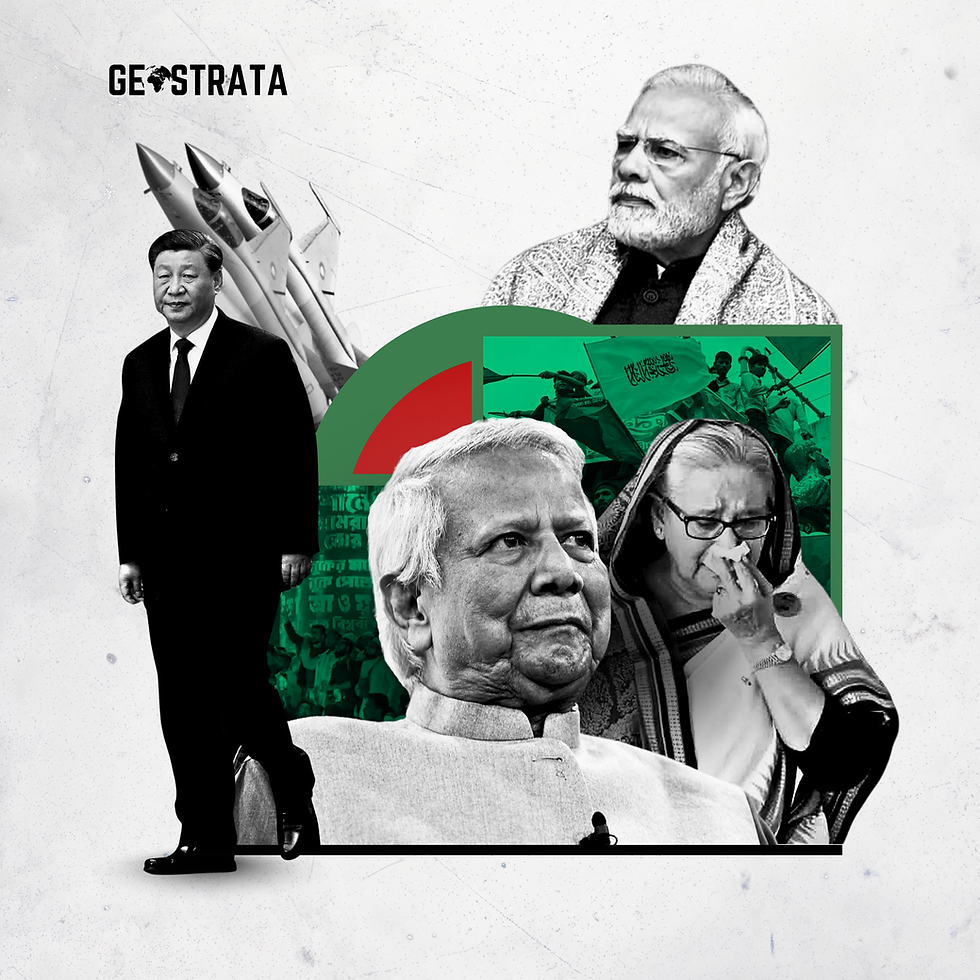
Illustration by The Geostrata
Following the exit of Hasina, who was regarded as the architect of Bangladesh’s non-aligned foreign policy, what appears to be unfolding is a deliberate shift from a peripheral focus to a more region-centric posture of Dhaka's foreign policy. From allowing a Chinese-funded port project near St. Martin’s Island to backing maritime corridors connecting Karachi and Chittagong, the redirection is evident.
What happens when a state loses its long-standing leadership of almost two decades? Is it the onset of structural reform, or the beginning of a strategic policy shift?
In the case of Bangladesh, Professor Muhammad Yunus, Chief Adviser to Bangladesh’s interim government, is the face of power neutraliser for Bangladesh. Unlike Hasina, who ruled with power, Dr. Yunus might just get played by it.
CHINA’S GROWING FOOTPRINT UNDER DR. YUNUS
The four-day visit of Dr. Yunus to China in March signalled a rhetorical shift in Dhaka’s foreign alignments, unsettling New Delhi’s trust in its long-standing border ally. During Hasina’s tenure, Bangladesh maintained a pragmatic balance with both India and China. However, under Dr. Yunus, signs of deeper strategic recalibration are beginning to emerge.
It is indeed a matter of concern for India, as Dr. Yunus welcomed China to treat Bangladesh as a maritime bridge for extending its influence in India's Northeastern states, Nepal and Bhutan.
Along with this, Bangladesh has been establishing direct maritime links with Pakistan, lifting import restrictions, and expressing intent to strengthen military cooperation, which has signalled a departure from Dhaka’s previously cautious posture towards Islamabad.
WHY SHOULD THIS NOT BE A SMALL BUT A GRAVE CONCERN FOR INDIA?
Dr. Yunus’ leadership has sought to rewrite Bangladesh’s diplomatic priorities, most notably by reaching out to Pakistan despite decades of estrangement since the 1971 war of liberation. Such outreach risks diluting India’s influence in the region. At the same time, growing Chinese investments in Bangladesh’s infrastructure and ports, coupled with Dhaka’s recent acquisition of JF-17 fighter jets, further undermine a shifting strategic posture that India finds discomforting. Adding to this, Bangladesh’s strengthening ties with Turkey, who is a known ally of Pakistan and a critic of India, further complicates New Delhi’s strategic build even more.
Among all of this, one notable shift that had been initiated by the arrival of a Chinese cargo vessel from Karachi to Chittagong, marks a direct maritime connectivity between the two estranged nations.
More concerning for India is Dhaka’s quiet removal of a long-standing clause mandating physical inspection of Pakistani cargo at Bangladeshi ports, signally more apprehensions from India.
When considering Bangladesh’s rebalancing act, it is important to note that under Hasina, Bangladesh championed the Bay of Bengal Initiative for Multi-Sectoral Technical and Economic Cooperation (BIMSTEC), which is seen as an India-led regional bloc aiming to replace the dysfunctionality of the South Asian Association for Regional Cooperation (SAARC) and counter China’s Belt and Road Initiative (BRI). But Dr. Yunus appears to be changing the routes. Dhaka seems to be deprioritising India’s regional ambitions by engaging with BRI and SAARC.
The new leadership in Bangladesh seems to be a wall in India’s rising influence in South East Asia. Its growing tandem with China has obstructed India’s ambition to spread its influence in the region and beyond. Under Hasina’s leadership, India could swiftly make its way to South East Asia and practise its “Neighbour first policy”, but now, it now poses a challenge for India to assert domination beyond.
It has been widely debated that this new realignment of Bangladesh’s Foreign Policy is a consequence of the steps India itself took.
Firstly, New Delhi maintained steadfast support for Sheikh Hasina, viewing her leadership as essential for regional stability and cooperation with a nation that shares India’s longest border.
Secondly, this consistent support reflected India’s prioritisation of continuity and predictability in Dhaka, even amid political turbulence.
Thirdly, India’s proactive border security measures and its engagement with the Rohingya crisis underscored New Delhi’s concerns over regional security, though these sometimes created diplomatic friction in the bilateral relations.
In the case of Bangladesh, it has better positioned itself than other post-regime change cases. A state structure is well in place, although in need of some serious reforms.
THE WESTERN HAND
For China, the problem here is the "foreign hand”, notably the United States of America. The USA has been helping Yunus and the interim government rebuild democracy, but the sole intention behind this is to keep China at bay.
What seems to be common here is that both India and the USA are concerned about China’s growing influence in Bangladesh, but their concern is none of Bangladesh’s concern.
At the moment Bangladesh is trying to build a cordial relationship with major powers, which is another way of increasing their regional influence. The concern for India is not just the loss of a diplomatic partner in Hasina, but the geopolitical vacuum that may now be exploited by external powers seeking to counterbalance India’s growing influence in the Indo-Pacific.
CONCLUSION
By inching closer to Beijing’s strategic orbit through revived port projects, softening ties with Pakistan, and deprioritising India-led initiatives, Dhaka appears to be re-shaping power dynamic in South Asia. While Dr. Yunus may not be inherently anti-India, his divergences from Hasina’s pro-Delhi legacy could enable foreign actors, particularly China and Pakistan to fill the strategic void, making this a grave concern for India’s regional aspirations.
BY AYAT RIZVI TEAM GEOSTRATA


Comments