.png)


Processing is the New Mining: Indonesia’s Resource Nationalism and India’s Strategic Response

For years, world energy politics had been centred around crude oil and the actions of the Organization of the Petroleum Exporting Countries (OPEC). But in recent decades, as the world shifts from fossil fuel to cleaner energy, the geopolitical balance is shifting from the oil wells to the mineral mines. And the most severe geopolitical tug-of-war is now taking place over key metals such as lithium, cobalt and nickel, which play a vital role in electric vehicle (EV) battery production and clean-tech infrastructure.
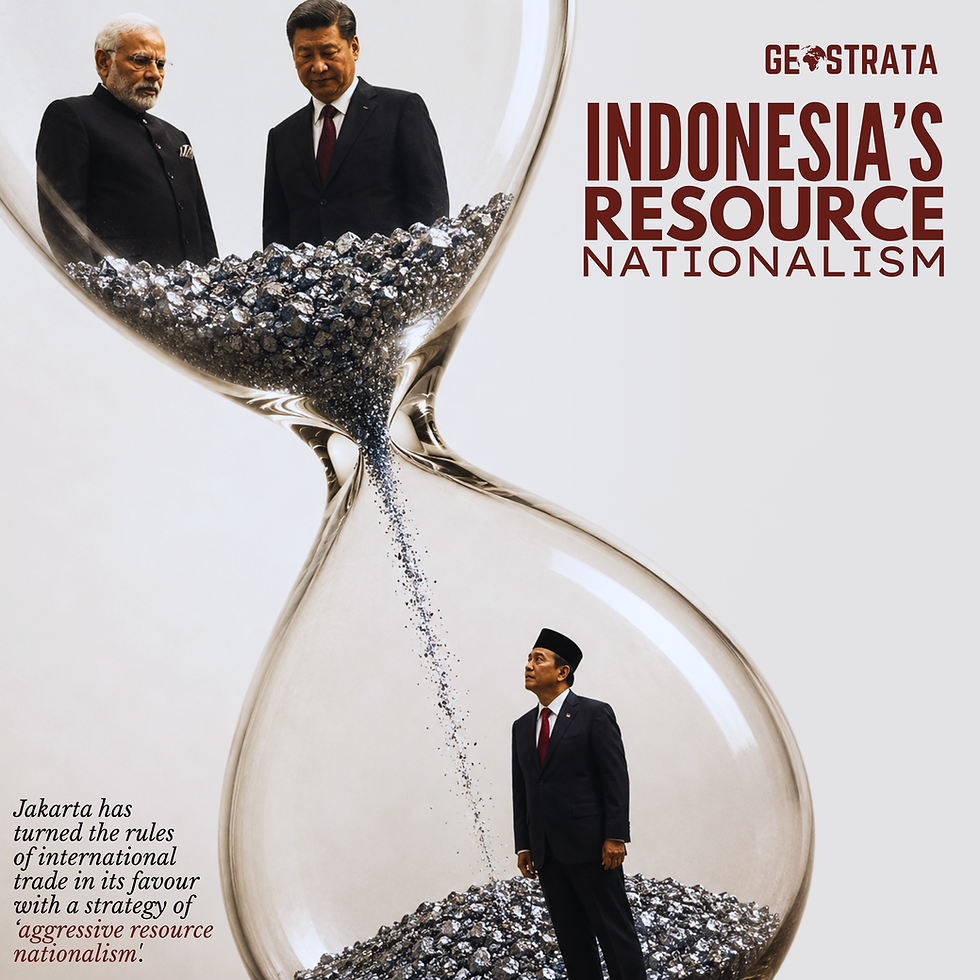
Illustration by The Geostrata
Indonesia is the very centre of this transformation. With more than 40% of the world's known nickel reserves, Jakarta has turned the rules of international trade in its favour with a strategy of aggressive 'resource nationalism'. This approach has shaken up global supply chains, and this has caused a serious economic shock and a strategic jolt for big importing countries such as India.
"DOWNSTREAMING" AS AN ECONOMIC
In 2020, the Indonesian government put into place a general prohibition on the export of raw unprocessed nickel ore. This was a warning to the international markets loud and clear: If you wish to have our nickel, you might not be able to simply dig it up and walk away, you'll need to construct your multi-billion dollar refining and processing facilities within our borders. And this is the exact policy that has helped to break the norm of free market.
Indonesia turned around from being a provider of raw dirt to a world-class manufacturing center by compelling foreign funds to buy its infrastructure. The policy was a success in enticing FDI worth tens of billions of dollars. But it also provoked a strong rivalry among the great powers. Chinese state-backed firms capitalised on the chance and invested massively in mega-refining plants in Indonesia. As of 2026, Chinese companies control roughly 75% of Indonesia’s local nickel processing capacity, creating a highly securitised supply chain that heavily favours Beijing.
And indeed, this pattern shift highlights a fundamental truth of the new green economy: having mineral resources is one thing, but processing them is another. Possessing raw geology in the ground can only yield so much leverage if a nation lacks the industrial infrastructure, high-temperature smelting technologies and capital required to transform raw ore into high-purity, battery-grade chemicals.
By recognising that the true geopolitical leverage lies not in the extraction of the dirt but in its metallurgical refinement, Indonesia has successfully forced global markets to bridge this gap within its own borders, effectively rewriting the handbook on resource dependency.
MARKET MANIPULATION AND THE "NICKEL CARTEL" AMBITION
Indonesia has actively used its dominant position to manipulate global market dynamics. The Indonesian Ministry of Energy and Mineral Resources (ESDM) reduced its official nickel production quotas (abbreviated as the RKAB) to a much more conservative 250-260 million tonnes in early 2026, from the previous target of 379 million tonnes.
Later, Jakarta was under great pressure from domestic smelters and changed these figures mid-year to around 360 million tonnes to avoid a complete local shutdown, but they nonetheless showed that Jakarta can manipulate global prices at will.
The first cuts in quotas saw nickel prices shoot up on the London Metal Exchange to $18,000 per tonne within a couple of hours. The long-term objective of Jakarta is to establish a “mineral cartel” similar to OPEC of other mineral-producing cities, including the Philippines. But within this “mineral OPEC” dream, there are significant structural constraints.
Western carmakers, fearing volatile policy shifts and Chinese levers on the ground here, are now working fast to devise ways to work around the problem In mid-2026, major EV manufacturers augmented a massive mass-market shift toward nickel-free battery alternatives such as lithium manganese iron phosphate (LMFP) and sodium-ion cells. This technological de-nickelization is now threatening to erode Indonesia's leverage before its cartel can even fully solidify.
VULNERABILITY AND THE MIDSTREAM DEFENSE
For India, this nickel cartel is proving to be a direct hindrance to both national security and economic growth. Indian Ministry of Mines data claims that India depends on 100% imports for raw nickel. India is dependent on imports of nickel for its large stainless-steel manufacturing industry and for its green energy push, which seeks to make 30% of private cars and 80% of two-wheelers electric by 2030.
When the Jakarta government limits supply and when Chinese-owned smelters adjust prices, Indian manufacturers are hard hit. Moreover, the purchase of processed nickel from Indonesia poses a serious question for New Delhi, namely, the fact that China's companies run the vast majority of the Indonesian refineries; in effect, this means that importing nickel from Indonesia positions the Indian government as an unwilling backer of its main geopolitical rival's supply chain system.
As a response, India has pursued an aggressive defence strategy based on midstream sovereignty. India is not going into the race of mining raw minerals that it does not possess but is creating a resilient processing and recycling industry. The National Critical Mineral Mission (NCMM), which aims to develop India's supply chains, has expanded field exploration at hundreds of domestic sites and has actively encouraged domestic research.
Under the NCMM, a financial plan offers direct subsidy for the establishment of advanced recycling plants, known as the ₹1,500-Crore Recycling Incentive. By 2031, India will strive to achieve e-waste and end-of-life battery scrap processing to process 400 kilotonnes of critical minerals, thereby reducing the primary import requirements. India is also aggressively seeking alternative diplomatic avenues through minilateral alliances.
India is trying to avoid the Chinese-Indonesian middleman to all but eliminate it by actively participating in the Minerals Security Partnership (MSP) to the west and setting up bilateral partner-specific supply chain observatories.
THE STRUCTURAL LIMITS OF RESOURCE CONTROL
This longstanding battle over global production of nickel is a lesson for the geopolitics of the 2030-2040 timeframe. Physical control of a resource gives short-term geopolitical power, not permanent long-term dominance. Indonesia has managed to demonstrate how resource nationalism can make global superpowers invest in its infrastructure by letting Chinese money control its factories and by generating market volatility; however, Jakarta has also spurred all other nations to innovate.
Importing countries such as India cannot replicate the mineral resources of resource-rich states, but must excel at the middle game of midstream processing, recycling know-how and diplomatic partnerships that maintain supply chains. In this new era of geoeconomics, true strategic autonomy belongs not to the nations that sit atop the raw elements of nature, but to those that control the technological processing and alternative chemistries that make them useful.
BY ASMITHA SAHA
TEAM GEOSTRATA


Interesting analysis of how resource policies can influence regional strategy and long-term economic planning. The article explains a complex topic in a clear and engaging way. Just like the best book marketing service helps a great book reach the right audience, thoughtful policy decisions can shape future opportunities. Thanks for sharing such an informative and well-structured perspective.
This is an insightful analysis of how resource nationalism is reshaping global supply chains and strategic partnerships. Indonesia’s focus on domestic processing highlights how countries are increasingly prioritizing long-term industrial value over raw material exports. It will be interesting to see how India balances securing critical resources with expanding its own manufacturing capabilities. While researching related topics, I also came across Assignment Help Ireland and https://www.assignmenthelp.ie/sligo, which reminded me how access to well-organized academic resources can help students better understand complex geopolitical and economic issues.
I enjoy reading a helpful blog when the author focuses on real reader needs. This post provides interesting information and several sensible recommendations. The writing is simple but never superficial. I liked the realistic discussion of possible challenges. The final paragraph suggested clear next steps. I will return for more articles.
I found the analysis in this post very useful. The author explained not only what happens but also why it matters. That additional context made the information much more valuable. Your blog insights provide readers with ideas they can apply in different situations. The writing also encourages independent thinking. I will be interested to see what subjects are explored next.
I found this article valuable for how clearly it connected theory to real-world application throughout. The author didn't assume prior expertise, which made the piece accessible without feeling watered down. Each section built naturally toward a conclusion that tied everything together well. That kind of structure makes it easier to walk away with something meaningful. This useful blog remains a great source for that kind of clear, practical writing.