.png)


Paralyse, Don’t Destroy: Chinese PLA's Taiwan Strategy

Recent reporting from Taipei Times regarding the Chinese People’s Liberation Army’s (PLA) operational planning highlights a fundamental paradigm shift away from traditional, high-attrition amphibious landing models towards systemic urban paralysis, grey-zone coercion and multi-domain encirclement.

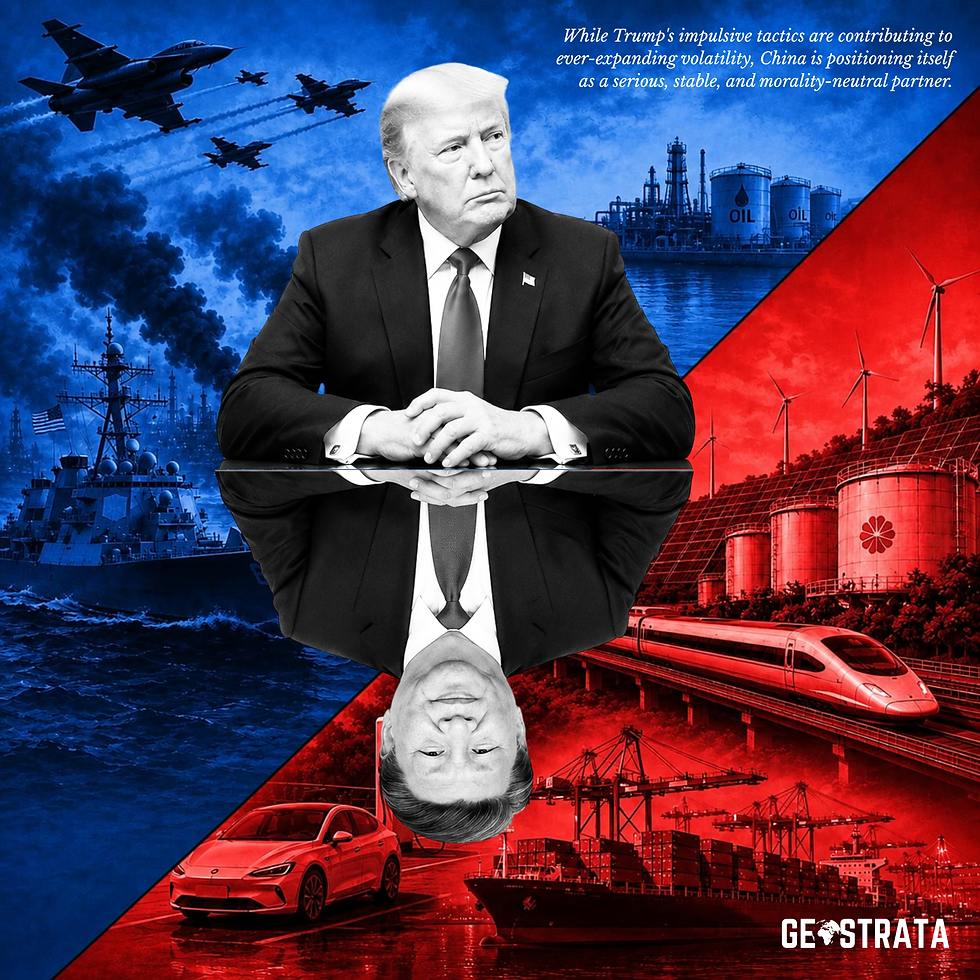
Illustration by The Geostrata
Moving beyond the classic Joint Island Landing Campaign, PLA strategists are actively refining an operational framework termed “All-Domain Megacity Incapacitation Warfare”. Centred on forcing political submission rather than executing physical destruction, this approach seeks to neutralise Taiwan’s political centre of gravity in Taipei through synchronised kinetic strikes, maritime blockades, cyber-electronic disruption and cognitive warfare.
THE THEORETICAL PIVOT: INCAPACITATION WARFARE
“Incapacitation warfare” is a strategic concept developed by Chinese military researchers to quickly neutralise an adversary- specifically Taiwan- while deterring US intervention. Learning directly from Russia’s protracted and destructive urban warfare in Ukraine, the PLA aims to avoid high military attrition, ruined infrastructure and international mobilisation. Instead, the overarching goal is to trigger a rapid collapse of the target’s state functions, presenting foreign powers with a swift fait accompli before an active intervention can even be organised.
To achieve this rapid submission without resorting to conventional bombardment, the doctrine relies on four synchronised operational vectors. These include executing a joint sea and air blockade to sever physical and digital lifelines; launching precision strikes and special operations to disable critical power and communication modes; deploying pre-positioned sleeper cells for decapitation strikes against the leadership and weaponising AI and social media as “information munitions” to destroy public morale and civil-military cohesion.
OPERATIONALISING THROUGH ENCIRCLEMENT
The PLA’s “Joint Sword” exercise series, specifically 2024A and 2024B, demonstrates a practical application of "incapacitation warfare” against Taiwan through grey-zone tactics, psychological pressure, and maritime blockades. Triggered by the speeches from President William Lai, these operations have rapidly escalated in both intensity and geographic proximity.
While the 48-hour 2024A exercise focused on testing joint command structures outside Taiwan’s 24-nautical-mile zone, the highly compressed 13-hour 2024B drill aggressively penetrated this contiguous zone to simulate blockades on critical infrastructure, specifically targeting vital Liquefied Natural Gas ports.
A defining feature of this evolving strategy is the integration of the Chinese coast guard alongside naval forces to frame military blockades as domestic “law enforcement quarantines”, intentionally creating operational dilemmas for Taiwan that complicate any kinetic response.
This grey-zone warfare is actively bolstered by the PLA’s recent structural reorganisation, which replaced the Strategic Support Force with specialised Aerospace, Cyberspace and Information Support Forces. These newly formed units provide the critical electronic warfare, cyber intrusion and real-time targeting capabilities necessary to execute multi-domain blockades and sever Taiwan’s energy lifelines.
ASYMMETRIC ASSAULT
To address historic amphibious transport shortages for a potential cross-strait invasion, the PLA is integrating its fleet of civilian Roll-on/Roll-off ferries into military logistics. While this hybrid model could rapidly transport up to 300,000 troops and heavy armour, the commercial ships lack defensive hardening and off-shore landing capabilities. Consequently, they are highly vulnerable to maritime attacks and rely entirely on intact deep-water ports, meaning they can only be deployed as a second-wave after primary military forces have secured a functioning harbour.
To facilitate these ground assaults and overwhelm defensive networks, the PLA plans to deploy massed waves of retired fighter jets converted into autonomous strike drones (J-6W) to exhaust enemy air defences and strike fixed installations. Additionally, Chinese military strategy includes options for sequential coercion, such as seizing outlying Islands like Kinmen or the Pratas. This approach would allow Beijing to exert intense psychological pressure on Taipei and test the response of allied nations without immediately committing to a full-scale invasion.
STRATEGIC VULNERABILITIES AND COUNTERMEASURES
Taiwan has fundamentally shifted its military defence strategy in response to emerging threats of incapacitation and blockade. Historically, Taiwan relied on the Central Mountain Range to shield its eastern bases as secure sanctuaries, but modern simulations reveal these areas are now vulnerable to advanced naval and aerial attacks from east of the First Island Chain. Consequently, the military is pivoting away from open-ocean naval engagements, opting instead to strengthen near-shore coastal defences supported by land-based anti-ship missile systems.
Alongside these tactical military adjustments, Taiwan is urgently prioritising the resilience of its communication networks, as 99 percent of its internet relies on vulnerable submarine cables. To protect against physical sabotage or network blackouts, a multi-layered approach is being implemented.
This includes U.S.-backed legislation to monitor and protect subsea infrastructure, the expansion of multi-orbit commercial satellite connectivity for emergency bandwidth, and the proposed development of decentralised, off-grid mesh networks (National Mesh Network). Taiwan relies on subsea cables, satellites and fibre optic cables to remain connected. However, in times of conflict, none of these would be enough to ensure that the government can communicate with its citizens, or that citizens could communicate with each other.
A mesh network, on the other hand, ensures sovereignty and autonomy. They often consist of small personal devices such as smartphones or Meshtastic LoRa nodes that relay messages to each other through a wireless signal or Bluetooth, instead of going through a centralised server, to ensure communication between citizens and civil defence authorities during a crisis.
STRATEGIC OUTLOOK
The evolution of PLA military doctrine, as tracked by defence analysts and reported by the Taipei Times, underscores a shift toward multi-domain paralysis and grey-zone encirclement.
By prioritising systemic incapacitation over high-risk amphibious landings, Beijing seeks to force political capitulation while raising the strategic cost and technical difficulty of foreign military intervention.
In response, effective deterrence requires Taiwan and its allies to strengthen multi-domain resilience alongside traditional defence procurement. Mitigating the threat of incapacitation warfare depends on hardening critical infrastructure, securing energy and communication lifelines, establishing clear rules of engagement for grey-zone incursions, and enhancing civil defence readiness.
The ultimate counter to Beijing's doctrine of rapid paralysis rests on Taiwan's capacity to absorb initial shocks, maintain state command continuity, and demonstrate societal resilience under sustained siege conditions.
BY AYAAN ALI
COVERING PEOPLE'S REPUBLIC OF CHINA
TEAM GEOSTRATA info@thegeostrata.com


Comments