.png)


The Silent Archivist of Trump’s Persian War: Trump’s Tactics Paving the Way for China's Rise

The 47th American President, Donald John Trump, declared in his inaugural speech on 20 January 2025 that his legacy would be measured by the “wars we never get into”, while promising a “greater, stronger & far more exceptional” America. Barely a year later, America finds itself trapped in an unending war against the Persian state, two broken ceasefire agreements, and a sharp decline in the world's tacit acceptance of American Greatness.
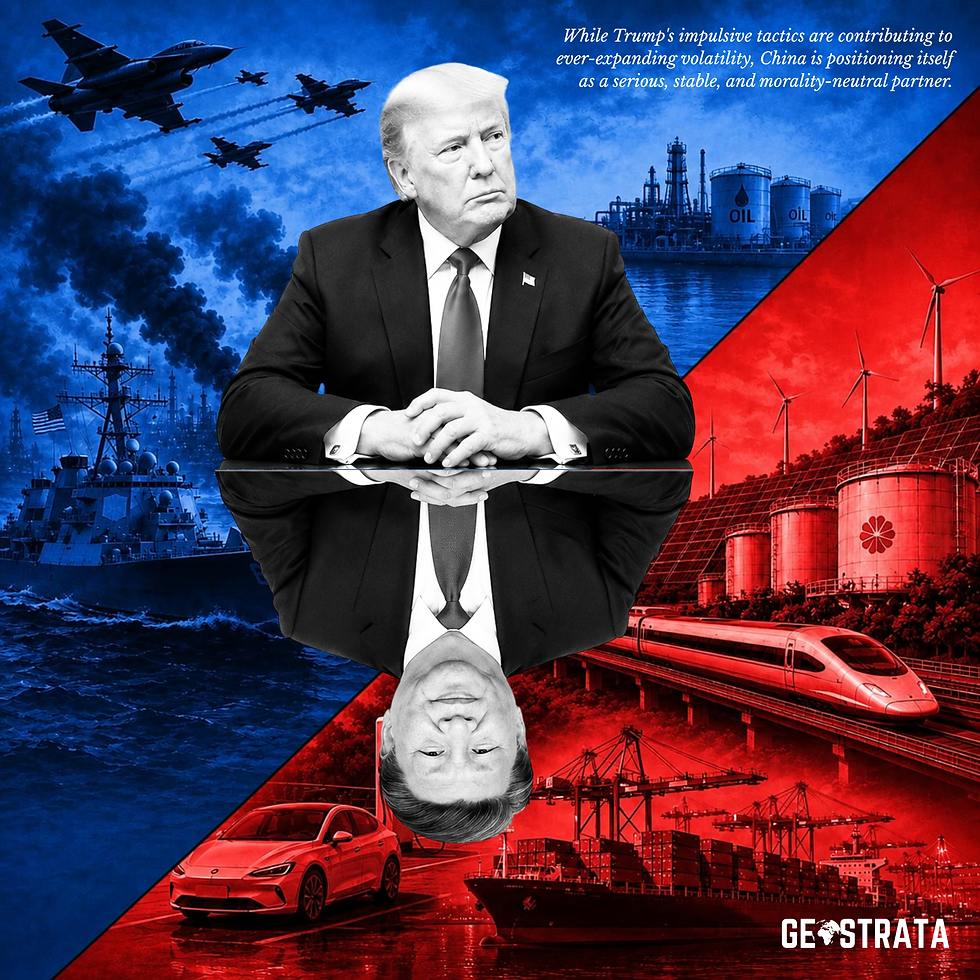
Illustration by The Geostrata
As Washington struggles to manage the fallout, Beijing has remained conspicuously restrained, quietly positioning itself to benefit from a crisis that has placed American power under renewed scrutiny.
THE EMERGING PICTURE
The USA & Israel conducted a joint attack on the Iranian state in February 2026, killing Iranian Supreme Leader Ali Khamenei along with many others from the top leadership of the national security establishment, with hopes for a quick surrender and epic victory. Those hopes remain unfounded.
Iran's response has dented not only America's reputation, but the tremors of the Houthi blockade have also been felt across the foundations of the global economy, with several countries declaring energy emergencies and many more resorting to fuel rationing amid a prolonged energy crisis.
As the world watches another prospective "peace deal" between the United States and Iran, with Islamabad attempting to claim the rather undeserved title of peacemaker, Beijing is quietly placing its bets elsewhere. On paper, China's response has remained predictably neutral, calling for respect for Iran's sovereignty, immediate de-escalation, and a ceasefire. In reality, however, Beijing has been playing the long game long before the world's attention turned to the 60-mile-wide Strait of Hormuz.
CHINESE RESILIENCE AMID FUEL CRISIS
Beijing has spent decades building an economy resilient to the muddled Middle East and its episodic energy shocks, thereby adding to China's international rise. Rory Green, in his recent report for TS Lombard, "Is China Immune to Energy Shocks?", identifies four main buffers: stockpiles of commodities, massive petrochemical capacity, high investment in, and nationwide integration of, green energy infrastructure, and low domestic inflation.

Though EV infrastructure has prevented major fuel price spikes, low domestic reserves still necessitate imports. Beijing's oil stockpiling has been grabbing market attention since the Russia-Ukraine conflict.
Though the exact size of its strategic reserves remains a state secret, estimates suggest China holds 1,397 million barrels, which, to put it in perspective, is more than three times that of the USA, at 413 million barrels.
It has also invested heavily in diversifying its crude suppliers, especially by purchasing from sanctioned players at discounted prices, making it the buyer of 80% of Iranian crude exports, while Russia has emerged as its largest import source. Moreover, China has also doubled down on coal mining, which, unlike crude, is widely available at home. When the wind, solar, and nuclear energy outputs are added to the equation, crude accounts for only a fifth of Beijing's total energy consumption in 2024.
Low domestic inflation is the final corner in this quadrilateral. Normally, an increase in the price of fuel would result in inflated upstream costs; however, in the case of China, if the manufacturer endeavours to increase the price to transfer costs to consumers, the lagging domestic demand would snowball into more losses. The sluggish growth rate of 4.3% year on year in 2026 ended up being a saviour in disguise, as the weak domestic demand further blunted the overall impact of war-induced inflation.
BEIJING'S RISE AS A COUNTERWEIGHT

China has historically aimed to build a reputation as a counterweight to America, whether through the saga of an alternative BRICS currency or the Belt & Road Initiative, contributing to China's rise. However, China has tended to fall short due to the good old suspicion surrounding an authoritarian state.
Trump and his republican companions, however, have done a good job of reducing global trust in the USA, with a modest appreciation for the Mandarin state. According to a recent Pew survey, China is viewed more positively than the USA in most of the thirty-six countries surveyed, including NATO members like Turkey, Spain, and Italy. The countries where China still carries a red mark are India, Japan, the Philippines, and South Korea, all of which are involved in long-standing border disputes with it.
Beyond public opinion, Europe, despite lingering scepticism, is now signalling its openness to engaging with China, with French President Emmanuel Macron suggesting that France is seeking a "Third Path" of strategic and sustained engagement with China.
China is the one country that has successfully pushed back against America's tariff warfare, leveraging its absolute dominance over critical mineral supply chains and positioning itself as a serious balancer to the U.S.
It is not just Europe; West Asia is also bandwagoning this trend in search of a counterweight to its partnership with the USA. In a recent episode of Fareed's Take, Zakaria posits that the unending war has pushed countries like Turkey, Iraq, and Saudi Arabia to pursue a balancing act against American dependence by opening the gates to deeper strategic engagement with China. Furthermore, what Washington once called the Axis of Autocracy is on its way to expansion, with Pakistan, Saudi Arabia, and Turkey inking a joint defence pact.
Beyond these strategic developments, China has committed a record $20.1 billion to BRI green energy projects in the first half of 2026. With the West preoccupied by the Ukraine-Russia war and the Iran war, China is using its green technology capacity to make diplomatic headway with energy-starved nations. Since 2022, China has single-handedly emerged as the largest source of global green energy finance across regions like Southeast Asia and Africa.
As the West stumbles to fulfil its climate change obligations to the Global South, China, with its "Alternative Supply Chain" lifeline and the 2026–2030 Five-Year Plan, is gradually earning the trust it lost following the acquisition of Hambantota Port and criticism of its hawkish debt diplomacy.
The world today stands at the fulcrum of a transition from a unipolar, America-led order to a multipolar, post-trust world. While Trump's impulsive tactics are contributing to ever-expanding volatility, China is positioning itself as a serious, stable, and morality-neutral partner, giving states a competitive choice.
BY ANJANI CHAUHAN
TEAM GEOSTRATA


Spent a couple hours on Pokiig last week going through the puzzle section. A few of the games were more engaging than I expected — kept telling myself one more level and then lost track of time.
Excellent, eye‑opening article! You offer a fascinating perspective on how regional conflict reshapes global power dynamics. The supporting charts and visuals make dense international‑relations topics much more accessible. It is a fantastic deep dive into energy resilience, shifting global public opinion and the transition toward a multipolar world order. Great work by The Geostrata team! --recordly