.png)


Indus Waters Treaty: Strategic Justification and Legal Foundations of India’s Suspension of the Treaty - A Report

In April of 2025, terrorists linked to the Pakistani organisation Lashkar-e-Taiba (LeT) perpetrated one of the heinous acts of terror against innocent civilians in Pahalgam, Jammu and Kashmir, in India. In the aftermath of the attack, India took many strategic, military and diplomatic steps to secure its national interest. One such step was the decision to place the Indus Water Treaty, 1960, in abeyance.
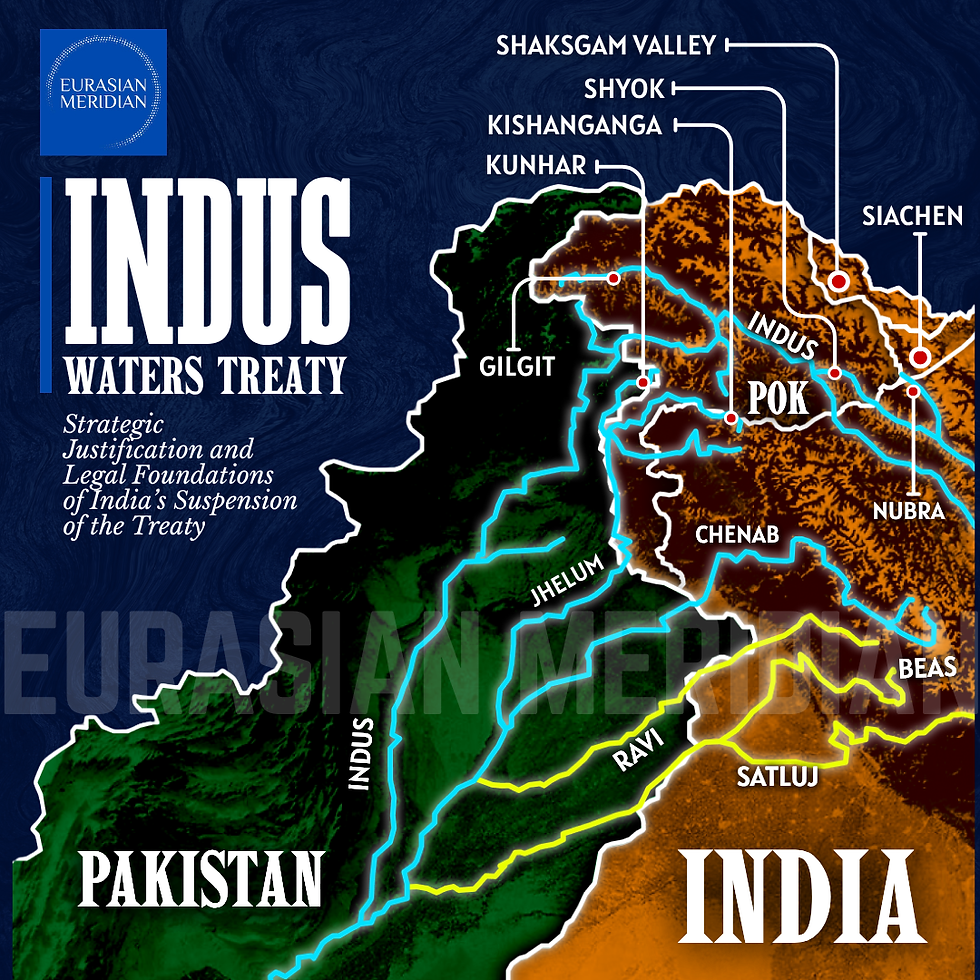
Infographic by Eurasian Meridian
For more than six decades, the Indus Water Treaty has been in operation despite so many terror attacks carried out by Pakistan in India, showing India’s exceptional commitment to international obligations.
However, the changing geopolitical realities, coupled with persistent state-sponsored terrorism by Pakistan and India’s legitimate development projects, have fundamentally altered the conditions in which the treaty came into existence. This report fundamentally proves how India’s decision to put IWT under abeyance is a lawful strategic recalibration and not the weaponisation of water, as Pakistan is falsely trying to portray.
The report further argues against the treaty’s asymmetric allocation, institutional weaknesses, and inability to accommodate twenty-first-century realities. It concludes by highlighting the need for a renewed, comprehensive renegotiation rather than unconditional continuation.
INTRODUCTION
Originally signed between India and Pakistan on September 19, 1960, the Indus Water Treaty (IWT) has long been celebrated as one of the most consequential treaties between the two neighbours.
After the British left the subcontinent in 1947, there was a persistent conflict between the two newly independent countries on multiple issues. From the sharing of boundaries to the sharing of water, there existed a confrontation. Amid such hostilities, the signing of this treaty sought to provide a stable framework for managing the waters of the Indus River system.
It allocated to India the exclusive rights over the Eastern Rivers (Ravi, Beas, and Sutlej) and to Pakistan the exclusive rights over the Western Rivers (Indus, Jhelum, and Chenab).
It has often been portrayed internationally as a model of successful hydro-diplomacy. However, an objective assessment of it will tell us that the treaty has imposed significant asymmetrical obligations upon India.
Under the treaty, approximately 80 per cent of the basin’s annual waters were allocated to Pakistan. While India, despite being the upper riparian state, retained rights over only about 20 per cent. India had further accepted severe restrictions on storage, irrigation, and hydropower development on rivers flowing through its own territory.
Despite this asymmetry and even during the enduring military conflicts as well as during the repeated terrorist attacks, including the Parliament attack (2001), Mumbai attacks (2008), Uri (2016), Pulwama (2019), and Pahalgam (2025), India has continued to honour every operational commitment under the treaty. The strategic environment that enabled this extraordinary restraint, however, has fundamentally changed.
Contrary to popular international perception, the IWT was never an equal bargain. To facilitate regional stability and to promote greater peace in the region, India accepted extensive concessions. As mentioned earlier, the treaty allocated nearly four-fifths of the Indus Basin waters to Pakistan despite the rivers originating in or flowing through Indian territory before entering Pakistan. India also relinquished opportunities to develop irrigation projects, hydroelectric facilities, and storage infrastructure that could have substantially contributed to its own development.
Unlike most international river agreements, this treaty imposed extensive operational restrictions solely upon the upstream state. India faces limits regarding matters ranging from irrigation expansion to reservoir storage and from sediment management to operational flexibility, especially in terms of hydropower design specifications. At the same time, there were no equivalent restrictions that constrained Pakistan’s utilisation of its allocated rivers. Such institutional asymmetry reflected the geopolitical realities of 1960 rather than enduring principles of equitable international maritime law.
To download the report, please click the button below -
For all official and academic purposes, use the following as a citation, which follows the Chicago Manual Style.
Eurasian Meridian
“Indus Waters Treaty: Strategic Justification
and Legal Foundations of India’s Suspension of the Treaty”
Eurasian Meridian, July 11, 2026.
BY EURASIAN MERIDIAN


There’s a clear effort to keep the collection current, which is crucial in this space. The hand-review aspect adds credibility, and the category breakdown helps when you’re exploring unfamiliar use cases. AllSot’s platform is a useful stop before committing to a tool.
Understanding Visheshan Ke Bhed helps in improving Hindi grammar skills, as it explains different types of adjectives and their usage in sentences for clear and effective communication.
Understanding sarvanam ki paribhasha helps in Hindi grammar because it explains the use of pronouns that replace nouns and make sentences clearer and less repetitive in communication.
Sangya ki paribhasha likho refers to asking the definition of a noun in Hindi grammar, where sangya denotes the name of person, place, thing or idea in sentences.
Understanding Viramchinh in Hindi is crucial for forming accurate sentences because punctuation helps clarify meaning, convey pauses, and express emotions, making communication in Hindi grammar more precise and easier to understand.