.png)


India’s Nuclear Quest: Powering Nation While Maintaining Nuclear Deterrence

Updated: Apr 29
India’s journey into the nuclear race is a unique chapter in modern geopolitics. India’s desire for scientifically independent developments caused the country’s “nuclear quest” to grow along two parallel lines: the use of nuclear energy for the economic development and growth of a large population, and creating a strong nuclear deterrent to guarantee the independence of the country.
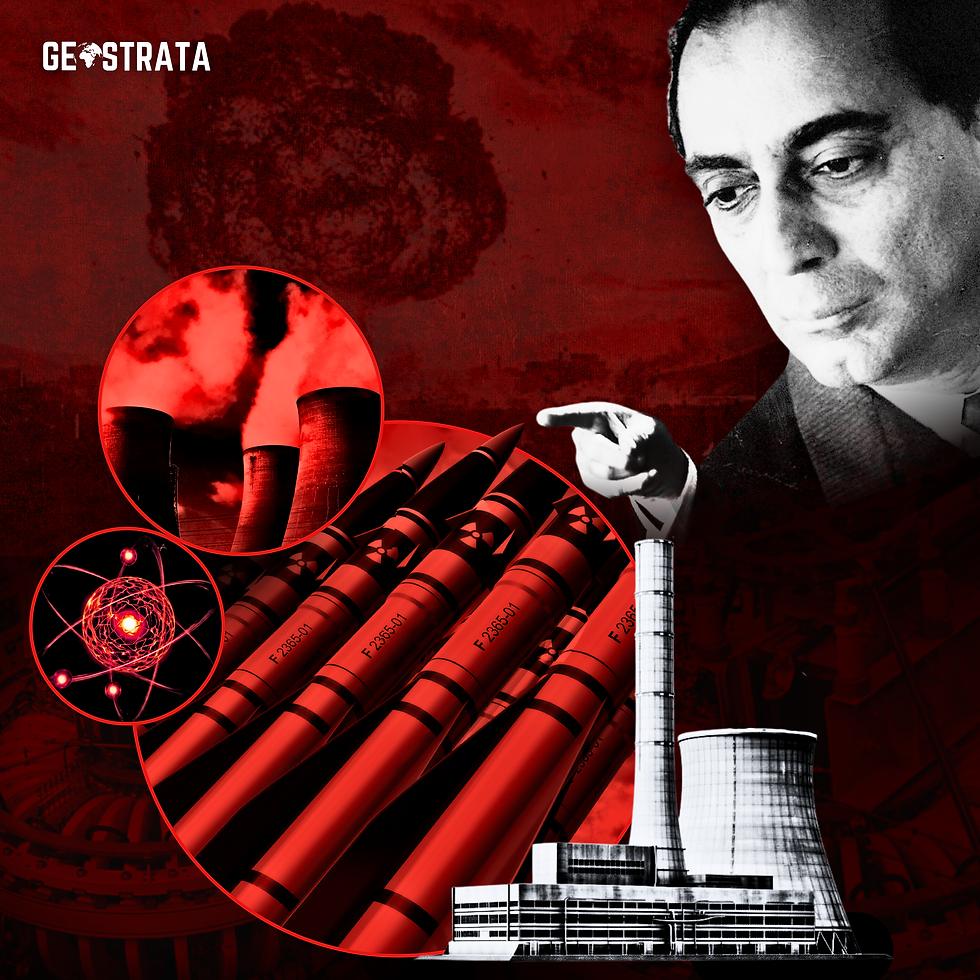
Illustration by The Geostrata
As the world addresses the climate change emergency and is dealing with significant uncertainty related to the security environment globally, India's nuclear program is currently undergoing a second strategic shift. To better understand how India fits into the current global landscape regarding nuclear power, both the establishment of the civilian nuclear program and the military nuclear program must be considered.
India has not signed the Non-Proliferation Treaty (NPT) and has historically not had a place in the international nuclear energy community, perceiving the NPT as being discriminatory, and therefore did not construct a nuclear energy program through cooperation with the NPT signatory nations. For many years, this position rendered India technologically isolated in the field of nuclear energy, causing India’s nuclear scientist community to develop and create an entirely indigenous nuclear fuel cycle.
The isolation of India due to its non-signatory status resulted in the Indian nuclear community developing an inherent resilience. Through the conclusion of the historic Indo-US Civil Nuclear Agreement in 2008 and the subsequent granting of waivers by the Nuclear Suppliers Group (NSG), India was afforded a new opportunity to be a part of the global nuclear commerce framework. India has become an international paradox, as it is a non-NPT signatory, but is viewed as a responsible nuclear power and has been building norms around global non-proliferation while constructing and significantly increasing its domestic nuclear capabilities.
THE CIVILIAN ENERGY RENEAISSANCE: RACING TOWARDS 2047
Historically, India has had fairly limited access to nuclear energy. However, India has been actively committed to developing its nuclear power capacity due in large part to the need for consistent and dependable sources of electricity to support future economic development and sustainable growth. In addition, nuclear power is being recognised as the only source of carbon-free energy that can provide a constant and dependable supply of energy to supplement unreliable sources of renewable energy like wind and solar. The recent press release from the Department of Atomic Energy (DAE) dated March 2026 indicates that India is implementing the most aggressive nuclear power expansion plan in the world today.
Today, India produces 8,780 Megawatts (MW) of installed capacity in 24 operating plants and generated a record of 56,681 Million Units of electricity in fiscal year 2024-25 from the nuclear plants that represent a steady and consistent 3% of the total energy generated in the country.
In order to significantly expand nuclear capacity, 18 new nuclear reactors with a capacity of 13,600 MW are now in development or under construction. By 2031-32, the government of India expects total installed capacity to approach 22.38 GW. The government has also started a Nuclear Energy Mission plan that outlines a long-term plan for future development of nuclear energy in India that will ultimately result in the development of 100 GW of nuclear energy capacity by 2047, which coincides with the one hundredth anniversary of India’s independence.
BREAKING TECHNOLOGICAL BARRIERS: FAST BREEDERS AND SMRS
“Moreover, when nuclear energy has been successfully applied for power production in say, a couple of decades from now, India will not have to look abroad for its experts but will find them ready at hand.”
These words of aspiration are from none other than the architect of the Indian nuclear program, Dr Homi Jahangir Bhabha. Recently, in line with this vision, India has achieved a major leap in the arena of nuclear power. India is uniquely positioned in the global nuclear power ecosystem because of its limited domestic uranium resources, but it is home to about one-quarter of the entire world’s available thorium reserves. Therefore, India operates a one-of-a-kind three-stage nuclear power program.
The 6th of April 2026 saw a landmark event in India’s nuclear plans, when the Prototype Fast Breeder Reactor (PFBR) (500 MWe) in Kalpakkam produced its first criticality. The achievement commemorates India’s formal advancement into Stage 2 of its nuclear plans. Fast Breeder Reactors are revolutionary in that they create more fuel than they consume, thereby establishing the critical foundation required to ultimately access India’s large thorium resources through Stage 3.
In parallel, India is aggressively pursuing next-generation scalable technologies (e.g., Small Modular Reactors [SMRs]) to address limitations imposed upon large-scale gigawatt plants by available land, water, and capital to meet the country’s energy needs. In the 2025-26 Union Budget, the government allocated Rs. 20,000 crore to fund the R&D of indigenous small modular reactors (SMRs), specifically the 200MWe Bharat Small Modular Reactor (BSMR-200). Factory-built reactors (e.g., BSMR-200s) will be deployed much more quickly and near industrial centres.
To break the historical state monopoly and hasten funding to the private sector, the Indian government passed the Sustainable Harnessing and Advancement of Nuclear Energy for Transforming India (SHANTI) Act in late 2025, which is a modernised legal framework that permits private sector participation and possible foreign direct investment (FDI).
THE STRATEGIC ARSENAL: CREDIBLE MINIMUM DETERRANCE
Based on climate and economic goals, India pursues a military posture that is influenced by their geography, surrounded by two nations that have nuclear weapons (China and Pakistan). With a strict adherence to their “No First Use” (NFU) policy, India’s military doctrine seeks “ Credible Minimum Deterrence”, which means that they do not attempt to achieve weight of numbers; rather, they want to be certain of being able to absorb damage from a first strike and deliver a catastrophic counter-strike.
According to the Stockholm International Peace Research Institute (SIPRI) 2025 Yearbook, India’s strategic posture reflects steady modernization rather than reckless proliferation:
Arsenal: SIPRI estimates that India has a stock of approximately 180 nuclear warheads compared to an estimated 170 currently in Pakistan; however, India has far fewer than the 600+ nuclear warheads available in China at this time.
The Nuclear Triad: India has successfully operationalized its ability to launch nuclear weapons from land, air, and sea. The continuous induction of the Arihant-class nuclear-powered ballistic missile submarines (SSBNs) ensures a highly survivable second-strike capability from the deep ocean.
Qualitative Upgrades: In addition to increasing the quantity of nuclear warheads, the tests of the Agni-V Intercontinental Ballistic Missile using MIRV technology have enhanced the quality of India’s delivery capabilities. With the introduction of canisterized missiles, India’s forces can maintain a ready set of strategic nuclear forces in peacetime conditions while continuing to develop their overall deterrent capability.
CONCLUSION
India’s position in the Nuclear Global Race is defined by maturity. In terms of use as a deterrence force, it has avoided the Cold War-style arms race that could lead to destabilisation and has now created a sophisticated and technologically advanced deterrent system.
In addition to this new role as a global leader in the development of clean energy, India is breaking down the barriers that used to block the development of their nuclear energy industry. The integration of the SHANTI Act, the financial backing of small modular reactors (SMRs), and the recent success of the Kalpakkam Fast Breeder Reactor mark a new phase in India’s growth towards being the world’s leading source for scalable forms of zero-carbon baseload energy.
BY HIMANSHU GOLHANI
TEAM GEOSTRATA


Fascinating insight into India's dual approach to nuclear energy. It's impressive how they balance power generation with maintaining deterrence. The password game adds an intriguing layer to this complex issue.
Really enjoyed reading about India’s nuclear quest—balancing energy growth with security is fascinating. Speaking of transformations, I’ve been playing with image combiner ai lately; it’s amazing how easy it is to tweak photos with just a few words.
I’ve tried a lot of indie horror titles, but this one feels more like a movement challenge disguised as fear. Idols of Ash kinda punishes you not for being scared, but for slowing down.