.png)


India’s Fractured Frontier: Unravelling the Threads of Regional Tensions

India has a unique neighbourhood, with terrorism spilling over borders, political unrest shaking its periphery, and instability brewing out of different nations. Thereafter, in South Asia, we trace two very divergent paths, one which India leads, based on democracy, stability and attempting to make its mark within the global order.

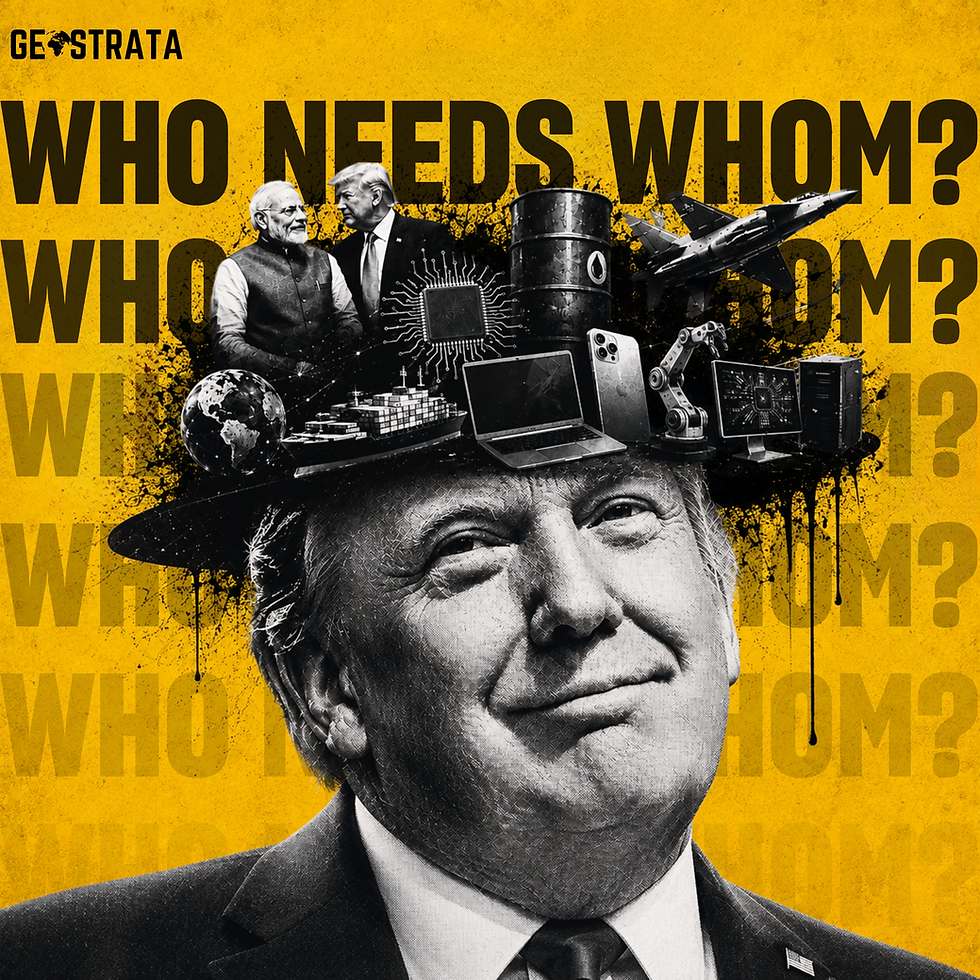
Illustration by The Geostrata
On the other side of the coin, we have our neighbours who are diametrically opposite, so close yet so far. Whether it be Pakistan sponsoring terrorism, Bangladesh undergoing a political turmoil following the resignation of Prime Minister Sheikh Hasina, the rise of Taliban in Afghanistan, Sri Lanka, facing its worst economic and financial crisis, following years of civil war, Myanmar’s troubled history, and the Maoist groups in Nepal, India has borne the brunt of it all.
We have seen the influx of Bangladeshi immigrants, illegally crossing borders and settling in different regions of India. Thereby straining resources and shifting the demographic landscape.
With political instability in Nepal, we witnessed the ideological influence of Maoist groups seeping into Indian states like Bihar and Chhattisgarh, subsequently igniting left-wing extremism.
Additionally, in light of the 2025 Pahalgam attack, the Islamic fundamentalist ideas have found ground due to Pakistan’s continued support for cross-border terrorism, especially in Jammu and Kashmir, paving the way for serious threats to our national security.
THE NEIGHBOURHOOD POLICY: ASPIRATIONS VS REALITY
Kautilya articulated long back that one can not be friends with our immediate neighbours. What is interesting to note is the fact that India has always contested for “Neighbourhood First Policy”, thereby pushing for strong and friendly relations with neighbours, leveraging into a consultative and outcome-oriented approach. But despite all of this, we find most of our neighbours often give us a cold shoulder, which yields subsequent strains.
CRISES OF NEIGHBOURHOOD: TRACING KEY ISSUES
After building upon the context, we trace the key issues which lead to the bone of contention. Starting with Pakistan, our primary string of tensions persists over the Kashmir dispute and the issue of cross-border terrorism. In addition to this, Pakistan’s continued support to terrorist groups like Lashkar-e-Taiba and Jaish-e-Mohammed poses a serious security threat to India, especially concerning Jammu and Kashmir.
In Bangladesh, the Teesta River water-sharing agreement remains a major source of discord, primarily arising due to resistance from West Bengal.
Additionally, issues like illegal immigration and episodes of trade disruptions, particularly India’s withdrawal of transhipment facilities, have aggravated the situation even more.
Historically, Nepal and India have shared warm and cooperative diplomatic relations, rooted in cultural, economic, and people-to-people ties. However, in recent years, the relationship has faced strains due to territorial disputes over regions such as Kalapani, Limpiyadhura, and Lipulekh, disagreements over water-sharing and hydropower projects, leading to prolonged delays in implementing joint ventures. Lastly, Kathmandu’s growing engagement with China has further strained the bilateral relations by adding a competitive edge.
With Sri Lanka, India continues to face challenges around the fishermen's conflict in the Palk Strait, signalling economic insecurity and blurred maritime boundaries. More so, the political significance of the Tamil population in both countries aggravates the tensions even more. For India, especially Tamil Nadu, the treatment of Tamil minorities in Sri Lanka remains a recurring concern that has influenced public sentiment and policy stances over the years, reaching its peak during the time of the LTTE.
In Myanmar, the military regime has created a volatile environment, leading to the influx of Rohingya refugees and increased insurgent activity along India’s northeast border. The situation presents a difficult balancing act for India, maintaining regional security as well as managing humanitarian fallout.
THE DRAGON IN THE BACKYARD
This crisis of the neighbourhood is further compounded by China, whose growing footprint in these countries is part of its strategy to encircle India both strategically and economically, commonly referred to as the “String of Pearls.”
The String of Pearls adhered to China’s effort to expand its influence across the Indian Ocean Region (IOR) through commercial and military ties.
The "pearls" here refer to ports, airstrips, and military bases. Therefore, through strategic economic ties, China aims to leverage its influence around the globe and India’s views as a direct threat to its national security and regional stability. For example, in Pakistan, the development of the Gwadar Port under the China-Pakistan Economic Corridor passing through the Indian territory has strengthened the military and economic ties between Pakistan and China, subsequently acting as a threat to India’s security.
In Bangladesh, China has invested heavily in infrastructure and defence, thereby weakening India’s long-standing partnership with Dhaka. Lastly, in Myanmar, China’s support for the military junta and control over critical ports like Kyaukphyu further complicate the situation and adversely affect India’s influence in its northeast.
After the US imposed a total tariff of 50 per cent on Indian goods, igniting a massive faceoff, recent tensions have drawn attention from China. China’s foreign ministry spokesperson Guo Jiakun stated that China opposes the misuse of tariffs and expressed support for India amidst the tensions with Washington.
Furthermore, India has been an important partner for the US in its efforts to balance China’s influence in the Indo-Pacific region by participating in groups such as the Quadrilateral Security Dialogue and I2U2.
However, recent disagreements, including US criticism of India’s purchase of Russian oil and stalled trade negotiations, have affected ties between the two countries. China has taken this opportunity to present itself as a more reliable partner. Chinese ambassador Xu Feihong highlighted China’s open trade policies compared to US tariffs on Brazilian goods.
In light of these developments, Prime Minister Modi is expected to visit China on 31st August 2025 for the Shanghai Cooperation Organisation (SCO) summit. This visit could be highly significant as it reflects shifting dynamics in the geopolitical landscape and demonstrates how India can maintain its relevance without relying solely on the support of the longstanding hegemon.
FUTURE OUTLOOK
Conclusively, in today’s complex geopolitical landscape, it becomes imperative for India to adopt a balancing approach for both its regional as well as global partners. The United States’ assistance to Pakistan, alongside its trade restrictions on India, such as the ending of GSP benefits and the imposition of tariffs on certain exports, highlight the changing dynamics of geopolitics. Thereby, these developments indicate the need for India to maintain strategic autonomy while avoiding dependence on any single global power binary.
BY URJA
TEAM GEOSTRATA


Comments