.png)


India's 80th Independence Day: Freedom A Continuing Journey

At the stroke of the midnight hour on August 15, 1947, India, which represents the unbroken chain of a civilisation that had once been denied the right to determine its destiny, reclaimed that right.
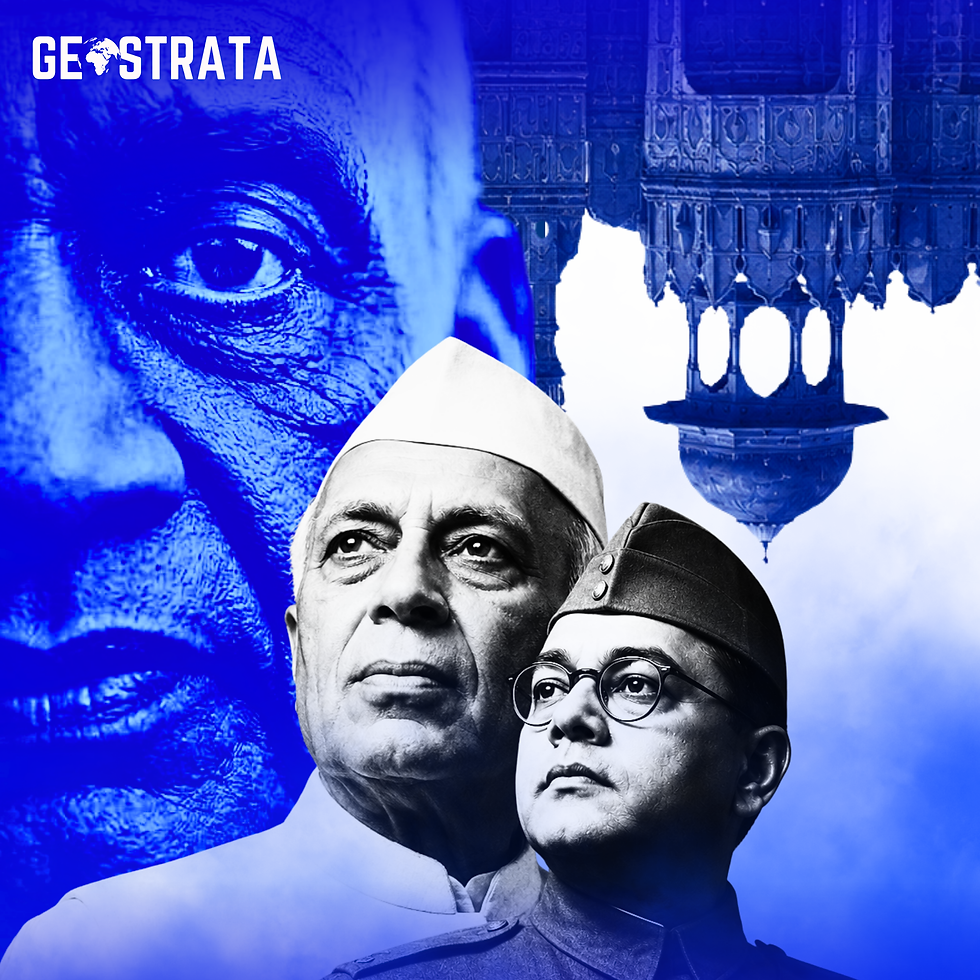
Illustration by The Geostrata
Our first Prime Minister, Pt. Jawaharlal Nehru called it a moment when India would “awake to life and freedom.” Hidden later in the same speech was perhaps a more important idea: the achievement of independence was only “a step, an opening of opportunity” towards what still remained to be built.
This is the essence of being independent, of being sovereign.
Nearly eight decades later, that distinction matters. And perhaps, it always should.
Now naturally, Independence Day is an act of remembrance. We remember the freedom struggle, the sacrifices that preceded 1947, the horrors of the violence of Partition, and the extraordinary political experiment that followed.
One that everyone around the world doubted, but one that we have successfully implemented, despite all the predictions of doom.
For all its glory, what one must remember is that there is a danger in remembering independence only as something that happened to us in the past. We must stay away from accidentally and implicitly turning freedom into a museum-piece phenomenon.
Daniel Kahneman, writing about human psychology, distinguished between the “remembering self” and the “experiencing self.”
The remembering self constructs the story of what happened; the experiencing self actually lives through it. This analogy, like any other, is of course imperfect, but it is absolutely useful for nations too, and in our case, necessary. India has a powerful remembering self when it comes to independence. Every August, we return to 1947. But the larger question is whether each generation also experiences independence by expanding what Indians are capable of doing with it.
Freedom, after all, was never meant to be static.
Let me elaborate on that argument a little further. For the generation of 1947, freedom meant ending colonial rule and reclaiming sovereignty. For the generation that followed, it meant building institutions, holding together an impossibly diverse republic, feeding a huge population, industrialising, and proving that democratic government could survive in conditions many observers believed were hostile to it, something that we talked about a little ago.
Our generation inherits a different India, and therefore organically we have a different test.
Political sovereignty today is only the beginning of meaningful independence. The world has changed completely ever since we attained independence. How the world order is changing is something that we are all aware of. The challenges of the twenty-first century, in my opinion, require us to think about independence as the capacity to participate in global affairs, without surrendering our ability to choose.
A country that cannot secure its energy, critical technologies, food systems, defence capabilities, digital infrastructure or essential supply chains can be politically free while remaining strategically vulnerable. That distinction is important. India’s rise will depend precisely on deeper trade, technology partnerships, capital, migration, ideas and engagement with the world.
There is also a more intimate dimension to independence.
Yuval Noah Harari has written about the extraordinary power of shared stories in allowing millions of strangers to cooperate. Whatever one thinks of his broader arguments, a nation is sustained partly by such a shared imagination: people who will never meet practically nevertheless agree that they belong to a common political project.
India makes that proposition unusually ambitious. It asks people distinguished by language, religion, geography and localised history to imagine a future together. It is this shared future where our tryst with destiny stays alive.
In that sense, the act of remembering Independence carries an obligation to not merely inherit India, but also to keep discovering it.
This endeavour requires learning more deeply about the movement that produced our freedom. This discovery of our freedom movement is of so much importance that I cannot stress this enough. It is not because our leaders or the numerous movements, both big and small, were flawless but because the independence that we cherish just so much, it emerged from disagreement, argument, organisation, sacrifice and competing visions of what India ought to become.
Gandhi, Nehru, Ambedkar, Bose, Patel, Bhagat Singh and countless other Indians did not all imagine the same country. The republic that emerged has been shaped by a manthan of all of those imaginations. Perhaps there is a lesson here for us. The further we travel from the generation that fought for freedom, the easier it becomes to mistake freedom for the natural condition of things.
But it is not.
Once, this country was not free. People whose names we know, and millions whose names we never will, changed that reality. We are fortunate enough to live among the fruits of their courage.
In that case, our responsibility is not just to remember the acts that got us independence every August 15, but rather to understand what freedom demands from us now.
To circle back to the iconic speech given on the eve of independence, in 1947 we inherited freedom, and what we build with it is our tryst with destiny.
TEAM GEOSTRATA


Comments