.png)


India's Deep State Dilemma: Understanding Evolving Dimensions of Security

Contemporary India’s strategic environment is like the Chakravyuh from the Mahabharat. The Chakravyuh was a military formation, and it had multiple layers to not only attack but also isolate the opponent from all sides. Abhimanyu knew how to enter it but not how to exit. The present situation of India is similar to that of Abhimanyu’s.
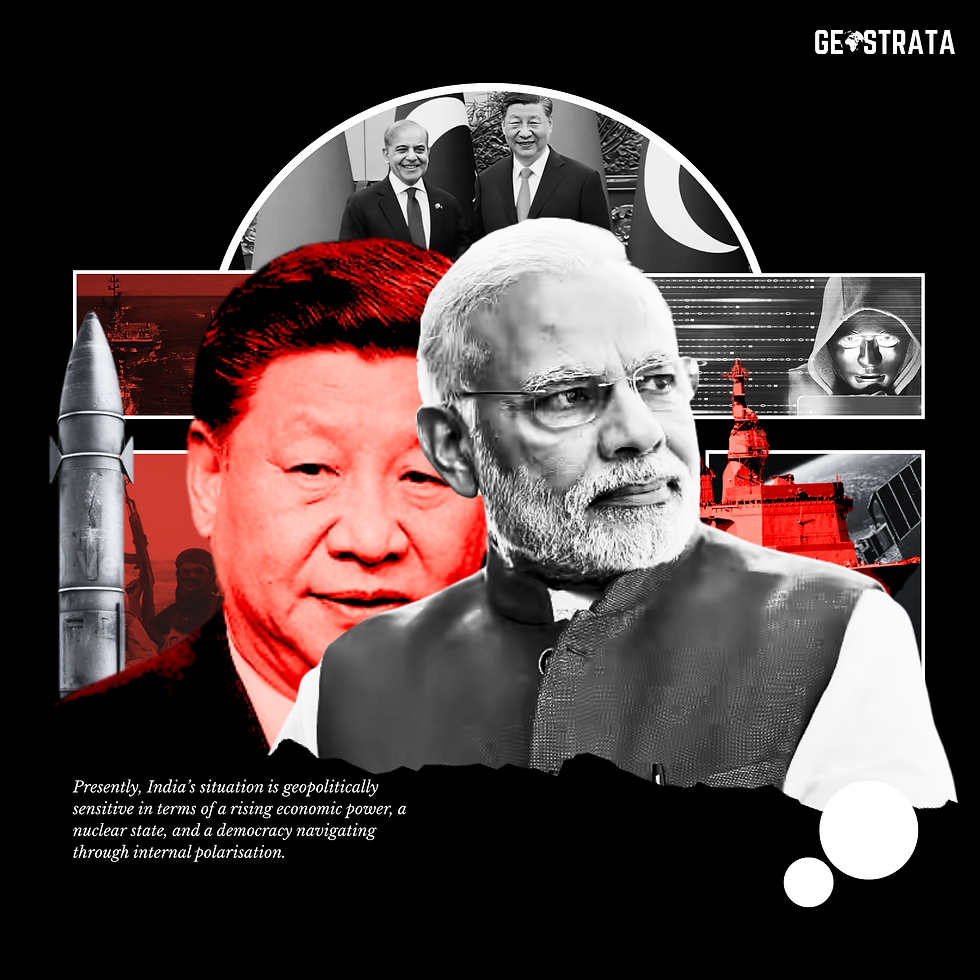
Illustration by The Geostrata
The layers of the Chakravyuh are a strong analogy to the present layers of encirclement faced by India. The first layer is the immediate military pressure from China and Pakistan along the Northern and Western border. Unresolved issues like the Line of Actual Control and recurring border stand-offs create a permanent two-front military dilemma for India.
The second layer is maritime containment, which further tightens the space in the Indian Ocean. The increasing influence of China through ports, logistic hubs, and infrastructure has created a strategic leverage for China around India’s maritime periphery. And the third layer is technological and economic dependency, which makes India vulnerable through supply chains, semiconductors, and a rare earth monopoly.
Presently, India’s situation is geopolitically sensitive in terms of a rising economic power, a nuclear state, and a democracy navigating through internal polarisation. Understanding the encirclement is therefore important and needs a deeper comprehension by moving beyond rhetoric.
THE DEEP STATE
The term deep state is quite misunderstood, as originally it refers to intelligence ecosystems, security establishments, proxy actors, and transnational strategic coordinators that continue to influence national policy regardless of which party is in power. But the word transforms when used geopolitically, as it refers to overlapping ecosystems of influence that work through intelligence agencies, military establishments, proxy networks, strategic lobbies, and transnational geopolitical coordination.
Wars are no longer fought with armies alone; they have new tools like supply chains, technology, diplomacy, currency, and psychological influence. From India’s perspective, the deep state includes cross-border terrorism, proxy militancy, information warfare, cyber operations, maritime pressure, and diplomatic narratives.
CHALLENGES
China-Pakistan Axis: The encirclement of India did not emerge in isolation; it is deeply rooted in historical experiences. Following Independence in 1947, India entered a permanent strategic fault line with Pakistan, leading to multiple wars, territorial disputes, and continued military hostility. And then the 1962 Sino-Indian war with China transformed relations strategically for both the nations, exposed the vulnerabilities, and marked the beginning of the long-term strategic alignment between China and Pakistan.
The most important factor in India’s deep state encirclement is the China-Pakistan partnership, as this relationship is not merely diplomatic but also military, geographical, and economic. Both China and Pakistan have emerged as a coordinated two-front challenge in creating a deep state around India. The China-Pakistan Economic Corridor is also a symbol of strategic convergence. It was initially framed as an economic activity, but it is viewed as a geopolitical instrument extending China’s influence deep into South Asia and the Arabian Sea.
String of Pearls & Maritime Encirclement: India's concerns extend beyond land borders and especially with respect to the maritime domain. China has expanded its economic and infrastructural footprints across the Indian Ocean region through ports, logistics, hubs, and energy corridors over the past few decades. This includes China’s involvement with countries like Sri Lanka, Myanmar, Bangladesh, the Maldives, Djibouti, and East African regions.
This network is popularly called as the String of Pearls and is a strategically positioned maritime space which is around India placed by Chinese-linked facilities.
While the Chinese side has always tagged them purely commercial and developmental, India views them as a dual-use tool that can be potentially used for surveillance, intelligence gathering, and military deployment when needed. This suspicion is reinforced by the military facility created in Djibouti. The Indian Ocean region is central to our long-term strategic security and also for trade, energy imports, and regional influence.
Proxy Warfare and Internal Destabilization: Pakistan’s security establishment, in supporting militant organisations and a cross-border insurgency network, is an instrument of asymmetric warfare, which has long been identified by India as it aims to strategically weaken India internally without triggering a full-scale war. The conflict in Jammu and Kashmir remains central to this debate, and security institutions in India have frequently pointed to infiltration networks, radicalisation pipelines, and terror financing of externally supported destabilisation.
Narrative Encirclement and Information Warfare: Modern geopolitical conflict unfolds through narratives rather than armies alone. It functions through a global information ecosystem shaped by social media, algorithms, foreign media influence, cyber threats, ideological activism, and digital propaganda. Digital information is the primary tool that is being used to weaken national cohesion and shape international perceptions of India. The debate over where to draw a line between legitimate criticism and coordinated information warfare continues and creates a deep problem.
DOCTRINE OF NATIONAL RESILIENCE
While India has been facing a long-term strategic encirclement, the challenge is complex. It requires a state response combining multiple dimensions. The threat is not only territorial aggression across borders but a multidimensional pressure that is being designed to slow India’s rise, fragment internal cohesion, and increase dependence.
The first pillar of this response strategy is economic strengthening, because no nation can remain independent while remaining heavily dependent on supply chains, foreign technologies, and energy vulnerabilities. In this light, India’s push towards manufacturing expansion, infrastructure development, semiconductor capability, digital payments architecture, defense indigenisation, and Atmanirbhar Bharat are not just economic policies but a geopolitical defense designed to reduce coercive leverage from rival powers.
Similarly, India must continue to strengthen its maritime strategy in the Indian Ocean through naval modernisation, surveillance systems, island partnerships, port diplomacy, and Indo-Pacific cooperation with countries like France, Japan, Australia, and the United States, to prevent commercial access from being turned into hostile encirclement.
The Malabar Exercise with the US, Japan, and Australia reflected India's effort to strengthen interoperability and maritime deterrence in response to China's growing regional footprint.
At the regional level, India must come up as a dependable nation for other countries in South Asia by becoming a reliable partner in development through connectivity projects, energy integration, trade access, humanitarian assistance, digital infrastructure, and rapid crisis response, as seen in the case with Sri Lanka, Bhutan, Nepal, and the Maldives in recent years.
India must also adapt to the realities of modern warfare tools and develop a long-term doctrine of an information warfare system capable of countering disinformation, cyber manipulation, ideological radicalisation, and psychological operations. At the same time, intelligence reform and inter-agency coordination must evolve to address modern multidimensional threats that blend these tools into a single ecosystem.
India's evolving security posture, including surgical strikes, intelligence modernization, border infrastructure expansion, and calibrated deterrence, reflects movement in this direction. Exercises like Vijay Prahar and Operation Sindoor emphasize rapid mobilisation, precision strikes, counterterror readiness, and multidomain deterrence.
India's greatest defense lies in national cohesion, because no external adversary can destabilise a society that is economically aspirational, institutionally trusted, and politically resilient. Hence, reducing polarisation, strengthening governance, ensuring economic inclusion, and preserving institutional credibility are not merely domestic concerns but strategic necessities.
Encirclement of India is multidimensional and not only military. While Abhimanyu was isolated and young, India is a nuclear power, a major economy, and a demographic giant. It is militarily powerful and an influential nation in today’s geopolitical world. Whether viewed from the China-Pakistan axis, hybrid warfare, or narrative manipulation, the broader objective remains consistent- to constrain India's emergence as an independent civilisational power that is capable of reshaping the balance of power in Asia and Indo-Pacific.
Yet, history is testament to the fact that rising powers are always resisted before being accepted. India's challenge is not just surviving external pressure but outgrowing economically, technologically, and rewriting narratives.
BY VASUDHA
TEAM GEOSTRATA


Thanks for sharing this information. I've been looking for the Carrier Transicold starter motor 25-39476 for one of our refrigeration units. Before ordering, I'd like to know if anyone has used this part recently. How has its performance and reliability been over time? Any feedback on fitment or installation would be appreciated.
An interesting perspective on a complex topic. Articles like this encourage readers to think about different factors that shape important decisions and the value of looking at issues from multiple viewpoints. The same attention to detail is useful in professional development too, where a professional cover letter writing service can help present skills and experience in a clear and well-structured way. Thanks for sharing this thoughtful read.
More people appear to be evaluating the Best Kitchen Renovation Companies in Toronto before beginning home upgrades. Planning ahead often leads to better results.