.png)


CARs on a Green Road?: Evaluating the BRI’s Sustainable Reorientations (The Case of China and Central Asia)

Updated: Mar 29
As BRI completes twelve years since being launched on the 7th of September, 2013, the Belt and Road Initiative (BRI) is pivoting towards several strategic transformations in several important aspects, like the international engagements that it seeks to facilitate between its signatories.

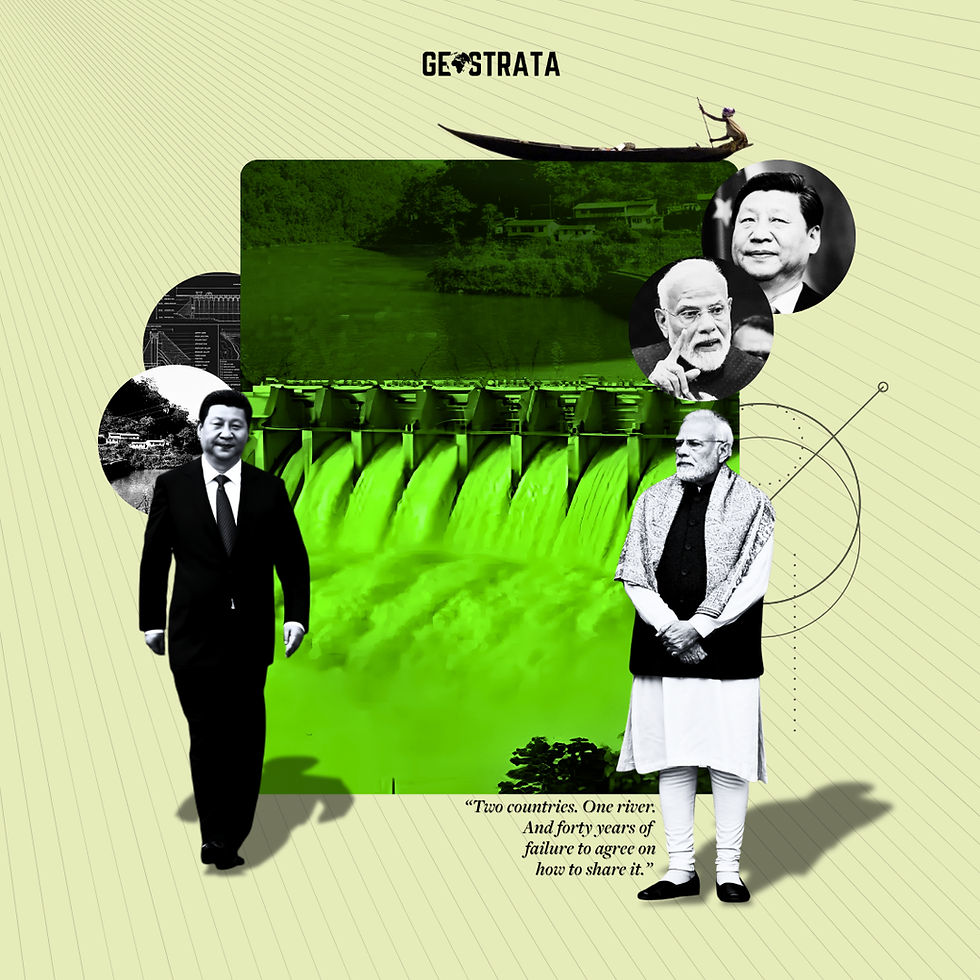
Illustration by The Geostrata
Initially launched with the objective of ensuring deeper regional integration and cooperation between China and its neighbours, the Belt and Road Initiative has since come to manifest a particular perspective for the future of globalisation and international relations that prioritises the idea of a ‘shared future’ for the world, wherein nations may be able to constitute a community dedicated to finding a greater degree of common understanding on matters of international developmental and security interests.
President Xi Jinping has thus positioned the BRI as a key driving force in achieving global peace, stability, and development, with China at the forefront of facilitating and deepening avenues through which nations can unite their efforts towards outcomes for the collective good.
"GREENING" THE BRI
In this regard, China’s championing for the ‘greening’ of the BRI — which is expected to account for 66% of global carbon emissions by 2050 — and efforts to reorient the technological capacities of its partners towards the production of clean, renewable energy to power their own development, comes as a move with the possibilities for major positive implications for the future of international commercial networks.
Gearing the BRI’s resources towards enabling the financing of sustainable infrastructural developments has been a cause that has seen important moves towards institutionalisation in the project’s strategic plans since 2018. Among the notable efforts in this direction was the publishing of a report, the Green Investment Principles for the Belt and Road (GIP), which details processes towards enabling the achievement of the BRI’s sustainability strategies and investments.
This was the first of several reports that aim to institute a comprehensive roadmap towards mitigating climate change and enabling sustainable outcomes as future iterations of the BRI develop, as well as possibly aiding nations to better develop their own compliance with the UN’s Sustainable Development Goals (SDGs).
More notably, China — which accounts for the majority of the world’s consumption of coal — has made commitments towards totally divesting itself from financing and developing coal-power projects by 2035.
This shift has also been marked by Beijing’s decision to move towards the ‘Small and Beautiful’ Model, an investment approach that prioritises a focus on projects that are smaller in scale than those undertaken in the BRI’s first decade, but chooses to focus on the development of high-quality outcomes in more important market sectors, such as energy.
This pivot is also marked by a greater focus on making projects sustainable from the point of view of both economics and sustainability. A prime example of this may be seen in the choice of engagements that China has chosen to pursue when building the BRI with the Central Asian Republics (CARS).
CHINA-CENTRAL ASIA RELATIONS THROUGH THE BRI
The year 2025 saw China’s annual engagements related to energy reaching new highs at around USD 42 billion, approximately USD 9 billion of which went to the development of green energy projects. A further USD 23.2 billion was invested in engagements related to clean tech. The venture into clean energy has also necessitated a corresponding rise in investments related to the mining and processing of minerals, which are critical to the development of the requisite technologies.
The first half of 2025 saw around USD 24.9 billion directed towards such endeavours, while Africa and Central Asia, which hold some of the largest reserves of these commodities, received the largest amount of BRI engagements at USD 39 and 25 billion respectively.
To the Central Asian Republics, the BRI represents a prime outlet to enable better connectivity with global markets, tap into China’s vast technological and economic resources to diversify their own infrastructural and energy apparatuses, develop a strong green energy program, overcome power shortages, boost various spheres of market production, and especially gaining them greater economic and geopolitical security than might be enabled by their traditional reliance on Russia and its energy exports.
China’s aims to ramp up its engagements in Central Asia may also be of great cultural significance, given that these regions were once key commercial nodes of the Silk Routes, which the BRI is ideologically based on. In the present, they can be seen as the result of several natural synergies stemming from their strategic interests in cooperation, coupled with China’s position as a global leader in renewable energy and mineral processing, and Central Asia’s access to mineral reserves and favorable geographic conditions for generating energy from solar, wind, green hydrogen, and hydropower.
Both parties stand to experience significant benefits from the bolstering of logistical dynamics along the Trans-Caspian International Transport Route (TITR), a key artery in the China-Central Asia-West Asia Economic Corridor.
Augmenting the BRI’s capacities in Central Asia could build the region into a critical point of overland commerce in Eurasia, ensuring important economic opportunities for the Republics, as well as strengthening their bilateral ties with China over the question of energy imports.
The China-Central Asia-West Asia Economic Corridor could be an important institution in allowing China to circumvent the ‘Malacca Dilemma’, ensuring the reliability of its oil imports from the Middle East, as well as with the Republics, whose central position in Eurasia makes them a prime conduit for gas pipelines. This equation could be further transformed in favor of green energy if the members of the Central Asia Regional Economic Cooperation Program (CAREC) are able to bolster cooperation towards green energy trade via the Caspian Green Energy Corridor.
CONCLUSION (IMPLICATIONS OF THE 'GREEN' BRI FOR CENTRAL ASIA)
The establishment of China-Central Asia Summits since 2023 has presented a dedicated forum for these collaborations, which have so far seen several promising projects; the International Renewable Energy Agency (IRENA) estimates that there has been a 26.6% increase in Central Asia’s renewable energy capacities.
Among the notable projects in stemming from this regional collaboration are hydropower, photovoltaic and wind power projects in Uzbekistan, Kyrgyzstan and Kazakhstan, the deepening of energy security measures between China and Turkmenistan over the Central Asia–China Gas Pipeline network, and provisions for the development of new energy locomotives and green rail transit networks, and deeper integration between the BRI and Nurly Zhol infrastructure project to boost exchanges between China and Kazakhstan.
The five Republics have made further commitments to ensure that the environmental degradation generated from earlier uranium mining projects under the Soviet Union is properly combated, before considering the possibility of tapping into nuclear energy to serve their clean energy requirements. These considerations may also serve to deepen ties between Central Asia and China, which has made notable innovations in the area of nuclear power and aims to construct over 150 new reactors on the path to carbon-neutrality by 2060.
While the reorientation of the BRI towards sustainability has been met by criticisms of purported ‘greenwashing’, a high potential towards furthering environmental degradation through the mining and processing of minerals, and China’s continued reliance on fossil fuels to meet the majority of its energy requirements, the potential that it holds towards making climate positive actions a fundamental aspect of global commercial and developmental networks, is undeniable.
BY SIDDHARTHA
COVERING PEOPLE'S REPUBLIC OF CHINA
TEAM GEOSTRATA


If you like word games, you might enjoy Canuckle game online. It focuses on Canadian-themed words, which makes it a bit more unique compared to other puzzle games I’ve tried lately.