.png)


Why are the United States and Iran Still Fighting?: The Strategic Logic of Unresolved Conflict Between the US and Iran

WAS THE CEASEFIRE DESIGNED TO STOP THE WAR?
The framing that the US and Iran are “still fighting” despite the Islamabad MOU contains an assumption that contains more than meets the eye. The assumption that the ceasefire was designed to stop the war is largely contradictory; it was designed to manage the war’s tempo while each side pursued objectives that were, to begin with, reconcilable at the negotiating table. Eleven days after Trump and Pezeshkian signed remotely from Versailles and Tehran, CENTCOM struck ten Iranian military targets, and IRGC retaliated against American installations in Bahrain and Kuwait.
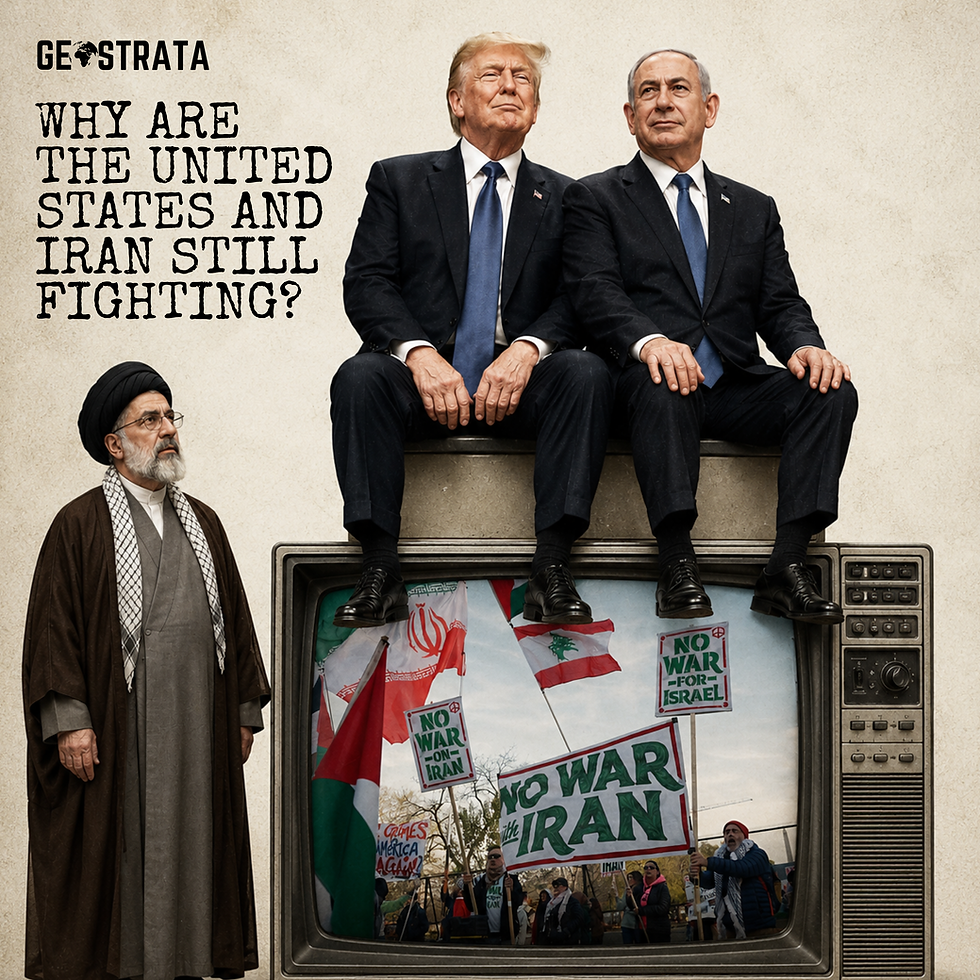
Illustration by The Geostrata
This is not an exact aberration from the agreement’s logic; it is what the agreement’s logic is. The structural problem does not arise from the necessity of better diplomacy, but rather from factors that can be solved through better diplomacy, better sanctions-relief sequencing, or more discussions with Islamabad. It is fundamentally a regime-type problem. This war is not between two democracies. It is between a status quo superpower marred by the constraints of domestic electoral politics and a theocratic revolutionary state marred by the requirement of ideological survival.
The same settlement can never satisfy the prevalent structures on both sides.
In their current form, the issues up for negotiation remain unresolvable, and it is not the nature of the agreement that would have to change. A change like the actors would be needed for this deadlock to finally end.
WHY DOES HEROIC FLEXIBILITY FOR TEHRAN HAVE A FLOOR
Western negotiators generally assume that the opposing party is always a rational actor optimizing cost against benefit. However, Iranian strategic behaviour can be largely better explained by a concept officials themselves point to in the narmesh-e-qahramaneh or ‘heroic flexibility’. The concept was first deployed to justify the 2013-2015 JCPOA negotiations. The concept is a license-granting mechanism that grants permission for tactical compromise only when it can be narrated domestically as resistance and not surrender.
The distinction laid down in the doctrine is the single most important piece missing from American assumptions because it finally explains a pattern that otherwise appears irrational on Iran’s part in the absorption of catastrophic material costs, the assassination of a Supreme Leader, the destruction of Fordow and Natanz, and an economy in free fall marred with protests. Even under all this pressure and domestic strife, the doctrine refuses permission for the concession that would at least alleviate these issues for the Iranians.
Iran’s 1979 constitution in Articles 152 and 154 encodes the export of revolutionary resistance as a constitutional mandate.
Enrichment capability and the proxy network are not bargaining chips that Iran is just holding onto by choice. These elements are the operational initiation of the regime’s identity from a constitutional standpoint. Iran cannot trade this legitimacy away for an MOU that would cause the collapse of this authoritarian system that exists to avoid. This is why Mojtaba Khamenei could approve the MOU while publicly noting he himself held a different view on the matter.
This very formulation sees the doctrine in action in the preservation of a revolutionary face while permitting tactical retreat. However, this positioning also tells us where the floor of this doctrine is. Enrichment capability is negotiable in degree, not in principle. This is because it is the principle that provides legitimacy to the IRGC’s domestic monopoly on coercive power in a nation where the revolutionary narrative does not move its own people. The rule now, increasingly, persists through fear and not conviction.
A regime facing legitimacy issues already from within cannot afford to buy into an agreement that would see its legitimacy hollowed even further.
BARGAINING CHIP TO EXISTENTIAL DETERRENT
There exists an even more dangerous shift that the ceasefire fails to capture, because it occurred during the war and affected the meaning of the very thing being negotiated. Before February 2026, Iran’s nuclear programme functioned as a tool of classic bargaining leverage. The card was used almost always for sanctions relief, like in 2015.
After the February-March strikes that killed Khamenei, Hossein Salami, and Amir Ali Hajizadeh, and after American strikes destroyed enrichment infrastructure at Fordow, Isfahan, and Natanz, the damage caused a shift in Iranian deliberation on the function of the programme: from leverage to be traded for security, to the only mechanism perceived to provide security at all. This is the reason why the 60-day deferral of the nuclear question is not a diplomatic delay but rather an impossibility dressed up as a delay.
For Tehran, conventional deterrence has just failed catastrophically because Israeli and American airpower reached the Supreme Leader himself, something that should be impossible. Iran has none. Its proxy network has been degraded by Hezbollah's leadership decapitation, Hamas's near-elimination, and the loss of the Syrian land bridge after Assad's fall, which eliminated significant accumulated Iranian strategic investment, and it can no longer perform its historic function of imposing the costs that deter direct attacks.
This is why the demand for "zero enrichment" is not merely aggressive; it is functionally equivalent to a demand for unilateral disarmament in the domain the regime now believes stands between it and a second decapitation strike. No government would sign that under a 60-day clock with no security guarantee, especially not from a counterparty that withdrew unilaterally from the last guarantee it signed.
TRUMP CANNOT OFFER WHAT IRAN ACTUALLY NEEDS
Iran’s own rigidity is not the only reason why the two sides are still fighting. The American constraint is equally structural, even with democratic accountability rather than ideological legitimacy. The Trump administration's stated objectives are threefold: destroy Iran's nuclear program, degrade its power-projection capability, and set conditions for regime change, with the third goal treated as the most flexible but the least negotiable, since walking it back would concede that two years of maximum pressure produced no permanent damage.
An administration that has invested political capital in the framing of Iranian capitulation cannot pivot to offering Iran the one thing that would satisfy its post-strike security logic with a binding and sanctions-backed security guarantee against future strikes without appearing to reward the very government it spent a year trying to topple.
Congress, which has rejected nine measures attempting to constrain executive war-making authority since March 2026 and which is already attacking the MOU's asset-release provision, further forecloses this option. The structural result is that the United States can credibly offer sanctions relief and trade normalisation as transactional instruments, but not the security guarantee Iran requires.
This is why the MOU is not a failed peace treaty but rather a performative agreement designed to manage escalation optics rather than transform the bilateral relationship. Both governments need the mirage of de-escalation in the form of Trump claiming a deal after 38 separate premature claims of imminence since March, and for Iran to demonstrate it forced the world's dominant military power to the table. Both needs are satisfied by signing.
THE MULTIPOLAR DEADLOCK
Israel was party to the strikes that killed Khamenei and destroyed the nuclear infrastructure Iran is now trying to rebuild, and yet Israel is not a signatory to the MOU and has stated the ceasefire excludes Lebanon. The very prospect of Israel in this equation exposes an age-old contradiction in American foreign policy. Since 1979, Washington pursues diplomacy with Iran now and then, but every single attempt had the pre-requisite of accommodating Israeli security concerns and domestic political influence in the United States.
Israel has always maintained that Iran’s attempt to access a nuclear weapon, proxy networks, and missile capabilities pose an existential threat to Tel Aviv.
Regardless of what the United States negotiates standalone, Tel Aviv will almost always reserve the right to act militarily against Tehran. As a result, it is nearly impossible for the US, in genuine negotiation with Iran, to guarantee that Israel won't take unilateral action even if Washington offers it on their part. From the Iranian perspective, this makes American security guarantees fundamentally incomplete because the country most likely to launch strikes against Tehran in the first place will remain out of any signed agreement.
This same pattern repeats itself in the current situation. Hezbollah, whose degradation is core to Israel's objectives, has rejected the Washington framework outright as a humiliation and continues independent of anything Tehran signs. China has its own interest in Hormuz stability. Pakistan, as the former, would want to claim diplomatic success that does not truly represent the actual little leverage it may have. This produces a mismatch between the bilateral decision-making and the multilateral violence.
Every party outside the formal MOU has the capacity to violate it and holds zero formal obligation under it. IRGC strikes on Bahrain and Kuwait on June 28 were retaliation for American strikes that were retaliation for an Iranian strike on a tanker rerouting around Iran's management of the Strait. Each link in that chain is rational because of the relevant actor's incentives and lack of coordination with the document that is supposed to govern all actors.
BY KRISH
TEAM GEOSTRATA


Huawei router offers reliable connectivity for accessing informative health and wellness content. This episode provides an interesting discussion about menopause, cardiovascular health, hormones, and HRT, while highlighting important factors women should understand about heart health and metabolic changes.