


Weaponization Of The Final Frontier: What America's Space Disclosure Means To The World

THE SCENARIO
For decades, outer space was secured without being openly treated as a battlefield. Satellites gradually became essential for intelligence, communication, and navigation making them increasingly important for national security. Yet the deployment of weapons in orbit is still a significant threshold where Governments generally avoid openly acknowledging publicly space as another arena of warfare.
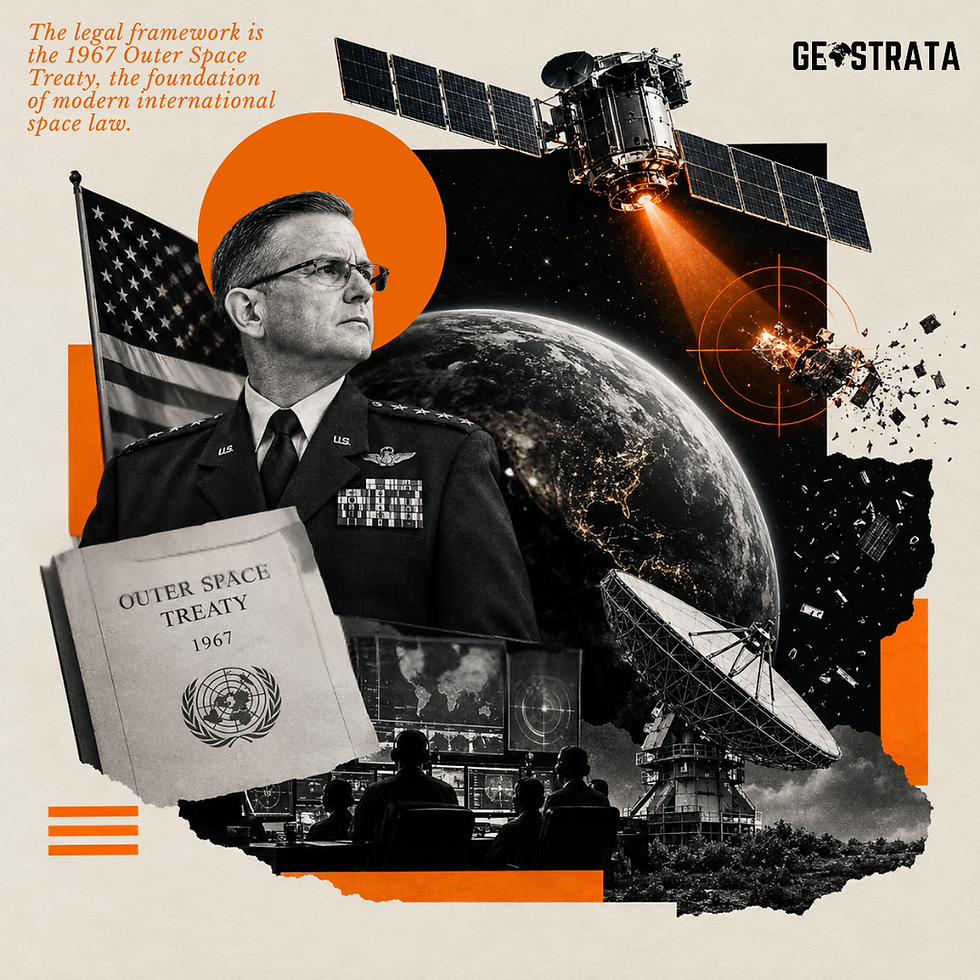
Illustration by The Geostrata
On September 14, 2026, speaking at the Air and Space Forces Association's annual conference in National Harbor, Maryland, US Secretary of the Air Force Troy Meink disclosed that the United States has "on-orbit space control weapons capable of defending the Joint Force against hostile adversary action." The US Space Force also confirmed the existence of these capabilities, and Chief of Space Operations General Douglas Schiess reinforced this.
But the precise nature of these systems, whether offensive or defensive, and whether kinetic or non-kinetic has not been disclosed. A kinetic weapon physically destroys its target while a non-kinetic weapon disrupts them through methods like jamming or directed energy, without creating debris. Most analysts believe the deployed systems are likely non-kinetic, but Washington has yet to confirm this.
The announcement doesn't mean that the United States has placed conventional missiles in orbit, its importance lies here that Washington has now openly acknowledged that it maintains weapons for space control purposes in orbit.
That raises a larger question: is the international community moving into a phase in which space is not only militarized, but also increasingly treated as an operational warfighting domain? The legal framework is the 1967 Outer Space Treaty, the foundation of modern international space law. Article 1 of this treaty states that the exploration and use of outer space should be carried out for the benefit and in the interests of all countries.
Article 4, the treaty's core arms control provision, prohibits states from placing nuclear weapons or other weapons of mass destruction in orbit, installing them on celestial bodies, or stationing them in outer space. It also prohibits military bases, weapons testing, and military actions on the Moon and other celestial bodies. As the Arms Control Association notes, the treaty had 115 States Parties as of June 2024.
But Article 4 does not constitute an overall prohibition on conventional weapons in outer space. This distinction is important when interpreting Washington's announcement. The US counterspace capabilities, its existence does not automatically constitute a violation of the treaty. The difficulty is that technology has advanced faster than the rules governing military behavior in orbit.
FROM COLD WAR TO PRESENT
During the Cold War, the United States and the Soviet Union built satellites for communications, navigation, and missile warning. Space infrastructure became closely tied to military operations on Earth long before governments openly discussed the possibility of fighting in orbit. The United States conducted a direct ascent anti-satellite test in 1985, destroying a defunct weather satellite and generating 285 trackable debris fragments.
China destroyed one of its own weather satellites in 2007, generating 3,533 trackable pieces of debris. Russia destroyed the Cosmos-1408 satellite in a direct ascent anti-satellite test in 2021, generating 1,807 fragments. India demonstrated a similar capability through Mission Shakti in 2019, generating 130 tracked pieces of debris. Unlike the US, Russia, and China, India has conducted only one ASAT test to date.
Now the competition has become more difficult to separate from broader military operations.
In May 2024, the United States said Russia had launched a satellite as a counterspace weapon into nearly the same orbit as an American reconnaissance satellite. In February 2026, two Russian satellites reportedly intercepted the communications of at least a dozen European missiles since the start of Moscow's full-scale invasion of Ukraine.
China and Russia are also deepening cooperation on capabilities aimed at degrading, disrupting, or destroying military satellites and commercial constellations such as SpaceX's Starlink- a network that Musk is now actively pushing into India as well which now holds over 10,000 active satellites in orbit and has become deeply embedded in military communications making it both a strategic asset and a high-value target.
Star link’s role has grown beyond internet connectivity. By 2026, SpaceX has secured major military contracts including a deal to integrate Star link into America's Golden Dome missile defence system.
What began as a commercial broadband network has quietly become a critical piece of US military infrastructure in orbit. When US officials said that they are responding to real and proven threats, there is evidence behind the broader concern. But the strategic problem is that every major power can present its own capabilities in similar terms. A new system is described as a response to an existing vulnerability; the other side then sees the same system as preparation for a future attack. The result is a cycle in which capabilities introduced for protection can also create new incentives for competition.
THE SECURITY DILEMMA IN ORBIT
Washington has presented the disclosure primarily in terms of defence and deterrence. But a capability that one state considers defensive may look offensive to another. This is the classic security dilemma. What one side sees as deterrence can therefore contribute to the insecurity of the other. As one analyst at the Secure World Foundation observed after the announcement: "What this does is normalize weaponizing space."
The September disclosure is significant for another reason: For other states, that uncertainty about orbital weapons' precise characteristics, intended targets may create new questions about how such systems could be used during a crisis.
The Meink announcement also needs to be understood alongside Washington's wider investment in space-enabled defence. On January 27, 2025 the 58th anniversary of the Outer Space Treaty President Trump issued Executive Order 14186, establishing what was initially called the Iron Dome for America and subsequently renamed the Golden Dome. The executive order directed the development of a layered missile-defence architecture that included space-based tracking and sensing, space-based interceptors, and other capabilities.
Space is becoming more deeply integrated into missile defence, military communications, and surveillance. As these systems become more important to national security, they also become more attractive targets. This creates a difficult paradox: the more dependent militaries become on space, the greater the incentive to protect those assets and the greater the incentive for opponents to find ways around that protection.
THE DEBRIS PROBLEM
There is another consequence of space weaponization i.e. debris. A kinetic strike that destroys a satellite can generate large quantities of debris travelling at orbital velocity. That debris can threaten unrelated spacecraft operating in the same environment, not only the military assets of rival powers, but commercial satellites, weather systems, navigation infrastructure, and scientific instruments belonging to countries with no role in the conflict.
The Secure World Foundation's 2025 report found that counterspace testing by the United States, Russia, China, and India has already generated 6,851 catalogued pieces of trackable debris, of which 2,920 pieces remain in orbit. These figures point to a problem that extends beyond great power rivalry. Orbital congestion is already affecting the routine operation of satellites, and countries that are not directly involved in counterspace competition can still face the consequences of actions taken by others.
WHAT COMES NEXT
The September 2026 disclosure did not create the militarisation of space. It made the shift from largely ambiguous counterspace preparations to openly acknowledged orbital weapon capabilities. The 1967 Outer Space Treaty was negotiated when humanity was only beginning to understand the strategic importance of orbit. Nearly six decades later, the challenge extends beyond keeping weapons of mass destruction out of space.
Military, commercial, and civilian systems now operate in the same increasingly crowded environment, making the consequences of conflict much harder to contain. The question after Washington's disclosure is therefore not only about which states possess weapons in orbit. It is whether the space powers can develop enough transparency, and crisis-management mechanisms to ensure that competition between them does not damage the orbital environment on which all states increasingly depend.
BY AYUSHI NIGAM
TEAM GEOSTRATA


Comments