.png)


The Rupee’s Quiet Rebellion: Small Trade Share, Big Geopolitical Signal

For decades, the world has run on the dollar. Oil is priced in dollars, most trade invoices are written in dollars only, and when a central bank anywhere from Lagos to Jakarta wants to build a reserve safety net, it still reaches for US Treasury Bonds First. This is not an accident, and it never should be. It is the result of America’s size, for its deep and liquid bond markets and the kind of institutional trust that took decades.

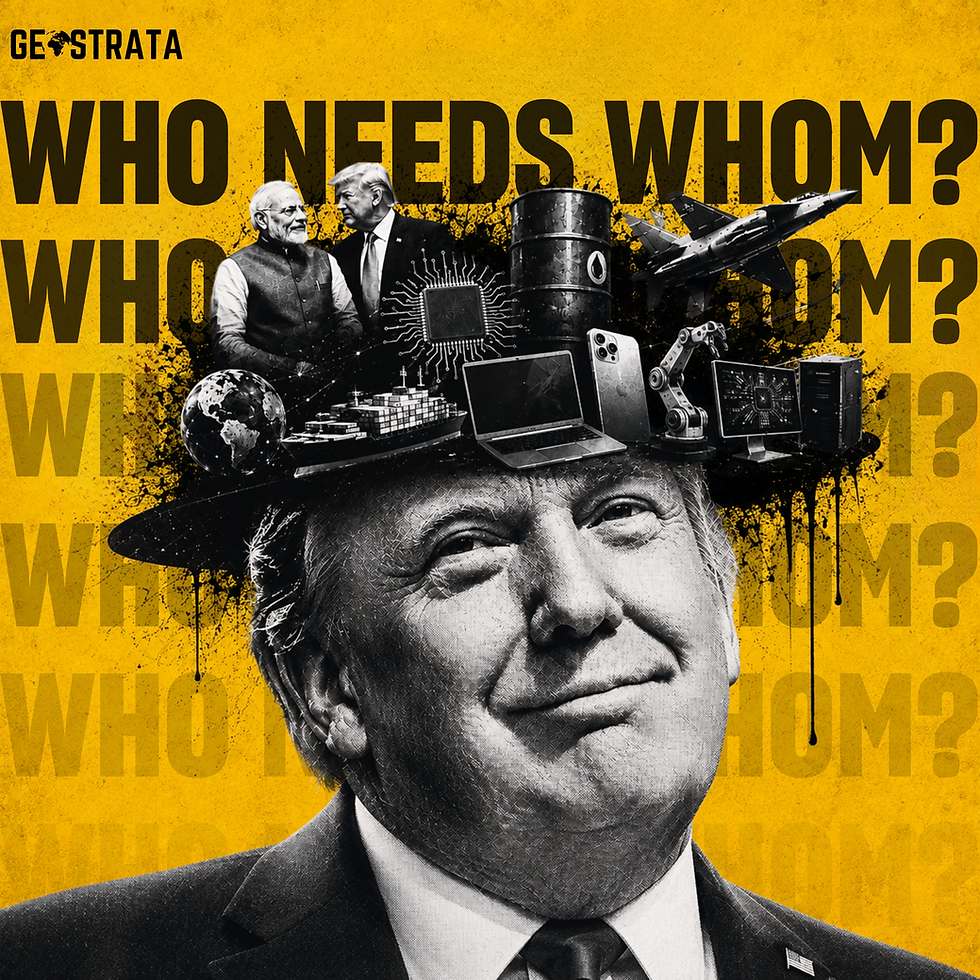
Illustration by The Geostrata
But lately a question comes up that used to sound almost unusual is being asked in serious policy circles. The question was “What happens when dollar shares actually start shrinking, obviously not just in headlines, but in real mechanisms of trade and reserves? and where does a currency like the Indian rupee fit into that story instead?
This is not the forecast of the dollar’s collapse, nor should it be read as one.
What it does suggest is that the direction of change deserves attention and India's own push towards rupee trade settlement offers a useful real world case study of what a more “multipolar” currency system could look like in practice.
THE DOLLAR IS STILL KING, BUT THE CROWN SITS A LITTLE LOSER
Starting with the numbers because in most of the cases they started telling a more complex story. According to the IMF’s Currency Composition of Official Foreign Exchange Reserve (COFER) data, the dollar’s share of global reserves stood at about 57% in the first quarter of 2026, actually it's up slightly from the previous quarter. The euro was a distant second at roughly 20% with the yuan which is typically sitting at under 2%.
In terms of foreign exchange turnover, the dollar grip is even tighter, showing up on one side of close to 90% of all currency trades globally as the Bank for International Settlements in the most recent survey. So the dollar is not being dethroned anytime soon but two trends are worth noting here, Firstly the dollar’s current 57% share of global reserves is down from over 70% in the year 2000 which is considered as a slow generational drift rather than a sudden break.
Secondly and this is the part that gets less attention, a large part of that dollar share is now propped up more by exchange rate valuation effects than by any genuine new appetite for dollar assets. Researchers at CEPR have pointed out that the changes in the aggregate dollar reserve share can be misleading because they mix together the actual portfolio preference shifts with simple currency valuation mathematics. Take that away and the underlying erosion in dollar preference looks a bit more real than the topline number suggests.
Politics has played its part in this shift too and only one episode which really stands out.
When all G7 countries, namely the United States of America, Canada, France, Germany, Italy, Japan and the United Kingdom froze roughly $300 billion of Russia's central bank reserves in early 2022, it sent a message far louder than any policy speech could, moreover dollar reserves are not truly “yours” until the country holding them decides who they are, that lesson wasn't lost on Moscow and it wasn't lost on Beijing or New Delhi either, which had its own uneasy moments with Washington over the years, whether it's Russian oil purchases or trade tariffs.
The response has been quiet but measurable. Central banks worldwide have been buying gold at a pace of roughly 50 tonnes a month since 2022, which is treating it as a reserve insurance that no sanctions regime can touch. At the same time, a handful of countries have started building parallel trade settlement channels that don't run through the dollar at all, which is not to replace it but to have an exit route ready if they ever need one.
ENTER THE RUPEE
India's own answer to this moment has been modest, deliberate and worth watching closely. In July 2022, the Reserve Bank of India (RBI) introduced a mechanism which cuts the dollar out as a middleman entirely, allowing Indian exporters and importers to invoice and settle trade directly in rupees, using what are called Special Rupee Vostro Accounts or SRVAs.
These are essentially rupee accounts that foreign banks open with authorised Indian banks, which lets a trading partner pay for Indian goods in rupees rather than routing everything to dollars first.
Four years later, this system has grown from a tiny test into something that is starting to get real support. By early 2026 roughly 123 correspondent banks from about 30 countries had opened 156 SVRAs across 26 Indian banks. Countries as varied as Russia, Sri Lanka, Mauritius, UAE and the several Gulf states have shown genuine interest, often precisely because the geopolitical disruptions of the last few years made pure dollar routing more complicated.
In February 2026 alone, traders settled more than ₹14,000 crore or roughly $1.5 billion, on imports paid for directly in rupees which went up sharply from the previous month. In fact data for the first eleven months of the year showed a 45% jump in these rupee payments compared to the year before. But here is the honest truth that every serious article on this topic must mention that imports paid for in rupees still make up about 2.35% of India’s total imports.
WHY IS INDIA DOING THIS ANYWAY?
So why is India pushing this, when the trade volumes involved are still so small? A few reasons make sense once you look at it from India’s own perspective.
First, it saves foreign money, India spends much more than it earns and it has to buy almost all of its oil from other countries. Buying oil in dollars increases the demand for dollars and makes the rupee weaker. Even by moving a small part of trade into rupees means India needs fewer dollars. This protects India's financial savings, which would otherwise be spent to keep the rupee steady.
Second, sanctions insulation is something that gets underrated in most coverage of this. India watched Russia's reserves get frozen almost overnight and that's not something New Delhi has forgotten. India has watched what happened to Russia’s frozen reserves with real attention. A country that trades more in its own currency or in bilateral local currency arrangements has a bit more room to move when Washington’s sanctions pen starts moving.
Third, there's a simple cost angle. Right now, when India trades with a country like Sri Lanka, the rupee usually gets converted to dollars first, then the dollars get converted to Sri Lankan rupees. Two conversions, not one. Banks charge for each swap, and prices can move in the gap between them, so an exporter might quote a rate today and by the time the payment actually clears through two currency changes, the numbers don't quite match anymore. It's not huge on a single transaction, but across thousands of trades a year, it's a lot of money quietly going to banks instead of staying with the businesses. So skip the dollar step and trade rupees straight for dirhams or Sri Lankan rupees, and most of that cost is gone.
Fourth, there's a real advantage in getting more countries to use the rupee, one that has usually nothing to do with prestige. RBI Deputy Governor T. Rabi Sankar as said as much directly that internationalising the rupee means India doesn't need to hold as much as in dollar reserves as a safety cushion.
Here's the simple way to picture that: RBI currently holds close to $700 billion in foreign exchange dollar, which kept as a buffer to defend the rupee or pay for oil trade flows dry up. An official from India's central bank the RBI explained that in internationalising the Rupee means India does not need to store as many as US Dollars or any other foreign money in reserve.
WHAT THIS MEANS FOR EMERGING MARKETS AND SOUTH ASIA
This is where the “currency multipolar” arguments gets interesting beyond India's own borders. India isn't the only country doing this. China has been pushing the yuan into more trade deals for years now, with mixed results. The Gulf states sitting on a enormous oil wealth, which have already started spreading their reserves across more than just dollars and euros and in Southeast Asia and parts of Africa smaller regional blocs have begun testing local currency settlements between themselves by cutting the dollar out of trades that were never really needed in the first place.
No single currency is about to replace the dollar here, that's not really what's happening. What you are actually seeing is a bunch of separate deals between pairs of countries or small regional groups, each one deciding to trade a bit more in their own currencies and a bit less in dollars. The implications are more tangible for India's smaller South Asian neighbours.
Countries such as Sri Lanka and Nepal which periodically face dollar shortages during periods of balance of payments stress, would stand to gain a practical cushion, if a meaningful share of their trade with India can be settled in rupees. This does not resolve their underlying economic vulnerabilities, but it does remove one specific point of fragility. The scramble for dollars during a crisis, which is often what turns a manageable balance of payments problem into a full blown crisis, as Sri Lanka discovered painfully in 2022.
The Indian rupee has certain limitations because it is only partially convertible. This means the Indian government maintains control over the movement of foreign money in and out of the country. Its own exchange rate isn't exactly a picture of stability either; it slid past ₹96 to the dollar in 2026. Its worst annual run since 2022, driven by oil imports bill and heavy capital outflows. A currency that trading partners are meant to trust and hold onto needs to be reasonably steady and the rupee isn't quite there yet.
THE REALISTIC ONE, NOT THE ROMANTIC ONE
The accurate framing of this trend is not that the dollar is declining and the rupee stands to replace it. Such a narrative overstates the case and which is inconsistent with the underlying data, given that a currency is retaining a 57% share of global reserves and appearing in 89% of currency trading volume cannot reasonably be described as being in terminal decline.
A more accurate amount of this trend centres on optionality, meaning the range of settlement choices are now available to countries that did not exist two decades ago and India stands among the more deliberate and methodical participants in constructing one such channel through the rupee. This is the real geoeconomic case for rupee trade; it quietly reduces India's and its neighbours'. Meanwhile, it is exposed to a system increasingly weaponised for reasons that have nothing to do with trade itself.
The rupee is not going to be the next reserve currency of the world, and it does not need to be. A currency that a country’s neighbours and trading partners can lean on when the dollar system gets complicated. In a world of sanctions, wars and supply shocks, a genuinely useful thing to have. India seems to have figured that out well before most of its peers and it’s already building the plumbing for it.
BY SHOUNAK MAJUMDER
TEAM GEOSTRATA


Comments