.png)


America as an Option, Not an Anchor: Is India De-Americanising or Reinventing Strategic Autonomy?

Indian foreign policy is reaching a stage where its relations with the US are too significant to give up but too unclear to stake everything on. New Delhi is strengthening its ties with Russia and China through its involvement in BRICS and the Shanghai Cooperation Organisation, while bolstering its partnership with the United States in defence, technology, trade, and the Indo-Pacific region.
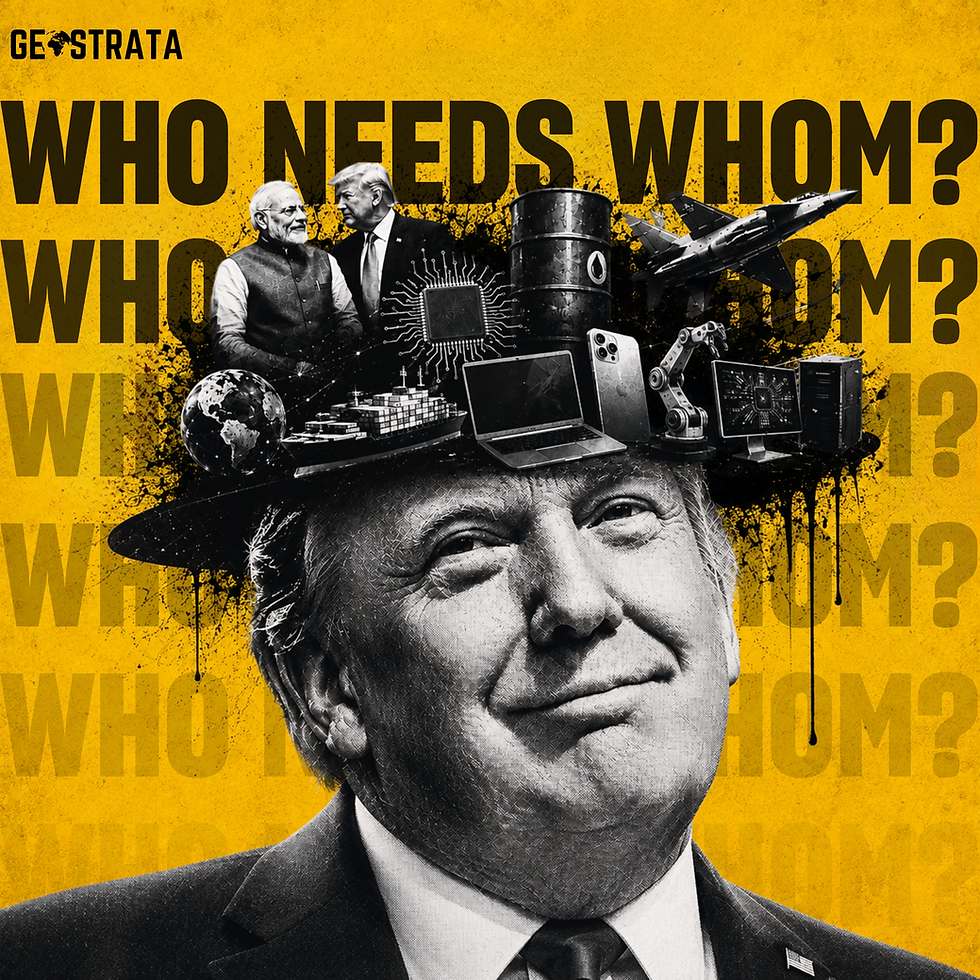
Illustration by The Geostrata
This growing strategic engagement with multiple power centres has raised questions about the concept of "de-Americanisation". “De-Americanisation” does not necessarily entail a break from the US or renouncing the India-US relationship. It could also mean India trying to reduce its reliance on the US strategically and economically by diversifying its military, energy, technology, trade, and diplomatic connections. The question, therefore, is whether India is really distancing itself from the United States or merely going through another phase of strategic autonomy amid an increasingly uncertain global environment.
STRATEGIC AUTONOMY, NOT STRATEGIC DISTANCE
For decades, India’s strategic autonomy has meant retaining the freedom to engage with each major power on its own terms, without allowing one relationship to dictate its approach to others. The principle has not vanished but evolved. Today, India is looking for partners based on strategic interests but without compromising its ability to make its own decisions. The multi-pronged strategy is evident from India’s engagement with the Quad, BRICS and the SCO simultaneously.
The Quad helps India strengthen its presence in the Indo-Pacific region, while BRICS and the SCO offer platforms for engaging Russia, China, and the broader Global South. India has not decided among competing power centres but has created room for manoeuvre through different strategic partnerships.
BEYOND DEPENDENCE, BUT NOT BEYOND AMERICA
India has always strived not to be overly dependent on any one external source for its security, energy, technology, and crucial logistics chains. The Ukraine conflict reinforced this calculation and shows that geopolitical competition can weaponise economic interdependence as leverage for influence, making economic relations a tool of political pressure.
In 2025, the US government implemented a reciprocal tariff of 25% on Indian imports and subsequently introduced an additional tariff of 25% due to India importing oil from Russia.
While the extra tariff has been removed from the trade system agreed upon in February 2026, the US is still contemplating tougher measures against nations purchasing Russian energy. Proposed legislation may levy tariffs up to 100% on major importers, which would affect Indian exporters. The Indian Ministry of Commerce has recognised this problem. Diversification thus becomes an insurance scheme, a way of safeguarding Indian strategic autonomy.
RUSSIA TESTS STRATEGIC AUTONOMY OF INDIA
Even today, Russia is perhaps the best example of India’s strategic autonomy. Regardless of the change in India-US relations, India has refused to consider that its relations with Russia are inconsistent with closer cooperation with the US. Russia remains significant for India in terms of its long-term defence partnership, energy security, and broader Eurasian interests.
On the other hand, India realises the dangers of being too dependent on Moscow, especially considering the close strategic ties that Russia shares with China. New Delhi has thus tried to address the vulnerabilities resulting from excessive dependence on Russia without completely severing ties, which are vital to its security and energy needs. Despite India's historical partnership with Russia, it is also enhancing its own defence and technological collaborations with the United States, France, Israel and other nations.
TESTING THE BOUNDARIES OF THE STRATEGY BY CHINA
China is perhaps one of the best examples of why India can’t simply "de-Americanise". India and China continue to compete strategically due to several issues, including the boundary issue and military competition in South Asia, Southeast Asia and parts of Africa. But at the same time, New Delhi is carefully trying to improve diplomatic relations with Beijing.
On August 25, 2026, the two countries conducted their 25th round of talks as part of the “Special Representatives Dialogue” to discuss boundary issues with Beijing.
This does not imply that India is switching its strategy toward Beijing but represents how India prefers to handle rivalry without making it an ongoing conflict. Direct engagement with China provides New Delhi with leeway to handle its Himalayan border and relationship with China, making sure that New Delhi’s policy toward China is in India’s best interest.
WHY WASHINGTON REMAINS IMPORTANT
India’s strategic conduct provides additional proof that de-Americanisation is not merely about scaling down relations with the United States across the board. This deep connection is best seen when partnerships with France, Israel, Japan, South Korea and European countries cannot quickly replace American capability, especially when it comes to advanced defence technology, semiconductors, space cooperation, and crucial supply chains.
Past year’s tariff issues showed how dangerous over-reliance could be, but they also showed the level of economic connection between the two countries. The US is still an essential market and a significant supplier of investments, technologies, and high-level expertise.
There is a strategic dilemma: India wants to increase its autonomy from the United States, but at the same time, it needs to get American technology and investments. But the two objectives do not necessarily contradict. Cooperation enhances independence if it increases options for a country and makes it stronger. For India, the problem lies not in partnering with Washington but rather in making sure that such a strategic partnership doesn’t turn into dependence.
FROM ALIGNMENT TO STRATEGIC FLEXIBILITY
India is pursuing a foreign policy that avoids dependence on any single major power. While Washington offers opportunities related to technology, defence cooperation, and Indo-Pacific collaboration, Moscow continues to be relevant in terms of energy and defence in Eurasian interests. Europe brings investment, technology, and supply chain diversification; West Asia offers energy and connectivity; while Central Asia helps India have better access to the broader Eurasian strategic environment.
These associations play different roles rather than simply repeating one another. By keeping itself involved in SCO activities and strengthening links across the entire region, India is reaching out to a strategic environment in which Russian, Chinese, Turkish, and Western interests collide. The BRICS and SCO help connect with non-Western nations, while the QUAD allows for strategic coordination in the Indo-Pacific region. India’s involvement in these multiple platforms therefore gives it several strategic channels through which it can pursue its interests.
DE-AMERICANISATION OR STRATEGIC AUTONOMY 2.0?
India is not likely to adopt the policy of de-Americanisation due to the huge cost implications and its strategic convergence with America. The only thing that has changed is the definition of strategic autonomy. New Delhi’s capability of operating effectively with Washington, Moscow and Beijing on the one hand, and enhancing its technology and industry base on the other, would decide the degree of freedom of manoeuvre that it would have.
The dispute regarding tariffs in 2025 and the potential for punitive action associated with Russian energy in 2026 shows why this distinction matters. These events demonstrate how even a strategically convergent alliance can serve as a liability if interests are not aligned. Equally, the dependence of India on technology, investments, markets, and military capabilities from the US makes a case that total strategic disengagement is neither realistic nor desirable.
The trend thus moves not from partnership to isolation, but from dependence to diversification. India is not rejecting America; it is ensuring that America remains a very important option without becoming its only option. From this perspective, "de-Americanisation" would be more accurately characterised as strategic autonomy 2.0: partnership without dependency, engagement without alignment, and autonomy without isolation.
BY HEMA
TEAM GEOSTRATA


Comments