.png)


The New Grammar of Trade: India-EU Beyond Tariffs

The world as a civilisation progressed through the firm establishment of trading routes among ancient empires, through the maritime routes, evolving to the nuanced Silk Road and then to the creation of the World Trade Organisation. These collective events highlight how important trading has been for any evolved civilisation throughout history across timelines. In the contemporary world, trading is not just limited to the material exchange but has gone beyond to establishing geopolitical relations and leveraging strategies.

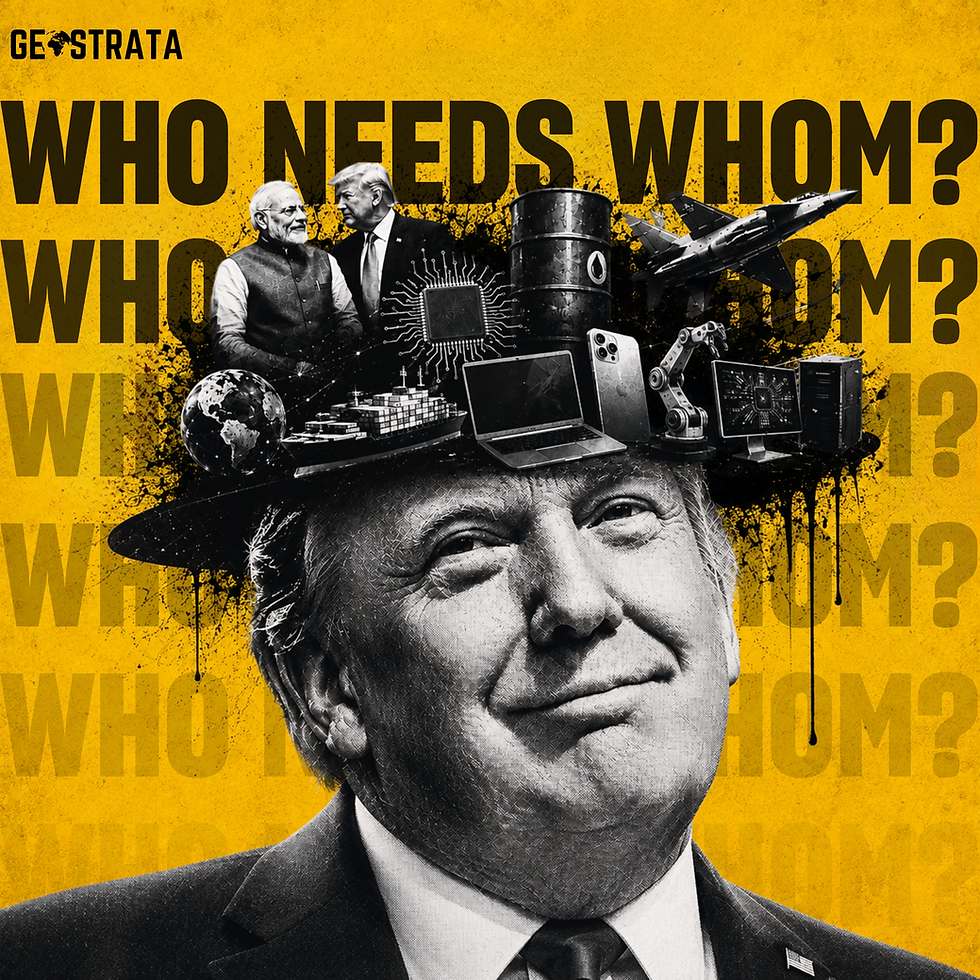
Illustration by The Geostrata
In this context, India, as a sovereign democratic nation in the extremely fragmented geopolitical world order, has been strategically navigating its course, balancing through the global trading order and forming crucial strategic alliances, all the while building its own unique multipolar identity.
TRADING AS A POLITICAL INSTRUMENT
Since the 1960s, India has had a strong trading relationship with the European Union, and now it’s stronger and larger than ever. The European Commission has described the recent EU-India FTA at the New Delhi Summit ’26 as “the most ambitious trade liberalisation India has ever granted,” a declaration that captures not only the scale of the economic opening but also the symbolic weight of the moment.
Once it gets implemented, the pact will bind two large democratic economic blocs that together represent roughly one-fifth of global GDP and a quarter of the world’s population, a partnership so vast that leaders on both sides have named it “the mother of all deals.”
“Our summit sends a clear message to the world. At a time when the global order is being fundamentally reshaped, the European Union and India stand together as strategic and reliable partners.” - President Costa
From history to contemporary times, trading is established as one of the prominent pillars in advancing bilateral economic growth and resilience, promoting opportunities in goods, services, and investment. Bilateral trade between India and the EU continued its incremental upward trajectory in 2024-25, with merchandise trade valued at INR 11.5 lakh crore (USD 136.54 billion).
India’s exports to the EU accounted for INR 6.4 lakh crore (USD 75.85 billion). Meanwhile, services trade reached INR 7.2 lakh crore (USD 83.10 billion), underscoring the deepening economic interdependence between the two partners. Also, this agreement helps India build an alternative route from overtly relying solely on China’s supply chain network. Thus, beyond this arithmetic of tariffs and exports lies a deeper geopolitical choreography.
The agreement promises to eliminate or reduce duties on over 90% of EU goods entering India, with projections suggesting that European exports could double by 2032.
Embedded within the text is a climate support mechanism, a financial and technological bridge designed to assist India’s transition toward lower emissions. Yet, even as the ink dries, the spectre of the EU’s Carbon Border Adjustment Mechanism (CBAM) looms large. Covering sectors such as cement, electricity, fertilisers, iron and steel, aluminium, and hydrogen, the CBAM introduces a phased financial adjustment beginning in 2026, effectively redefining the cost of carbon in cross-border trade. For India, this raises questions not only of compliance but also of sovereignty, as environmental regulation becomes a new frontier of economic diplomacy.
HIGHLIGHTS ON INDIA'S PREFERENTIAL ACCESS TO EU MARKETS
Preferential access across 97% of tariff lines, representing 99.5% of the trading value.
Immediate duty elimination of 70.4% of tariff lines, covering 90.7% of India’s exports in sectors pertaining to textiles, leather, footwear, tea, coffee, spices, sport goods, toys, gems and jewellery, and marine products.
Phased zero duty access in 3-5 years- 20.3% of tariff lines, covering 2.9% of exports in sectors such as marine products, processed foods, arms and ammunition.
Preferential tariff reduction/ TRQs about 6.1% of tariff lines, covering 6% of exports in items related to poultry, preserved vegetables, bakery goods, cars, steel, shrimps/prawns.
The zero-duty entry upon FTA enforcement would presumably result in enhanced competitiveness, job creation and deeper integration into EU/global value chains. On the other hand, India’s tariff offers to the EU, the following-
Overall coverage of 92.1% of tariff lines, representing 97.5% of EU exports,
Immediate duty elimination of 49.6% of tariff lines,
Phased elimination of around 39.5% in tariff lines,
Phased reduction/TRQs- 3% of products, including apples, pears, peaches and kiwifruit.
The above-mentioned factors will help in diversifying India’s import sources, lower input costs, consumer benefits and greater integration of Indian firms into the global supply chains for strategic benefits. Equally significant are the non-tariff dimensions: European product standards, certification regimes, and digital compliance frameworks that will require sustained negotiation.
These are not mere technicalities; they are instruments of power. The gravity of this trade, technology and investment deal also demands better regulation to analyse the magnitude of its impact on the domestic markets and especially farmers, labour sector, enterprises under the small-scale sector initiatives (MSMEs) and also the environmental sectors.
CONCLUSION
The geopolitics of standards encourages the contest to write the rules that govern technology, trade and infrastructure, which has become the new grammar of global influence. The simple exchange of goods, services and capital across borders has today turned into a complex web of systematically curated international relations that further determines the policy framework, economic theories and ushers a strategic impact on the global market.
“Trade is a crucial geopolitical stabiliser. And a fundamental source of economic growth. Trade agreements reinforce a rules-based economic order and promote shared prosperity.” ~President Costa
The current piece on the EU-India FTA deal can be brought down to three broad areas in which this deal can prove beneficial: first, it advances economic security and supply chain resilience. Secondly, in this time of global uncertainty, it creates a strategic autonomy for both partners. Thirdly, it advances the geopolitical alliance between the Indo - Pacific. In this arena, the nation that codifies the protocols of connectivity and production also scripts the future of economic advantage and digital sovereignty. The EU-India agreement, therefore, is not just a trade pact; it is a declaration of intent to participate in the authorship of the world’s next operating system.
BY RACHITA SAHA
TEAM GEOSTRATA


I found Drive Mad through a recommendation thread and ended up spending the entire evening trying to clear a few tricky levels. It’s easy to learn but hard to master.