.png)


Petrol, Politics, and the Price of Not Asking: E20 was never about ethanol. It was about consent

E20 is currently one of the most trending topics for debate right now in India. While many have praised the government for reducing dependence on imported crude, supporting local farmers and promoting cleaner fuels, others have raised concerns over mileage and breakdown issues in vehicles. A policy supposed to roll out by 2030 was rolled out 4 years prior in 2026 and has now become a new reality across the country.

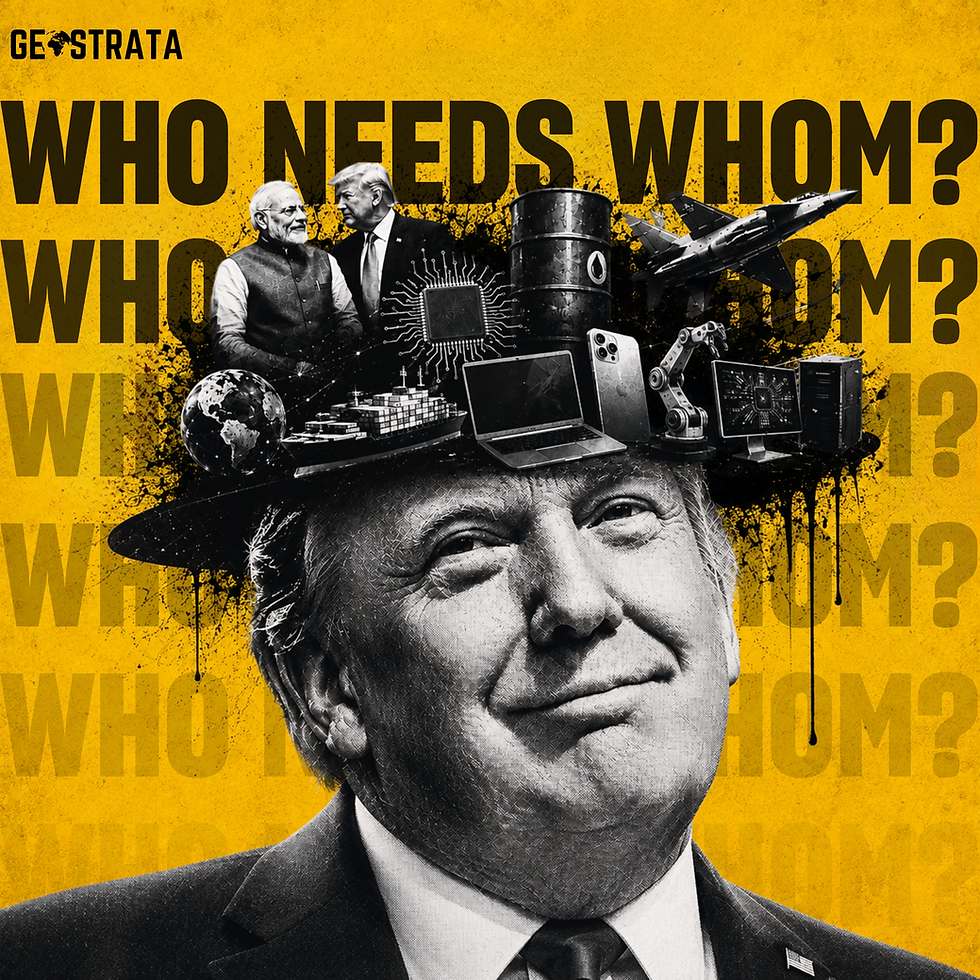
Illustration by The Geostrata
From April 2026, the Ministry of Petroleum and Natural Gas instructed all oil companies to sell 20% ethanol-blended fuel across all states and union territories; citizens had no choice but to choose a fuel that may not be compatible with some older vehicles.
It left millions of citizens with questions rather than answers. What exactly is ethanol? Is E20 safer for every vehicle? Does it damage older vehicles? And is this a simple environmental policy, or is it also a stepping stone towards a larger electric vehicle transition? To understand what the policy means for India’s future, let's first understand ethanol itself, its benefits, its limitations, and where the transition is ultimately heading.
WHAT E20 IS AND WHY THE GOVERNMENT MADE IT MANDATORY?
E20 is petrol blended with 20% ethanol, a biofuel derived domestically from sugarcane, maize, and surplus grain. This also raises the minimum octane rating to 95 (up from 91 previously); this was aimed at keeping combustion stable with the blended fuel. Ethanol’s calorific value (how much energy a fuel releases when you burn a fixed amount of it) is roughly around 21-24 MJ/litre compared to 32-34 MJ/litre for pure petrol; therefore, ethanol releases less energy when it burns a litre of fuel, and that's the actual reason behind the mileage losses reported by people.
From April 1, 2026, the Ministry of Petroleum and Natural Gas directed oil companies to sell this blended fuel across all states and union territories. There is no soft rollout, no exemptions and no opt-out lane. The fuel now is E20, and that's it.
The government is right when it comes to the reason for its implementation. India imports around 85% of its crude, and every barrel imported is a barrel of strategic exposure to global supply shocks. This was evident from the 2026 West Asian tensions. Converting a slice of that import bill into domestic ethanol demand is straightforward energy-security arithmetic. When it comes to rural income, over 1.18 lakh crore had flowed to farmers through ethanol procurement by early 2026; this is really beneficial for the agricultural sector and a real transfer to the agricultural economy that has bought institutional support.
However, implementation is rather harder to defend. With a single-blend, zero-choice structure, people are left with no choice but to add a fuel that can possibly lead to damage in their vehicles. NITI Aayog's own 2021 roadmap, backed by submissions from the Society of Indian Automobile Manufacturers, had recommended keeping lower blended fuel alongside E20; this will ease the burden on drivers and give them a choice.
It also warned that consumer acceptance would depend on pricing higher blends below regular petrol; this was mainly recommended to offset ethanol’s lower energy content. Those recommendations were shelved, the rollout was moved up rather than staggered, and the lower price recommendation never materialised. The engineering and economics of E20 are sound and beneficial, but what’s being challenged is how it was imposed and forced on every vehicle overnight. The government did not even listen to the safety valves of its own advisors.
WHETHER IT REALLY DAMAGES VEHICLES
The evidence is not a clean yes or no; it rather depends on who you ask. However, from the physical mechanism, it's real and uncontested. Ethanol is a problem because it pulls moisture from the air. This moisture then damages fuel tanks, injectors, and lines. These parts were not made to handle ethanol. The rubber and polymer seals in these parts get bigger cracks as time goes on. In fuel systems that are not set up correctly, ethanol can cause issues. The air and fuel mixture can get too lean. This can make the engine run rough when it is idling. It can also make it harder to start the engine when it is cold. It can even clog up the filters. Ethanol is really bad for these fuel systems.
Vehicles manufactured in India from April 2023 onwards are E20 compliant by regulation, but millions of vehicles sold before the date were only ever suited to fuel mixes with 5-10% ethanol, and nearly 300 million such vehicles remain on Indian roads today.
The numbers split sharply depending on who’s doing the counting. ARAI, the government’s own testing body, estimated that E20 causes only a 3-5% reduction in fuel efficiency, while several independent real-world studies have reported a loss of 8-12% in older vehicles. A local survey of over 22,000 respondents found 66% of owners of pre-2023 vehicles have reported mileage declines exceeding 10%, up sharply from 45% in a similar survey conducted just a month earlier, while 45% reported a moderate to significant rise in engine wear and maintenance costs. Nearly a third said they would pay more just to have the choice of E0 or E10 again.
Different manufacturers have different takes. Honda maintains its vehicles have been materially compatible with E20 since 2009, while Maruti Suzuki has acknowledged the core concern around E10-compliant and older vehicles and recommends periodic injector cleaning and quicker inspection of fuel hoses as mitigation, even as it has stopped short of offering commercial upgrade kits. Some dealers report that some mileage complaints circulating on social media are likely seasonal, tied to summer air conditioning load rather than purely fuel-related.
IS THIS SECRETLY A TRANSITION TO EV?
Officially, no, and the government would object strongly to this framing. The E20 policy logic treats ethanol as a fuel that works with India’s existing internal combustion fleet to enable immediate steps toward environmental concerns. While EV infrastructure and green hydrogen adoption are built separately for the segments that ethanol can't reach. This is rather a parallel development than a sequential bet.
However, as the government pushes toward E20 and flex fuel, some car buyers are opting for EVs instead of trying to decode fuel-blend compatibility. FADA CEO Saharsh Damani points out a genuine gap generating consumer anxiety. At dealerships, questions about E20 compatibility, expected mileage loss, and long-term engine health have become routine. Another dealer said the uncertainty associated with E20 is pushing people towards EVs, where the central government’s policy has been consistent. Buyers are also conflating E20-compliant vehicles with true flex-fuel vehicles, and with several blend standards being discussed publicly at once, caution becomes the default response.
WHERE DOES E20 GO NEXT?
E20 is not the endpoint; it is a waypoint. The government has already signalled a further increase in blending beyond E20, with standards for E22, E25, E27, and E30 in progress. Industry voices are pushing for a clear time-bound roadmap towards further blend, arguing that policy predictability is what unlocks the next wave of distillery investment.
India’s ethanol capacity has already grown from under 2 billion litres in 2014 to nearly 20 billion litres today. The longer horizon, floated by the road transport minister, is E100 and full flex-fuel vehicles, alongside emerging interest in isobutanol blending for diesel.
However, we need to fix the trust issue that came up during this rollout first. Otherwise, none of this will make sense. The government has been focused on defending science. People are actually asking for the test data behind it. The government's not sharing this data is the gap that turned an energy plan into a big political problem. The trust deficit from this rollout needs to be repaired. The government needs to shift from defending science to building consensus.
CONCLUSION
The economics underlying ethanol blending is not the problem. India’s crude import bill is real; the farm-income transfer is real, and the industry has proven it can scale ethanol production faster than anyone expected. What has gone wrong is the execution of the policy. A mandatory, unchosen blend forced into 300 million vehicles that were never built for it, with no price offset, no retrofit support, and no data released to settle the argument. Energy security bought through quiet coercion tends to look successful until the coercion becomes visible. For E20, that moment has already arrived; what happens next with E25 and E30 will depend on whether the government has learned anything from it.
BY AKSHAJ
TEAM GEOSTRATA


Una página sobre Film App APK Gratis puede aportar mucho más valor si responde dudas habituales. Información sobre instalación, búsqueda de contenido, favoritos, subtítulos y reproducción ayuda al usuario tanto antes como después de instalar la aplicación.
This is a well-written and informative article that covers the important details couples should consider before selecting a wedding venue. The practical advice about planning, guest arrangements, vendor options, and unexpected situations makes the guide more useful and easier to follow. I also came across this while exploring 10.0.0.0.1 and found the information genuinely helpful. Thanks for sharing such valuable insights!