.png)


The Kuril Island Conundrum: Russia, Japan, and the Geopolitics of the Pacific

The islands known as the Southern Kurils in Russia and the Northern Territories in Japan have regained importance after Russian President Vladimir Putin’s recent visit to the disputed territory. Russia has also conducted large-scale military exercises around the islands, which have provoked protests from Japan.
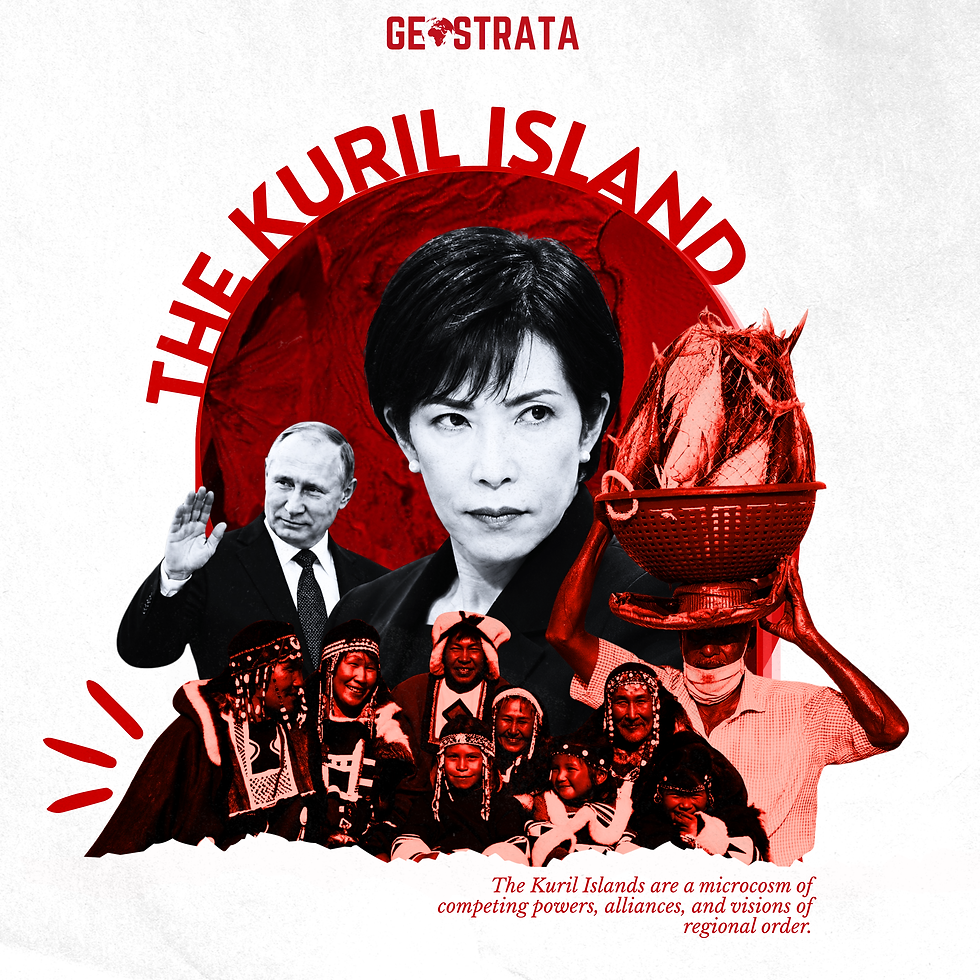
Illustration by The Geostrata
The renewed tensions over the islands come at a time when Russia’s military posture in the region is drawing greater attention from Japan and other Indo-Pacific powers. Moscow’s efforts to strengthen its presence around the disputed territory have given the decades-old territorial dispute a broader security dimension.
The Kuril Islands are a volcanic arc that stretches over 1100 kilometres across the northwestern Pacific Ocean and represent one of East Asia’s most enduring geopolitical flashpoints. While the chain consists of 56 islands situated between Japan’s Hokkaido and Russia’s Kamchatka Peninsula, the contemporary Japan–Russia territorial dispute centres specifically on four of its southernmost territories, namely Etorofu (Iturup), Kunashiri (Kunashir), Shikotan, and the Habomai islets.
The islands remain a symbol of unresolved historical territorial tensions that continue to shape regional relations between Moscow and Tokyo.
HISTORICAL ROOTS OF THE DISPUTE
The Kuril Islands were initially inhabited by the indigenous Ainu community. During the 17th and 18th centuries, both Russia and Japan gradually expanded towards the islands. Russia moved southward from Siberia and Kamchatka, while Japan expanded northward from Hokkaido. Over time, both countries developed competing claims and forms of presence in the archipelago, laying the groundwork for the territorial dispute that would emerge more clearly in the centuries that followed.
In 1855, both nations signed the Treaty of Shimoda, which established the boundary in the Kuril Islands. The treaty placed the islands south of the boundary, including Etorofu, under Japanese control, while the islands to the north remained under Russian control. Japan later came to regard the treaty as an important historical basis for its claims to the four islands it calls the Northern Territories, including Etorofu, Kunashir, Shikotan and the Habomais.
Twenty years later, the Treaty of Saint Petersburg, signed on May 7, 1875, superseded the earlier agreement, under which Japan ceded its rights to Sakhalin to Russia in exchange for Russia’s cession of the entire Kuril Islands chain to Japan. From Japan’s perspective, this treaty marked a loss of territory under diplomatic pressure and limited leverage against the stronger Russian Empire. Soviet forces occupied the disputed islands in August-September 1945 and incorporated them into its territory.
Japan continues to dispute the legal status of that incorporation, making the distinction between the initial military occupation and subsequent incorporation central to the ongoing sovereignty dispute. The modern dispute originates in the final days of the Second World War. The Soviet Union declared war on Japan on 9 August 1945. Japan subsequently lost control of the islands, and the Soviet Union incorporated them into its territory.
In the 1952 San Francisco Peace Treaty, Japan renounced its “right, title and claim” to the Kuril Islands. The treaty did not specify which state would receive sovereignty over the islands. Japan and Russia have different interpretations of the treaty’s implications. While Japan has said that its renunciation did not extend to the four southern islands it calls the Northern Territories. On the other hand, Russia regards the postwar territorial settlement as confirming its sovereignty over the islands. These competing interpretations remain central to the dispute.
WHY DO THE ISLANDS MATTER?
The islands occupy a critical position in the geopolitics of the Pacific. They are a central point of access to the Sea of Okhotsk, which is one of the world’s most important fishing grounds and a strategic body of water enclosed by Russian territory. For Russia, the islands are important for its maritime defense perimeter and crucial naval bases, particularly in the southern islands.
Whereas for Japan, the islands extend its territorial waters and economic zones significantly into the Pacific, while also reducing Russian military influence close to Japanese territory. The Kuril Chain acts as a strategic bridge between the Sea of Okhotsk and the North Pacific, giving the islands more significance. Their location provides Russia with access to the Pacific while also helping shape the maritime approaches to the Sea of Okhotsk, an area of particular importance to Russia’s Pacific Fleet and strategic forces.
For Japan and the wider Indo-Pacific, Russia’s military presence on the islands therefore has implications for regional maritime access, surveillance and the broader balance of power in the North Pacific.
The islands are part of the broader Asia-Pacific security balance. As Japan sees the Northern Territories issue as a matter of territorial integrity, and Russia considers its military presence important to maintaining its Pacific position. Russia’s deployment of missile systems concerns Japan, while closer Japan-US security cooperation is viewed by Moscow as a threat. This creates a security dilemma, where both sides are seeing the other’s actions as defensive but threatening to the other.
The waters surrounding the islands are extraordinarily productive in terms of Exclusive Economic Zones(EEZ). The region has the world’s richest fishing grounds, and specifically salmon, crab, and pollock. Fishing rights and marine resources are worth billions of dollars, and this is crucial for Japan’s fishery industry, livelihood, and food security. The seabed around the Kuril Islands contains deposits of oil and natural gas, along with rare earth metals, which makes them even more significant with the rising energy demands and climate change. The fundamental problem is that both sides have strong incentives not to compromise, but for Japan, it has high domestic political costs, as the issue is deeply embedded in national memory. And for Russia, surrendering territory would be strategically inconvenient due to its importance in the Pacific defence architecture. This creates a classic security dilemma.
Japan views Russian military expansion as a threat, while Russia sees Japan’s alignment with the United States the same way. Hence, the security policies of both sides have created a cycle of mutual insecurity. Both sides’ efforts to strengthen their own strategic position are seen by the other as a threat. And this reinforces their existing fear and leads to further military and security measures.
THE UNITED STATES FACTOR
Although the dispute is between Japan and Russia, the United States is an important third factor. Japan and the US have a longstanding security alliance. Japanese control of the islands could strengthen Japan’s strategic position in the region. Under the US-Japan alliance, this could expand the strategic reach of US-Japan security cooperation closer to Russia’s Pacific interests and help increase Moscow’s security concerns, reinforcing its determination to retain the islands. This reinforces Russia’s will to hold the islands.
Russia also views US-Japan-South Korea alignment as an encirclement. The Kurils become more important for Russia in this context. And Russia’s military buildup is also a response to the perceived US military expansion in the region. While the presence of the US works in favour of Japan, Russia sees any US involvement as a bias.
THE CHINA FACTOR
China’s rise has influenced the strategic context of the Russia-Japan dispute over the Kuril Islands. Closer Russia-China strategic cooperation has strengthened Moscow’s position against Japan and reduced its incentive to make territorial concessions. China’s growing military presence in the Western Pacific heightens Japan’s security concerns. Hence, Tokyo increasingly views the Kuril dispute as a wider regional security framework involving Russia, China, and the United States. China therefore affects the dispute indirectly by reinforcing Russia’s strategic posture and encouraging Japan to strengthen its northern defences and alliance with Washington.
THE GEOPOLITICS AROUND THE KURIL ISLANDS
The Kuril Islands dispute is significant far beyond the question of who controls four islands in the North Pacific. It represents the continuing geopolitical legacy of the Second World War and a fault line in the emerging Indo-Pacific security order. It has become more important again as it reflects much wider tensions in East Asia, rather than being a territorial dispute.
The dispute therefore connects directly to the broader strategic competition involving Russia, Japan, the United States and China. For Japan, the Russian military presence so close to Hokkaido reinforces concerns about its northern security environment and strengthens the importance of its alliance with the United States.
More broadly, the Kurils demonstrate how territorial disputes can become instruments of great-power competition. Russia's recent military activity and Putin's August 2026 visit to Iturup signal that Moscow views the islands not merely as historically Russian territory but as strategically valuable assets. Japan's continued claim, meanwhile, reflects a wider effort to defend the post-war territorial and rules-based order.
The dispute also shows the growing militarisation of the Indo-Pacific. As tensions rise over Taiwan, the Korean Peninsula and maritime security, another unresolved territorial dispute adds to the region's network of potential flashpoints. A direct conflict over the Kurils remains unlikely, but increased military deployments, exercises and diplomatic confrontation could contribute to miscalculation.
Ultimately, the Kuril Islands are a microcosm of the changing international system: an unresolved issue from the twentieth century becoming increasingly entangled with twenty-first-century rivalry between competing powers, alliances and visions of regional order.
BY VASUDHA TEAM GEOSTRATA


Comments