


The Ethics of War Above the Earth: What Happens When Space Becomes a Battlefield?

Outer Space was primarily a realm of scientific discovery. But now it has become a critical sphere of military competition. This dual character creates one of the most difficult ethical questions of modern security: how can states protect their interests in space without turning space into another battlefield? The growing dependence on satellites means that any conflict in space would not remain limited to military forces.

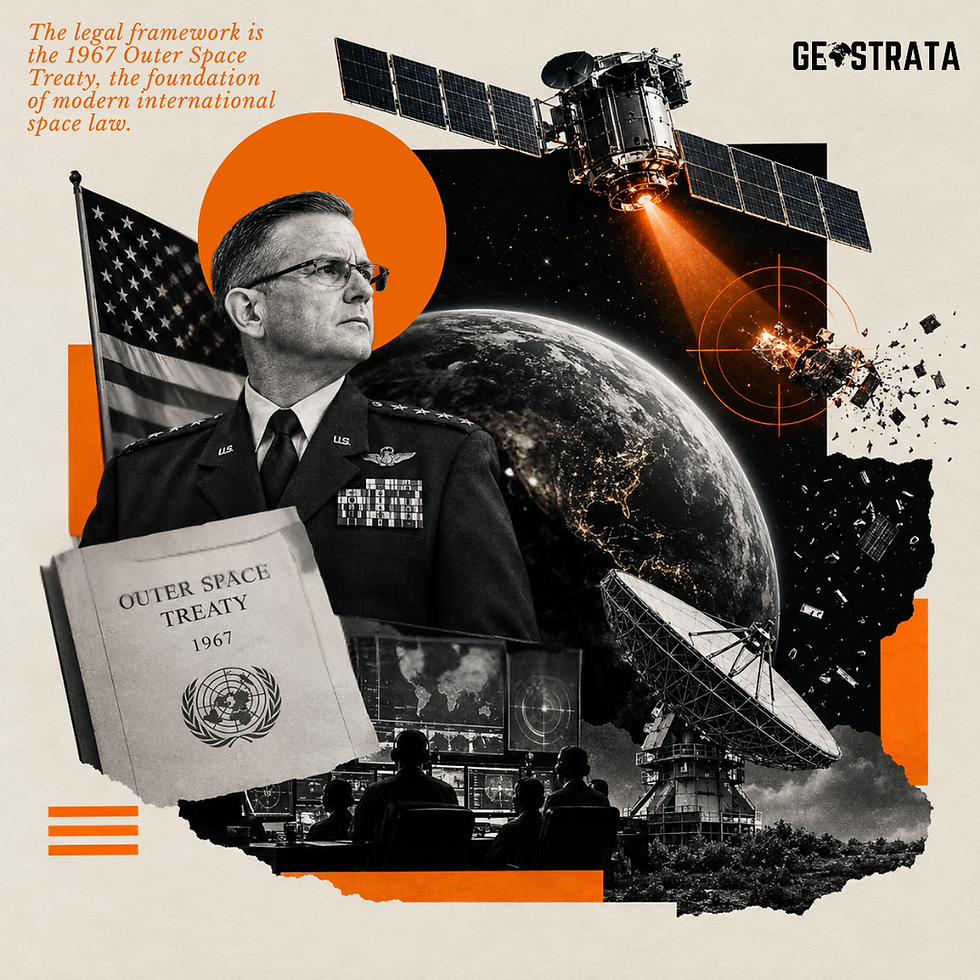
Illustration by The Geostrata
If the space infrastructure is damaged, it could impact the communication networks, navigation and other services on Earth. This makes the issue of space security important not only for national defence but also for the wider international community. Hence, the article seeks to explore how outer space is turning into a new battlefield and what the growing militarisation of space could mean for humanity.
FROM THE COLD WAR TO A NEW SPACE ARMS RACE
The roots of space weaponisation can be traced back to the Cold War. The launch of Sputnik in 1957 demonstrated that rockets capable of reaching orbit could also have military applications. Both the United States and the Soviet Union developed reconnaissance satellites because information from space became vital to nuclear strategy.
This marked the beginning of a paradox that continues to shape space security today. While satellites helped maintain nuclear deterrence by allowing countries to monitor their adversaries, they also became potential targets during conflicts. The United States conducted an early anti-satellite (ASAT) experiment in 1959, while the Soviet Union developed co-orbital anti-satellite systems, marking the early stages of military competition in space.
As this competition grew, efforts were also made to establish limits on the militarisation of space. The 1963 Partial Nuclear-Test-Ban Treaty prohibited nuclear explosions in outer space, while the Outer Space Treaty of 1967 prohibited placing nuclear weapons and other weapons of mass destruction in orbit. It also established that the exploration and use of outer space should benefit all countries.
However, the treaty did not prohibit all conventional weapons or military activities in space. This left a gap between the ambition to keep space peaceful and the growing desire of countries to use it for strategic advantage, a tension that continues to drive the space arms race today. The post-Cold War period did not end the competition, and instead, new powers started demonstrating counterspace capabilities.
In 2007, China destroyed the Fengyun-1C weather satellite in a direct-ascent ASAT test, creating thousands of pieces of debris; in 2008, the United States destroyed the malfunctioning USA-193 satellite. India also conducted Mission Shakti in 2019, destroying Microsat-R at relatively low altitude, while Russia destroyed Cosmos-1408 in 2021. These are the four countries widely recognised for conducting direct-ascent ASAT tests that generated orbital debris.
This reveals an important ethical difference between warfare on Earth and warfare in orbit. It makes orbital debris one of the most serious ethical problems associated with destructive ASAT weapons.
According to the European Space Agency (ESA), around 40,000 objects are currently tracked in Earth’s orbit, while more than 1.2 million debris fragments are estimated to be in space, many of which can cause serious damage to satellites.
Also scientists such as Laura Grego of the Union of Concerned Scientists have highlighted the dangers created by destructive ASAT testing, particularly orbital debris. A country may destroy an adversary's satellite for strategic reasons, but the resulting debris does not recognise national borders.
CONSEQUENCES OF WAR IN SPACE
A war in space could have serious consequences beyond the destruction of satellites and the creation of orbital debris. Since countries depend on satellites for communication, navigation, banking and weather forecasting, any disruption could affect everyday life and economic activity across the world. Military forces could lose access to critical intelligence and communication systems, making it harder to coordinate operations and increasing the risk of miscalculation during a conflict.
For instance, if a country loses access to satellite navigation or missile-warning systems, it may struggle to distinguish between a technical failure and an incoming attack, potentially triggering a dangerous response.
The economic impact could also be significant, as disruptions to satellite-based services could affect aviation, shipping, financial transactions and supply chains. Developing countries, which may have limited resources to replace damaged infrastructure or access alternative systems, could face particular difficulties.
Furthermore, the growing use of space-based technology for both civilian and military purposes makes it difficult to restrict the effects of an attack to military targets alone. A conflict in space could therefore threaten civilian safety, deepen geopolitical tensions and escalate into a wider war on Earth.
THE GEOPOLITICS OF SPACE WEAPONISATION
The discussion around space weaponisation gains wider importance with respect to geopolitical competition. The United States and China are competing for technological and strategic influence through multiple areas and space is increasingly turning into a new arena of competition for both nations.
The central problem with space weaponisation is the security dilemma. One state develops a weapon because it fears another state is doing it. The other country views the weapon as a threat and starts developing its own to protect itself. The first state then sees the response as proof that its fears were justified.
Nobody necessarily wants a race, yet everyone believes they cannot afford to be unprepared. And the cycle continues until all countries have deployed some form of dual use space weapon.
The difficulty is increased by the fact that states cannot always know the intentions behind another country's space activities. A satellite may have civilian purposes while also supporting military operations. This uncertainty can encourage states to prepare for the worst, even when the other side may not intend to attack. As a result, defensive preparations themselves can become a source of tension.
This is why international rules and communication are important. States may not be able to completely eliminate military competition in space, but they can create limits on the most dangerous activities. Agreements on destructive testing, orbital debris and responsible behaviour could reduce the possibility that competition develops into an uncontrolled arms race.
CONCLUSION
Space was once seen as humanity's final frontier. Today, the challenge is not to deny countries the ability to protect their interests, but to ensure that their pursuit of strategic advantage does not undermine the infrastructure on which the rest of the world depends. Space may increasingly be a domain of military competition, but it cannot be treated as the possession of any one country. Its security requires states to recognise that an advantage gained by putting the shared space environment at risk may ultimately leave everyone less secure.
BY VASUDHA
TEAM GEOSTRATA


Comments