.png)


The Cold War’s Heir: The Strategic Reality of Russia’s Leverage over Ukraine

In 1987, Soviet political scientist Georgy Arbatov told off his American counterparts, saying, “We are going to do a terrible thing to you. We are going to deprive you of an enemy.” The West laughed off the warning, but it should have known better. If there was ever something that held the entire NATO alliance together, it was the common threat of the totalitarian regime beyond the Iron Curtain. Once that threat lost its plausibility, the fractures that had only been masked by years of prosperity and obliviousness became apparent, and Russia was quick to remind the West just how far they had been allowed to stray.
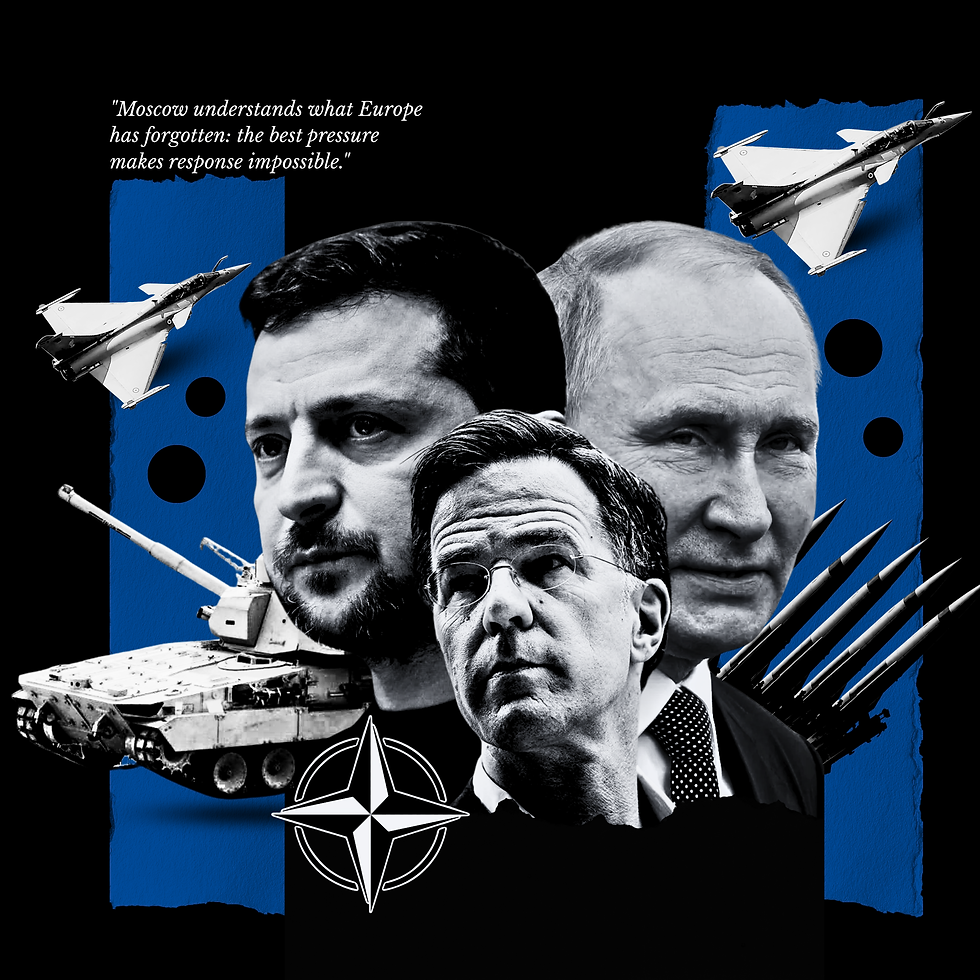
Illustration by The Geostrata
Russia has not had a single military victory over a NATO member. And, while it may be worth asking what Russia has defeated, it is more interesting to look at what Russia has extracted from NATO by other means: leaving the gas on or off at will, squeezing at NATO's nerve with nuclear weapons, holding a strip of Moldova, which it has not annexed or released for thirty years, and having a 65 km strip in Poland for the same reason. Russia has drawn NATO into the grey area between peace and war, where the alliance's strength has constantly proven to be insufficient.
NATO’s founding logic was binary: an attack on one member is an attack on all, deterred by the certainty of collective response. Russia has spent three decades finding every way to make that logic ambiguous, to threaten, destabilise, and coerce without crossing the threshold that would trigger the clause. It has abided by what has been, by any honest assessment, a sophisticated hybrid warfare doctrine that combines conventional military posture with cyber espionage, energy weaponisation, information operations, and the maintenance of frozen conflicts on NATO’s periphery.
ENERGY AS RUSSIA’S ORIGINAL LEVERAGE
Before the tanks rolled into Ukraine in 2022, the most effective weapon in Russia’s arsenal against Western Europe was not a missile. It was a gas contract. Europe nearly imported one- third of its natural gas and 30% of its crude oil from Russia in the years before the invasion, a dependency that Moscow had spent decades cultivating deliberately.
The strategy was not subtle: Russia used its energy position to divide Europe, applying political pressure on countries with energy vulnerabilities, funding its own defence spending on the revenues that European gas payments generated.
Germany was the most evident example, as the Nord Stream pipeline, strongly promoted by Russia and partially tolerated by Berlin over the persistent irks of Washington and Eastern allies, created an untenable situation in which Russia held Europe’s largest economy by the throat. In 2022, when Moscow turned off the spigots in an effort to coerce Germany into restricting its military aid to Ukraine, it was simply employing the same tactics that it had been openly discussing for years.
Russia’s position on energy had always aimed to use Europe’s dependence on its resources to fracture the continent’s unity, with economic and potentially military consequences. For the most part, that policy has already borne fruit: Hungary’s veto of several sanction packages, the hesitancy in Germany to approve military aid, and the overall fear in Italy of gas shortages have all demonstrated how deeply political issues of energy can be.
Meanwhile, Europe’s energy security has dropped, but not by much. The shift towards diversified supplies, including liquefied natural gas, pipeline gas from Norway, and the development and deployment of renewable energy sources, will likely take years to achieve, but it has begun. Nevertheless, Russia has demonstrated that gas contracts could be a powerful instrument in geopolitical contests, and the attempt to use them against Europe has already taken a toll on the unity of the Union.
TRANSNISTRIA
On the eastern bank of the Dniester River in Moldova, sandwiched between a NATO candidate state and a war in Ukraine, sits a strip of territory that has not officially existed since 1992. Transnistria was directly supported by Russian forces and has since operated as a de facto Russian protectorate unrecognised by any UN member state, including Russia itself. Approximately 1,500 Russian troops remain on Moldovan sovereign territory. The Cobasna ammunition depot nearby holds one of the largest stockpiles of Soviet-era munitions in Europe, and only Russia and Transnistrian authorities know its true inventory. NATO, the EU, and Moldova itself operate on outdated intelligence.
For three decades, this arrangement served Moscow’s interests with remarkable efficiency. Russia used Transnistria’s control over Moldova’s largest power plant, which at peak operation supplied up to 80% of Moldova’s electricity; this provided chronic leverage over Chisinau. Gas was delivered to Transnistria at subsidised rates, keeping the separatist economy afloat while Moldova’s pro-European government remained perpetually dependent on a region it could not control. Russia used gas supply reductions to pressure Moldova, particularly in winter 2022-2023, when price spikes targeted the pro-European government directly.
The model shifted in January 2025 when Russia abruptly suspended gas deliveries to Transnistria after the expiry of its Ukraine transit agreement. Industries across Transnistria shut down, heating was cut off, and the main power plant switched from gas to coal at drastically reduced output. Moldova, which had by then diversified its energy supply and signed a gas interconnector with Romania, was able to supply emergency electricity to the region it nominally governs. In a single winter, three decades of energy leverage were reversed.
The broader lesson of Transnistria is about what Russia achieved without a reversal, for thirty years without it: a permanent source of political and strategic leverage over Chisinau that complicated Moldova’s EU trajectory, fragmented its society along ethnic and linguistic lines, and kept a country of 2.6 million people geopolitically immobilised on the EU’s eastern edge. Russia did not need to annex Transnistria. It needed Transnistria to remain unresolved.
RUSSIA'S GREY ZONE LEVERAGE
In December 2025, Vladimir Putin warned that any attempt to blockade Kaliningrad would cause “an escalation unprecedented to date” and that Baltic beaches might become “slightly radioactive.” The threat was directed towards the Suwalki Gap. A 65 km strip of land between Kaliningrad and Belarus connecting Poland to Lithuania, which is NATO’s sole land bridge to the three Baltic states. By threatening to cut it off, Russia would have isolated Estonia, Latvia, and Lithuania from NATO by land. To accomplish that, Russia does not need to go to war; it merely needs to deter NATO from attempting it.
Poland’s surveillance systems registered 2,732 incidences of GNSS interference (GPS spoofing) in the region in a single year, threatening civilian aircraft navigation and critical positioning technology. Undersea cables in the Baltic Sea have been severed twice already in the region by ships with possible Russian affiliations. Migration surges funnelled through Belarus and aimed at destabilising Poland have occurred.
According to Danish intelligence, Russia has an overwhelming lead over NATO in terms of numbers and types of non-strategic nuclear weapons. These weapons have a lower yield and can deliver a punch without massive destruction of populated places and other military assets. Russia can use its nuclear umbrella for intimidation and stop short of full-scale war since NATO would not risk engaging in a direct military confrontation with Moscow.
In 2024, Donald Trump openly questioned whether the United States should defend NATO members he deemed insufficiently prepared. The statement sent shockwaves through Baltic capitals and provided Moscow with exactly the uncertainty it had spent years trying to engineer.
Germany’s Chief of Defence warned in the same year of a potential Russian attack on NATO by 2029. Germany, under NATO, subsequently announced permanent troop deployments to Lithuania and construction of physical fortifications along the eastern border. The escalation Russia provoked with threats produced exactly the anxiety that makes alliance cohesion harder to maintain.
NATO’s defence policy continues to depend on America’s dominance in areas such as intelligence, surveillance, reconnaissance, strategic lift capabilities, and extended deterrence, notably the nuclear umbrella. With the U.S. looking elsewhere for its power projection, mainly the Indo-Pacific region, and a new administration willing to say so, Europe’s strategic autonomy becomes an existential necessity, not an optional extra. Russia did not create this situation, but it was the first to realise and exploit it.
Moscow recognises that the pursuit of strategic objectives requires the cultivation of leverage, whether through contractual obligations involving Gazprom, frozen separatist conflicts, nuclear deterrence, or control over strategically significant corridors that may prove more effective than conventional military divisions. The alliance that prevailed against its adversary through collective effort now confronts a proud and resilient opponent that understands the alliance’s vulnerabilities perhaps better than the alliance understands those of its adversary.
What Moscow understands, and what Europe appears to have forgotten, is that the most effective pressure is that which makes an effective response as difficult as possible. Russia, therefore, need not threaten to open fire on NATO; instead, it can rely upon thirty years of patient diplomacy, strategic positioning, and accumulated leverage over Ukraine, and simply wait for a response.
BY RAGHAV GUPTA
TEAM GEOSTRATA


Been using Pico Image for a while now for resizing and compressing images. It runs entirely in the browser so nothing gets uploaded to a server, which I find reassuring. Background removal works pretty well too, saves me from opening heavier software for simple tasks.
I keep a tab open with Crazyig for when I need a break during work. They have a decent collection of browser games that run smoothly without any lag. The racing and shooting categories are where I usually end up spending most of my time.
Excellent geopolitical analysis! This article does a fantastic job breaking down Russia’s diverse toolkit of strategic leverage, from past energy‑weaponisation to frozen conflicts and grey‑zone intimidation near NATO borders. It offers sharp perspective on the vulnerabilities within post‑Cold‑War European security. A thought‑provoking read for anyone following European great‑power competition. Great work! --addition