.png)


Multi-Polar Nuclear Order: Is The World At The Cusp Of A New Nuclear Age?

“The winds of change are with us now.” When U.S. President George H.W. Bush spoke these words in 1991, he expressed hope for a "new world order."
The Cold War was about to end, and the ideological hostility between Moscow and Washington was receding. This seemed to suggest that a much more cooperative international security system might be possible, one in which nuclear dangers could be contained through ambitious arms control measures.

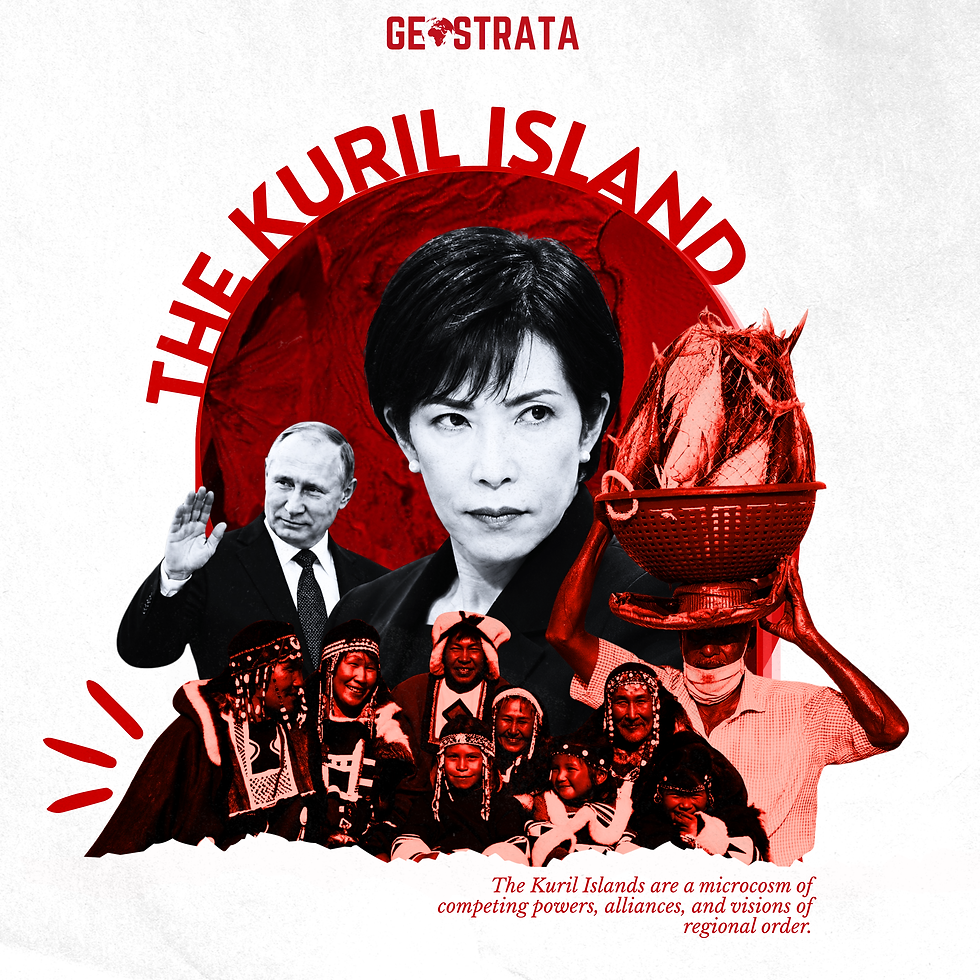
Illustration by The Geostrata
With this optimism, in 1992, Bush announced significant nuclear arms reductions and a moratorium on underground testing.
Alongside his Soviet counterpart, Mikhail Gorbachev, he signed the first treaty of the Strategic Arms Reduction Talks (START I). With this atmosphere for greater cooperation, many believed that the era of mutual assured destruction (MAD) was over.
Unfortunately, the past tense is correct. Three decades later, it is evident that such hopes for a benign nuclear order have not been fulfilled. Rather, we have now entered a new nuclear era with fears of a new nuclear arms race.
Fewer warheads are being dismantled each year, while the deployment of new nuclear weapons is accelerating. As Hans M. Kristensen at SIPRI said, “The era of reductions in the number of nuclear weapons in the world…is coming to an end”.
A FRACTURED NUCLEAR ENVIRONMENT
Today’s world has become more complex. Recent developments have escalated tensions among the great powers to a post-Cold War high. Putin’s nuclear threats, Xi’s accelerated weapons programme, and the growing momentum in the U.S toward a comprehensive nuclear buildup have raised the spectre of great power instability.
Trump’s recent order to immediately resume nuclear weapons testing at a level equal to China and Russia, reversing a 33-year moratorium, is being called a step toward nuclear anarchy.
Meanwhile, challengers to the nuclear status quo, North Korea, continues to expand its arsenal, and Iran, despite setbacks, is closer than ever to producing a nuclear weapon.
Hence, many experts now refer to the post-Cold War period as merely a "nuclear intermission," as the race for nuclear weapons, once thought a relic of the Cold War, has resurfaced.
Only this time, the race would be far more dangerous, with a three-sided confrontation now including China, coupled with greater manoeuvring by “middle powers” to earn a spot in the changing global order.
To make things worse, the focus on developing low-yield warheads, also referred to as tactical nuclear weapons, and increasing dual-use technologies such as dual-capable missiles is blurring the long-standing separation between conventional and nuclear forces.
This poses the risk of "conventional-nuclear entanglement," which would be catastrophic. Countries are also heavily investing in hypersonic weapons, whose speed and manoeuvrability make them hard to intercept with traditional defence systems.
Additionally, the advent of AI, cyberweapons, anti-submarine warfare, the possible weaponisation of space, and other technological advances would amplify the risk of nuclear war higher than ever.
CHINA'S BIG PLAY
The most momentous shift in the global nuclear order is China’s determination to become a nuclear powerhouse. But what explains this shift, given that China maintained only a minimal nuclear capability for decades?
The answer lies in China’s quest to attain parity with the arsenals of the U.S and Russia (both together possess around 90 per cent of all nuclear weapons). Under Xi Jinping, China has ordered a major modernisation and expansion of its arsenal.
Along with hundreds of new ICBM silos, it would include hypersonic delivery systems, an orbital warhead-delivery system designed to bypass U.S. missile defences, and a stronger submarine-based deterrent to ensure a second strike capability.
According to SIPRI, in just five years, Beijing has doubled its number of warheads to 600, and is estimated to reach 1,000 by 2030 and 1,500 by 2035, a shift that is not just qualitative, but equally quantitative.
This open-ended nature of expansion, abrupt departure from the long-standing minimalist policy, and China's vehement objection to participating in arms control negotiations have all contributed to suspicions about Beijing’s intentions.
Beijing’s changing nuclear posture is one of the major drivers of restructuring the global nuclear order from a bipolar to a multipolar order.
The ‘golden age of nuclear arms control’ that shaped the existing nuclear order, including frameworks such as the Nuclear Non-Proliferation Treaty (NPT) and the New Strategic Arms Reduction Treaty (New START), now risks becoming outdated.
CHINA-INDIA-PAKISTAN NUCLEAR TRILEMMA
South Asia is the only place in the world where three nuclear-armed nations sit in such proximity with violently contested borders.
This triadic nuclear relationship is further defined by asymmetry and divergent strategic doctrines. India maintains a credible minimum deterrent and a no-first-use policy, supported by a triad of nuclear delivery systems.
Pakistan, in contrast, pursues an explicit first-use posture with a full-spectrum deterrence that includes employing tactical nuclear weapons to lower the threshold against India's counter-force posture.
With so much ambiguity, what happens if just one player breaks the status quo? That uncertainty now casts a shadow over South Asia’s nuclear landscape, which is witnessing increasing entangled trends.
China's nuclear ambitions, with eyes on U.S capabilities, risk setting off a “chain reaction” in South Asia, influencing India's strategic calculus and, in turn, Pakistan’s.
Frequent India-Pakistan and India-China confrontations, Beijing’s strategic partnership with Islamabad, and New Delhi’s fears of a dual threat from China-Pakistan, all shape this evolving nuclear triangle.
Another threat is Pakistan’s persistent nuclear sabre-rattling. Its army chief, Asim Munir, recently warned about MAD, saying, “We are a nuclear nation; if we think we are going down, we’ll take half the world down with us.”
This showcases how the country overrelies on nuclear brinkmanship to achieve its strategic objectives. The threat of nuclear terrorism also looms large over fears of Pakistan’s control over nuclear stockpiles weakening.
This China-India-Pakistan triad raises strategic risks and instabilities, with experts stating that it arguably poses a greater risk to nuclear use than the ongoing three-sided race between China, Russia, and the U.S.
RUSSIA'S ERODING RHETORICAL RESTRAINT
Russia's nuclear doctrine centres on deploying nuclear weapons as a deterrent against NATO's military presence and potential encroachments. Since the 2022 Russia-Ukraine war, President Vladimir Putin’s nuclear rhetoric has become a permanent feature of the conflict.
Putin has warned about deploying nuclear weapons if Moscow feels threatened; he revised the nuclear doctrine to include targeting nuclear-armed states, such as the U.S, France, and the U.K., that provide aid to a non-nuclear belligerent fighting Russia, such as Ukraine, thereby lowering the threshold for nuclear use.
It suspended the 2010 New START treaty, which had reduced the Russian and U.S arsenals to their lowest in 60 years. The Kremlin has also deployed Russian nuclear weapons in Belarus.
In 2023, Putin formally revoked Russia’s ratification of the 1996 Comprehensive Nuclear Test-Ban Treaty (CTBT), bringing parity with the U.S, which signed but never ratified it.
This sabre-rattling strengthened Moscow’s war position and forced the U.S and its allies to weigh escalation risks carefully before aiding Ukraine. “No one has listened to us,” Putin said. “You listen to us now.”
Under renewed pressure over ending the war, Russia recently tested a nuclear-powered and nuclear-capable cruise missile, Burevestnik, and a nuclear-powered underwater weapon, Poseidon.
This escalation has significant consequences for the global nuclear order. First, it erodes the taboo against nuclear weapons use, which has been the foundation of nuclear deterrence theory and international stability since World War II ended.
Second, Russia’s strategy in Ukraine has provided a possible playbook for revisionist powers such as China and North Korea to use nuclear threats as a shield for regional aggression.
Third, Russia's posture complicates the strategic calculus of countries under the NATO-U.S. umbrella, such as Poland or Germany.
They may soon consider the unthinkable: acquiring their own nuclear capabilities or hosting these weapons under nuclear-sharing agreements. This would raise the probable threat of a regional arms race, accidental escalation, and even nuclear proliferation.
THE WEST ASIAN POWER STRUGGLE
The West Asian nuclear tug-of-war is primarily between Israel and Iran. Israel's policy of “nuclear opacity” acts as a strategic deterrent in an adversarial neighbourhood. Then there is Iran, whose nuclear ambitions, though framed as peaceful, have garnered increased international scrutiny.
Rafael Grossi, the head of the UN nuclear body, stated, “The [Iranian nuclear] programme runs wide and deep.” Tehran continues to advance its program, reducing the time required to build a weapon to potentially months.
Recently, weakened by the dismantling of its proxy network and the Israeli-U.S. strikes on its nuclear and military facilities, it has strengthened the resolve of Iranian hardliners for the rapid weaponisation of its nuclear capability.
An Iranian bomb, if built, would pose an existential threat to Israel, a worry that might prompt re-attacks and risk regional war.
An additional concern is that Iran’s nuclearisation could push regional rivals, including Saudi Arabia, to pursue their own capabilities. Talks of an Islamic NATO and Riyadh’s defence pact with Islamabad already signal a regional shift towards extended nuclear deterrence.
Additionally, great powers could be drawn in: the U.S supports Israel's security, while Iran's nuclear ambitions have brought it closer to Russia and China, reshaping not just the regional but global security itself.
EAST ASIA'S CONUNDRUM
Despite the global community’s efforts to prevent North Korea from acquiring nuclear weapons, it has developed an increasingly sophisticated nuclear arsenal since its first test in 2006. It has declared itself an "irreversible" nuclear nation and has repeatedly said it will never give up its nuclear weapons.
In 2024, North Korean leader Kim Jong Un called for a “limitless” expansion of the country’s nuclear programme.
Pyongyang has taken a series of steps, including adopting a nuclear law with an aggressive nuclear doctrine, a possible expansion of fissile material production for nuclear warheads, and the unveiling of new launch platforms for nuclear missiles.
Since 2022, North Korea has launched more than 100 ballistic missiles, including 13 ICBMs, marking an unprecedented level of provocations in the Korean Peninsula and beyond.
Add to this China’s regional assertiveness, Trump’s transactional diplomacy, his willingness to revive nuclear talks with Pyongyang, and the eroding credibility of the U.S. nuclear umbrella, and the result is Asia on the precipice of a nuclear arms race.
Such a shifting landscape has placed U.S allies such as Japan, South Korea, and even Taiwan in a dilemma: develop their own nuclear weapons or accept vulnerability.
In 2022, Japan revised its National Security Strategy (NSS), which signalled a significant departure from “security pacifism”. Japan is one country that is already assumed to have a latent nuclear weapons capability, a “bomb in the basement”, with the material and technical know-how to produce nuclear weapons within six months, according to some estimates.
Seoul has already declared nuclear weapons a policy option, an idea that enjoys nearly 70% public support. So, if more nuclear powers emerge on the global stage, it would be akin to opening a Pandora’s box that the U.S, with its extended deterrence, has fought for decades to keep closed.
Amid these volatile developments, an informal alliance of China, Russia, Iran, and North Korea, called the “Axis of Evil” by Western officials, is emerging.
The recent Xi-Putin-Kim bonhomie during China’s military parade was a chilling display of unity, which Trump blasted as “conspiring against the U.S”.
It raises the possibility of coordination or collusion among them; for example, a crisis on the Korean Peninsula could draw in Beijing, Moscow, and Washington, with each supporting its respective ally, creating a true nuclear nightmare.
CONCLUSION
The prospect that nuclear weapons might recede from global politics has thereby turned out to be an illusion. Instead, they are back with a vengeance.
The three pillars of the existing nuclear order, deterrence, arms control, and non-proliferation, are all under strain. This evolving dynamic marks a clear departure from the Cold War's bipolar structure towards a fragmented, multipolar nuclear environment.
As nations navigate this more dangerous nuclear landscape, some fundamentally important questions should be addressed: Are we entering a nuclear era that is more multilateral, more unstable, less constrained by arms-control agreements, and probably with additional nuclear-armed actors? Will this mark a shift from the prospects of a cooperative calculus to a zero-sum-based order? If so, how do we navigate this emerging nuclear age safely?
The ability of global humanity to address these urgent nuclear challenges will shape the trajectory of our collective future. Failing to act risks making Albert Einstein’s grim warning come true: “I don’t know what weapons World War III will be fought with, but World War IV will be fought with sticks and stones.”
BY GARIMA ARORA
TEAM GEOSTRATA


Comments