.png)


Isles of Importance: Strategic Relevance of the World's Most Contested Islands

On a map, they are almost insultingly small. A chain of islands so minute that the eye skips past them, drawn instead to the vast blue nothing surrounding them. But the ocean is not just an empty space. It is a highway. And an island is the only place you can build a tollbooth. And yet these fragments of territory, which are remote, often uninhabited, and ecologically fragile, are among the most contested pieces of land on earth. Empires were built to control them. Treaties have been broken over them.
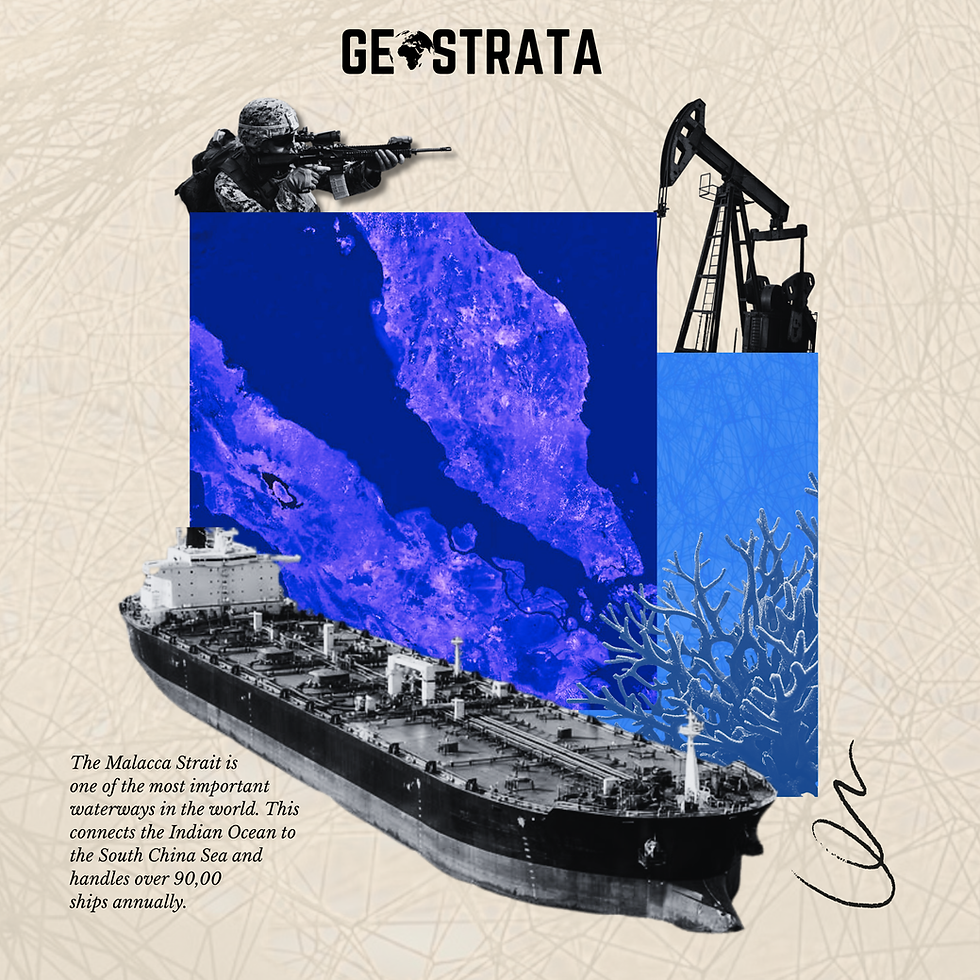
Illustration by The Geostrata
Armies have been stationed on them. And in the twenty-first century, as great powers jostle for position across the Indo-Pacific, the question of who controls which island has never been more consequential.Islands project power across water in ways that land borders cannot. They extend a nation’s Exclusive Economic Zone under UNCLOS, unlocking fishing rights, seabed resources, and energy deposits across thousands of square kilometres of ocean.
They sit astride chokepoints through which the majority of global trade must pass. They provide early warning, surveillance, and strike capability against adversaries operating at sea. And they support various ecosystems that are as important to the planet’s biological future as any military installation is to a nation’s security.
What makes an island strategically important? What are the chokepoints that determine global trade? How is China using islands it does not legally own? And what does India’s own island architecture from the Andamans to Lakshadweep mean for the balance of power in the Indian Ocean?
THE CHOKEPOINTS: THE HINGES OF GLOBAL TRADE
The Malacca Strait is one of the most important waterways in the world. This connects the Indian Ocean to the South China Sea and handles over 90,000 ships annually, carrying approximately 30% of the world’s traded goods. For China specifically, the strait is essential, because over 60% of China’s trade and 80% of its oil imports pass through this single bottleneck, a strategic vulnerability that former Chinese Premier Hu Jintao openly described as the “Malacca Dilemma.”
At its western entrance sit the Andaman and Nicobar Islands, which serve as an important geopolitical lever for India. The Malacca Strait is not the only case. The Sunda Strait, the Lombok Strait, and the Ombai-Wetar Strait are alternative passage routes that Chinese naval planners have mapped as contingencies. The Nine Degree Channel, which is named after the latitude running through Lakshadweep, carries billions of dollars worth of trade between Southeast Asia and the Middle East.
The Ten Degree Channel, in the Andaman and Nicobar region, connects the Suez Canal and Persian Gulf routes to East and Southeast Asia. India’s two principal island territories sit astride both, and in the past decade, India finally began to build infrastructure commensurate with them.
Diego Garcia, the largest island in the Chagos Archipelago, demonstrates what a strategically placed island can do for a global power. Located at the geographic centre of the Indian Ocean, the US-UK military base on the island is 2,570 miles from the Strait of Hormuz and 2,390 miles from the Bab al-Mandeb Strait. It has launched operations in Afghanistan, Iraq, Yemen, and against Iran.
In October 2024, B-2 Spirit stealth bombers conducted strikes on Houthi positions in Yemen from its runway; this was the first confirmed B-2 combat employment from the island. A single coral atoll, which was barely visible on a world map, has now impacted a major world conflict, and the world still remains oblivious.
INDIA’S ISLAND ARCHITECTURE
India’s island territories are among its most underutilised strategic assets; this fact is what the Indian government has started to correct. The Andaman and Nicobar Islands consist of 836 islands covering 8,249 square kilometres, of which only 31 are inhabited. Their EEZ extends across 5,95,217 square kilometres, which is approximately 30% of India’s entire maritime zone.
India’s only tri-service theatre command, the Andaman and Nicobar Command, established in 2001, coordinates Army, Navy, Air Force, and Coast Guard operations from Port Blair and is now renamed Sri Vijaya Puram. Air Marshal Saju Balakrishnan, the commander-in-chief, has stated publicly that thinking about the islands has shifted from “just holding territorial integrity” to developing them as “strategic outposts.”
A 310-kilometre highway connecting North and Middle Andaman to South Andaman has been doubled-laned. Bridges have replaced ferry crossings over two straits. IAF stations are being upgraded to support fighter squadrons for extended durations, with runway expansions enabling combat aircraft deployment.
The National Remote Sensing Centre has been tasked with increasing satellite image analysis across 55 inhabited islands in Andaman, Nicobar, and Lakshadweep. Meanwhile, China is constructing military facilities on Myanmar’s Coco Islands, situated directly north of the Andamans.
These Chinese developments have lent further urgency to India’s infrastructure timeline.
Lakshadweep presents a different but equally consequential case. Thirty-six islands with a total land area of just 32 square kilometres confer upon India a 400,000 square kilometre EEZ in the Arabian Sea.
The commissioning of INS Jatayu at Minicoy Island in March 2024, with plans for a new airstrip capable of operating Sukhoi-30s and Rafales, signals India’s intention to develop Lakshadweep as a forward-operating military base in the Arabian Sea, guarding the Nine Degree Channel and monitoring the western approaches to the Indian Ocean.
THE DRAGON’S ISLAND STRATEGY
No country has pursued the island strategy more aggressively in the twenty-first century than China. Since 2014, China has conducted rapid and large-scale land reclamation across seven features in the Spratly Islands, creating approximately 12.9 square kilometres of artificial land. This is sixty times more than all other claimants combined during the same period. On these reclaimed features, China has built ports, military installations, radar systems, and airstrips capable of hosting combat aircraft.
The 2016 UNCLOS tribunal ruling found that China’s claims in the South China Sea had no basis in international law. The construction continued. The Paracel Islands, seized from Vietnam in 1974, now host fighter jets, cruise missiles, and a full radar system on Woody Island. Through these features, China can monitor activity across the South China Sea, through which 80% of China’s oil imports flow.
China’s island strategy operates not only through reclamation but through influence, and its clearest current expression is the Maldives. Following the election of President Mohamed Muizzu in 2023, the Maldives expelled Indian military personnel, elevated ties with China to a Comprehensive Strategic Cooperative Partnership, and signed 20 bilateral pacts with Beijing in a single meeting. A Chinese military delegation visited the country and signed an MOU on military cooperation.
China has also invested in a Maldivian airport and controls several islands within the region. The Maldives sits astride the primary sea lanes connecting the Middle East and Africa to Southeast Asia, which has made the direction of travel clearer than it ever has been in the past few years.
THE UNDERWATER IMPORTANCE: BIODIVERSITY AND THE ECOLOGICAL STAKES
The strategic importance of islands is not just the military installations and shipping lanes. Beneath the surface of the same water lies an ecosystem of global consequence, one that is simultaneously India’s richest biological inheritance and its most rapidly disappearing one.
The coral reefs surrounding India’s island territories are the most biodiverse marine ecosystems in the country.
The Andaman and Nicobar Islands alone have a coral cover of 1,021 square kilometres, making it India’s largest, followed by the 934 square kilometre coverage in Lakshadweep. However, this is more than just ecological trivia. Reefs are crucial as they are a means for the coastline to fend off storm surges, the basis of fisheries on which poorer communities along the coast have no choice but to depend, and the basis of tourism, without which the economy will have nothing to offer to visitors.
Tourists visiting the reefs of Andaman and Nicobar Islands number close to 2 million, providing revenues worth about ₹1,200 crore each year, but that does not include the 5 million fishermen who depend on reef-supported biodiversity for their livelihood, or the protection from the sea that the reefs offer to islands that do not have any higher land to escape the rising tides.
The crisis is equally significant. A 2022 study by the Wildlife Institute of India found that more than 50% of reefs in the Andaman and Nicobar region have experienced bleaching due to rising sea surface temperatures. In Lakshadweep, widespread bleaching affected 84.6% of reefs during the 2016 El Niño event, and recovery has still not been achieved to this date.
The connection between the ecological health of these islands and strategic value is not incidental. As India accelerates military development across its island territories, the question of how to build without destroying what makes the islands worth defending is one that cannot be overlooked.
Islands have always been where the world’s largest ambitions meet its smallest geographies. India has the islands, the law, and a continuity in the growth of architecture. Whether it can hold all three together, the strategic, the economic, and the ecological importance, without sacrificing one to the demands of the others, is the defining island question of our time.
BY RAGHAV GUPTA
TEAM GEOSTRATA


Comments