.png)


From Partition to Protest: The Unfinished Story of PoK

“The Pakistani state’s oppression on its own people is a reality, which becomes into an cowardly irony whenever they face off against their avowed enemy, India.”
A THROWBACK IN TIME
The partition of India was not just a political division; it separated millions of people who had once fought together for freedom. It was based largely on religious demographics, creating Pakistan as a separate homeland for Muslims, while the rest became India. The real challenge was not drawing borders, but separating communities that had lived together for generations. Families were separated overnight; people abandoned homes, businesses, farmland, and memories. In the chaos, the princely states faced a critical choice: join India, Pakistan, or stand alone.

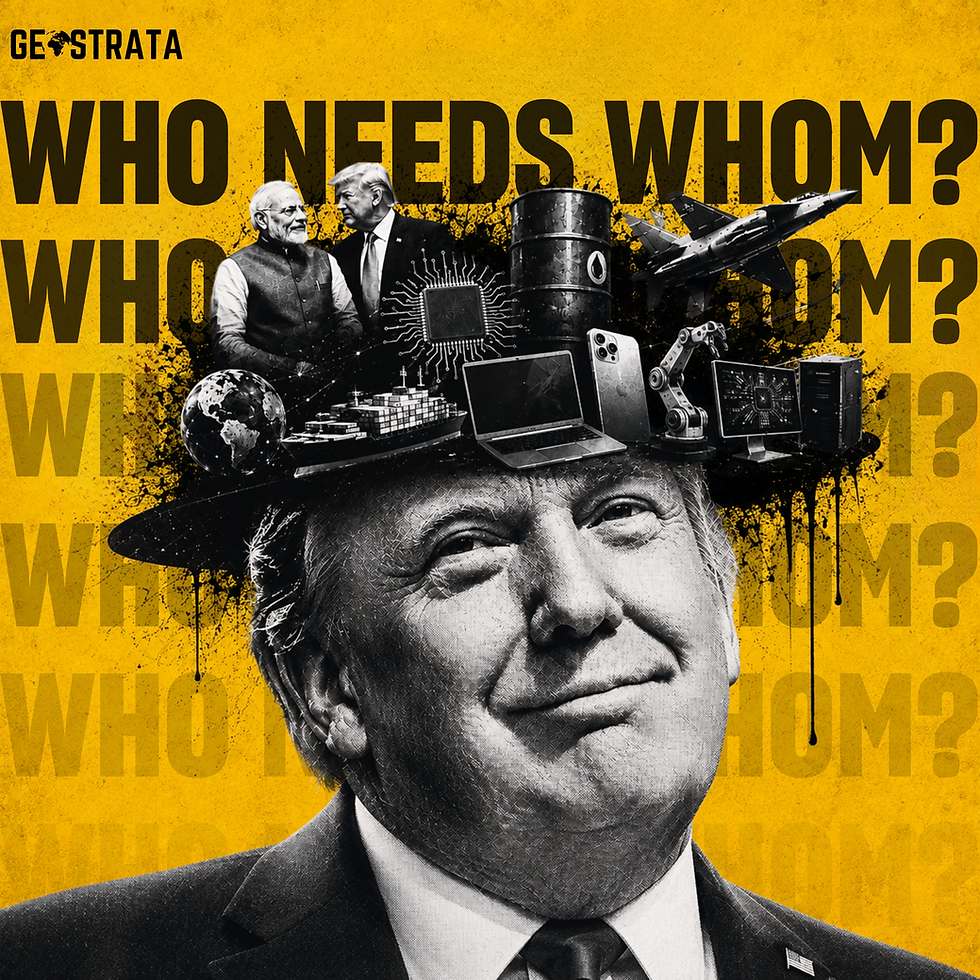
Illustration by The Geostrata
Maharaja Hari Singh, the ruler of Jammu and Kashmir, initially hesitated. But history remembers what followed: Pakistan didn't wait for a diplomatic choice; it sent armed tribal proxies to invade and seize the territory by force. Left with no choice, the Maharaja turned to India for military assistance, signing the official Instrument of Accession on October 26, 1947. Jammu and Kashmir formally acceded to India.
UN TO THE RESCUE
The conflict soon escalated into the first Indo-Pak war, which lasted until January 1, 1949, when a United Nations-brokered ceasefire came into effect. The UN proposed a three-step resolution: Pakistan was to withdraw its forces from the region, India was to gradually reduce its military presence while maintaining law and order, and finally, a plebiscite was to be conducted to allow the people of Jammu and Kashmir to decide whether to join India or Pakistan.
Pakistan has spent decades crying out for a UN referendum on the global stage, yet they are the single reason it never happened. However, Pakistan never withdrew its forces from the occupied territories, which prevented the conditions for the plebiscite from being fulfilled. India was forced to maintain its military presence purely to defend its borders against continuous aggression. The temporary Ceasefire Line of the 1949 Karachi Agreement solidified into what we know today as the Line of Control (LoC)— the starting point for the human rights crisis that continues to torment the region they illegally occupy.
UNDERSTANDING THE CRISIS IN THE PRESENT
The present-day POK is divided into two regions, namely Azad Jammu and Kashmir(AJK) and Gilgit-Baltistan. It's a living irony that “Azad,” which means free, is far from its true meaning for the region.
AJK shares the western border with Pakistan’s Punjab and Khyber Pakhtunkhwa provinces and the eastern border with the Indian administered union territory of Jammu and Kashmir, along with the LOC. The region has its own administrative structure with a Prime Minister, heavily dependent on Pakistan's federal government. Gilgit-Baltistan, on the other hand, is six times larger than AJK, and is situated in the north, being bordered by Pakistan on the west, Afghanistan to the north, China to the north and northeast, and the Indian union territory of J&K and Ladakh to the southeast.
The local population has long been demanding that the region be formally integrated into Pakistan. It is also a gateway for the China-Pakistan Economic Corridor(CPEC). Besides the Venus illegality of Pakistan in controlling the reason wasn't enough. Without any proper agreement or voice of the people, the Akshardham valley, a strategic height east of the Karakoram range, was handed over to China, which today is the infection point of the rather infamous CPEC.
From discriminatory land rights, to forceful religious education, farcical counter-radicalisation techniques, and military boots on the freedom of expression and association have all taken their toll on the mindset of the citizens. And this only justifies their angst against the state in the way they are reacting, slowly drawing a leaf out of the Baloch booklet of independence struggle
PEOPLE'S STRUGGLE IN THE PRESENT
The unrest in PoK today reflects years of political and economic dissatisfaction. Decades of systemic neglect have left ordinary people fighting just to survive amidst skyrocketing unemployment and unaffordable prices for basic necessities like flour and electricity. When citizens took to the streets in Muzaffarabad, Rawalkot, and Mirpur to demand their basic rights, security forces responded with force against demonstrators, opening fire and killing more than a dozen protestors.
Cities including Muzaffarabad, Rawalkot, Mirpur, Bhimbar, and Kotli witnessed widespread shutdowns, transportation halts, and heavy security deployment as authorities attempted to suppress the unrest. The Joint Awami Action Committee (JAAC), one of the leading groups coordinating the protests, was declared “unlawful” under anti-terror provisions — a move widely criticized by activists and observers as an attempt to silence dissent rather than engage with legitimate public concerns. And if this wasn't enough, a brutal internet and communication shutdown was enforced on June 5, which has limited the stream of brutality videos that were starting to come out as a fallout of these protests. With local leaders being picked up, sedition cases being filed, forces being deployed to stop citizen marches, all of these are just the tip of the human rights violations, being state-sponsored.
The movement in PoK is not demanding privilege — it is demanding basic human rights: economic stability, political representation, and the right to govern themselves. Among the protesters’ demands is the abolition of the 12 reserved seats in the PoK Legislative Assembly allotted to Kashmiri refugees settled across mainland Pakistan since 1947. Protesters argue that these seats have long allowed Islamabad to influence the region’s political structure from afar. Since the constituencies lie outside PoK, the ruling party in Pakistan often secures all 12 seats, tipping the balance of power, shaping the government in Muzaffarabad, and tightening Islamabad’s control over the region. The food for thought in all of this is that the meat of the Pakistan jihadi terror model is majorly fed and given to foot soldiers from this region itself.
PoK and Gilgit Baltistan remain politically overlooked and economically limited, caught within Islamabad’s rigid administrative control that has left little room for local autonomy. Such is a state of affairs in the region that there is no conclusive data available for basic human indicators showcasing signs of a failed state, doing the bidding of Mullah Marshal Asim Munir.
FORCED NATIONALITY OF A FAILED STATE
For many on the streets today, the issue goes beyond politics — it is about the frustration of being governed by decisions made outside their land, by people they never elected to represent them. In addition to this, the issue of describing the Kashmiri language and culture has been a slow and steady process undertaken by the dominantly Punjabi Pakistani state, from settling soldiers to induce a demographic divide and non impacts given to the Kashmiri language in public education soon made Punjabi and Urdu the chosen choice of languages in the region.
The standards of incompetence and administrative paralysis are appalling. The persistent use of violence, today in the day and age of social media, has seen videos of unarmed citizens being shot and taken out as threats, leaving the world baffled.
However, the pocket media of the mainstream state seems to be in delusion, with no coverage of these protests. In fact, the protest rally in Rawalkot, which attracted a crowd of over 80,000, also got no media coverage.
And now it seems the patience is running thin, with local police and rangers being beaten, stoned, stripped of their uniforms, and in some cases being lynched. Well, sure, these protests have the intensity, like no other before, but how long before they lose steam or bow down against brutal state violence is an instance to be seen.
PAKISTAN AT HISTORY'S CROSS ROADS
The fun fact here is that the Pakistani state and its penchant for gross human rights violations are not new. From the erstwhile East Bengal, where forceful racial change and rape camps were a site to be held, to the butchering of Baloch dissidents, to now using live ammunition like a practice range on protestors. The state has shown itself to be a limitless macabre of violence. However, this very state cowers behind the lamp post like a wet cat when it comes to fighting India, as seen during Operation Sindoor, when Mullah Marshal Munir went into a bunker, hiding. This very state is seen as a loyal dog to its masters in Washington and a donkey to its “loan giver in chief” in Beijing. However, what has never been seen since its creation in 1947 is an earnest mother who can take care of her citizenry as children.
BY RITU SEHRAWAT AND KAUSHAL SINGH
CENTRE FOR POLITICS AND LAW
TEAM GEOSTRATA


At 2:37 AM, with your tracking page frozen on “Out for Delivery” and panic setting in, UniUni’s customer service can feel unreachable because their support operates within limited hours. Their call centers are open Monday through Saturday, 10 am to 9 pm EST, so middle-of-the-night queries will go unanswered until morning .
Thank you for publishing such a well-researched and thought-provoking article. Regardless of readers' individual perspectives, it's important to have access to detailed historical context and informed analysis when discussing complex video quality enhancer free online geopolitical issues. I appreciated how the article connected historical developments with more recent events, encouraging readers to look beyond headlines and consider the broader picture.
Hello, I’ve been reading about how digital platforms manage continuous improvements, and it’s actually quite interesting how update systems are structured to avoid disrupting the user experience while still adding new features and fixing issues. In many cases, platforms like jackpot fishing use flexible backend architecture where updates are rolled out gradually, ensuring stability while enhancing gameplay and interface performance. I also came across a discussion on Jackpot Fishing where they explained how systems like help maintain smooth integration of new features without affecting ongoing user sessions, which makes the whole experience feel seamless and dynamic. What I find most interesting is that modern update systems are no longer just about fixing bugs — they are becoming part of the…
Hello friends, I came here to ask, how the update system works in digital services, what can you advise me? I would be very grateful.