.png)


Why Are Papers Leaked In India?: Supply Chain, Capacity, and Incentives

On the morning of May 3, 2026, millions of Indians sat down in examination halls across India to write the NEET-UG examination to fulfil their dream of becoming doctors. Nine days later, the path to this dream was unceremoniously stopped by an all-too-familiar feature of the education system in Indian democracy. Across the SSC exam and state exams, yet another paper leak declared this path closed. Even the National Testing Agency (NTA) declared that the exam was cancelled and would be conducted again.
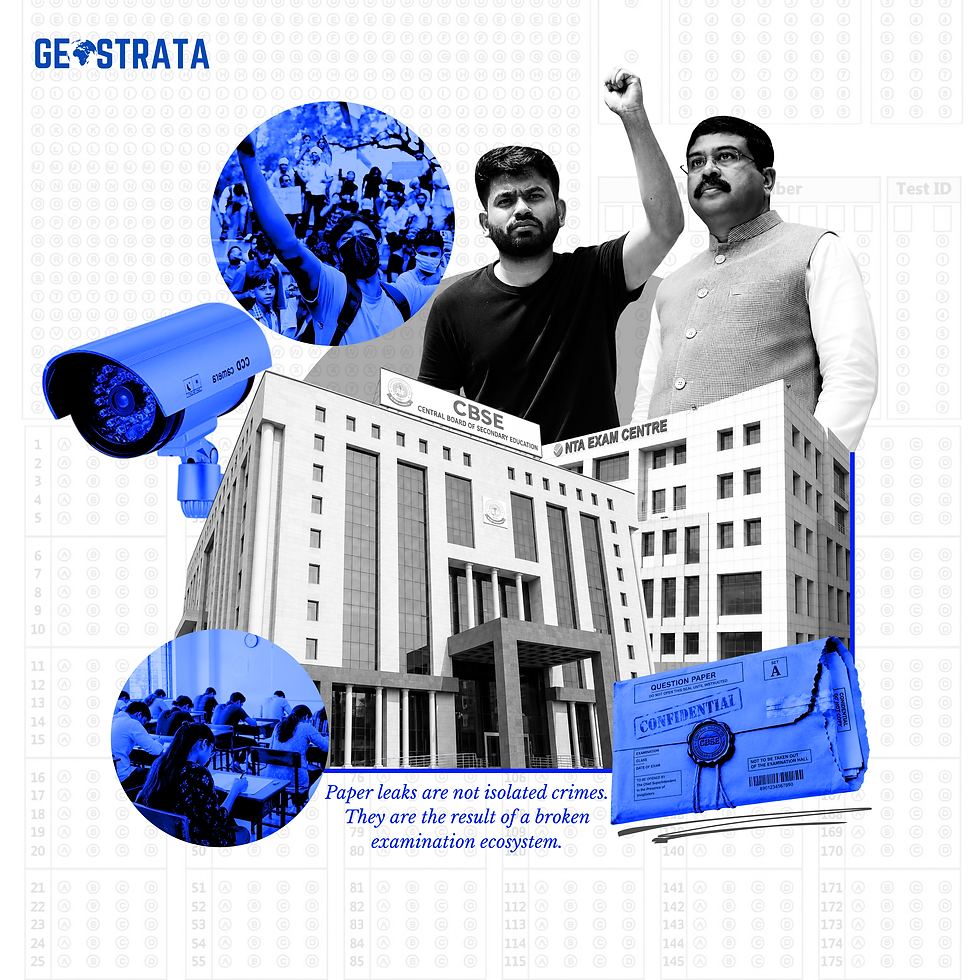
Illustration by The Geostrata
This announcement was followed up with 6 weeks of chaos, the rush to reschedule, rumours of a second leak days before the June 21st retest, a CBI probe, and, threaded all too deeply into it, the rage of young aspiring medical students, rightly angry because of the announcement. Amongst all this, the government acted swiftly, involving the air force in the supply chain of delivering papers to avoid a second leak, banning the Telegram app, and imposing such stringent measures to ensure transparency.
While that all sounds great, such expensive and lofty arrangements expose the concession even the education minister has made: the entire supply chain of printing, distribution, and question setting in Indian competitive exams is unreliable and was rejected by even the government to avoid a second leak.
Even when the government does not trust the set process, it raises serious questions as to how even the digitisation of the paper next year would prevent a leak next year.
LEAKS ARE A TRADITION, NOT AN ACCIDENT
The reading of the NEET-2026 paper leak in India or any paper leak in India as an isolated criminal act mischaracterises the entire issue as it stands. India has recorded more than ninety documented instances of examination leaks and irregularities in the past 20 years, and at least fifteen involved central agencies rather than state boards.
The lineage of leaks runs way back to the CBSE-conducted AIPMT cancelled in 2004, and the IIM common admission test compromised the year prior; the CBI chargesheeted 52 people, several doctors, for using a pen-sized scanner called the DocuPen to smuggle out the AIIMS postgraduate medical entrance paper.
Extending on a similar line, the Vyapam scam in 2013 in Madhya Pradesh morphed into one of the largest exam fraud controversies in Indian history, implicating bureaucrats, middlemen and politicians with dozens of suspicious deaths of witnesses and accused members of the scam. JEE Main 2021 saw the CBI register a case against a private entity accused of manipulating the online exam process from the inside. NEET alone has, in record form, delivered controversies in 2019, 2021, 2024 and even 2026 now.
The resignation of a minister, a bureaucrat, or a government is not what connects this decades-long pattern seen in this process.
Institutional security capacity and the journey of that question paper from the point of setting questions to the point of distribution are so long that no aforementioned entity can truly stop a leak in a system where every additional middleman is a covert name for the possibility of additional corruption.
LEAKS ARE INVEVITABLE IN THE STATUS QUO
Primarily, the exam system in India is poisoned by the problem of scarcity. NEET alone is the gateway to more than a lakh MBBS seats every single year for roughly 20 lakh applicants. When the application-to-selection ratio is that lopsided, the creation of a black market is inevitable. The very prospect of it being a government exam unlocks immense attractive benefits which are otherwise closed off in the form of a stable income guarantee, low government college fees compared to private ones, status and social mobility that few professions in India enjoy.
Accumulating all these benefits, in addition to the age-old popular notion in India to become a doctor, engineer, or get a government job, makes paper worth crores of rupees for organised networks. Coaching hubs in Bihar, Jharkhand, Rajasthan and Gujarat have developed their very own cottage industries around this specific business of paper leaking. The economic incentive is powered by scarcity and is the very engine of the entire issue.
Secondly, a paper travels from a setter to a printing press, to strong rooms, to bank lockers, to police custody and then to the exam centre. This process often occurs across state boundaries and passes through private vendors. In this entire supply chain, all it takes for one to leak the paper is one corrupt individual in any of these supply points amongst thousands that come into proximate contact with it. The NTA outsources most of this to third-party service providers, and it is exactly at these handoff points where most leaks actually occur.
Third, much like most Indian sectors, ambition has never been backed by capacity when it comes to the process of conducting examinations.
The NTA was created to relieve CBSE from conducting mass examinations, and it now administers NEET, JEE, UGC-NET, CUET and others for millions of candidates every year. Yet it remains an administrative body relying on outsourced logistics, without the cybersecurity or even basic personnel-vetting infrastructure that this process demands.
HAS ANYTHING BEEN DONE?
The most significant reform to date remains the Public Examinations (Prevention of Unfair Means) Act, 2024. However, it is worth noting that this is because it is, in effect, the only true law related to the subject in Indian history. Passed by Parliament in February 2024 and notified into force on, ironically, June 21 that year, in the aftermath of the NEET-UG scandal, the act criminalises a set of "unfair means," from question-paper leaks to impersonation to tampering with the technology used in exams.
It reserves its sharpest punishments for organised crime, and any examination authority or service provider found complicit is stipulated to face up to ten years in prison, along with fines up to one crore rupees, and non-compliant private vendors can be barred from conducting public exams for four years as part of the legislation.
Alongside the law, the NTA layered on operational fixes in the form of police-escorted transport of papers; CCTV coverage at centres; biometric verification; tighter monitoring of coaching hubs and messaging platforms, and as visible in the run-up to the 2026 re-exam, a dedicated portal for reporting fake leak claims, since misinformation about leaks in itself is a recurring crisis.
Several states have layered their own exam-security legislation on top of the central act to ensure security for these exams. States like Tamil Nadu, in recent times, have also gone as far as suggesting that other academic avenues be opened up for students to use as academic criteria in their pursuit of a medical college seat. Student groups like the Students' Federation of India (SFI) have also gone as far as demanding NEET be abolished.
IS THIS ENOUGH?
Measured against the defined and elaborated-upon scale of the problem, the answer, unfortunately, is not yet. While the 2024 Act is a genuine advance, it punishes leaks after they have already happened, adding wider redundancy to any fixes, considering even recently, the necessity for fast-track courts for the 2026 leak has shown how enforcement has not worked to the extent necessary for these exams.
India passed this Act in 2024 and still saw a crisis in May 2026, suggesting that pursuing deterrence as the primary policy tool to avoid leaks cannot compensate for a supply chain that, in its current form, will always be unreliable.
Even if enforcement does happen, due to limited capacity, investigations take months and prosecutions under the new law are hardly ever tested in courts.
This creates a need for something to show for as a resolution, and hence the pattern of arresting couriers and small-time solvers while the financiers and masterminds of these networks evade conviction has not visibly changed. Even now, nobody has questioned whether a single, high-stakes, paper-based national exam for millions of candidates on a single day is itself a design flaw.
Countries that have moved to staggered, computer-adaptive testing across multiple windows, while the government is exploring such a system for NEET 2027 along with the process of digitisation to ensure, like international systems, it reduces the value of any single leaked paper to near zero and removes the incentive of conducting the crime in the first place. However, how the 2027 process, even with digitisation, would translate on the ground is yet to be seen due to the rural-urban divide.
Until the issue of paper leaks in India is treated with the recognition of the problem being supply chain, capacity, and incentives rather than a crime to be prosecuted after already being done to create deterrence, perhaps the nation will be writing this same essay in 2028.
BY KRISH
TEAM GEOSTRATA


Comments