.png)


Democracy in Disguise: Understanding Modern Autocracies

Historically, various forms of governments have emerged, ranging from coercive– authoritarian, totalitarian, dictatorial, despotic, fascist, autocratic, to participative models like democracy. Somewhere between the spectrum lie forms of governance like monarchy, oligarchy, kleptocracy, and the very recent ones like broligarchy. These terms may sound similar and at times used interchangeably, but their essence does differ- Same, Same but Different!
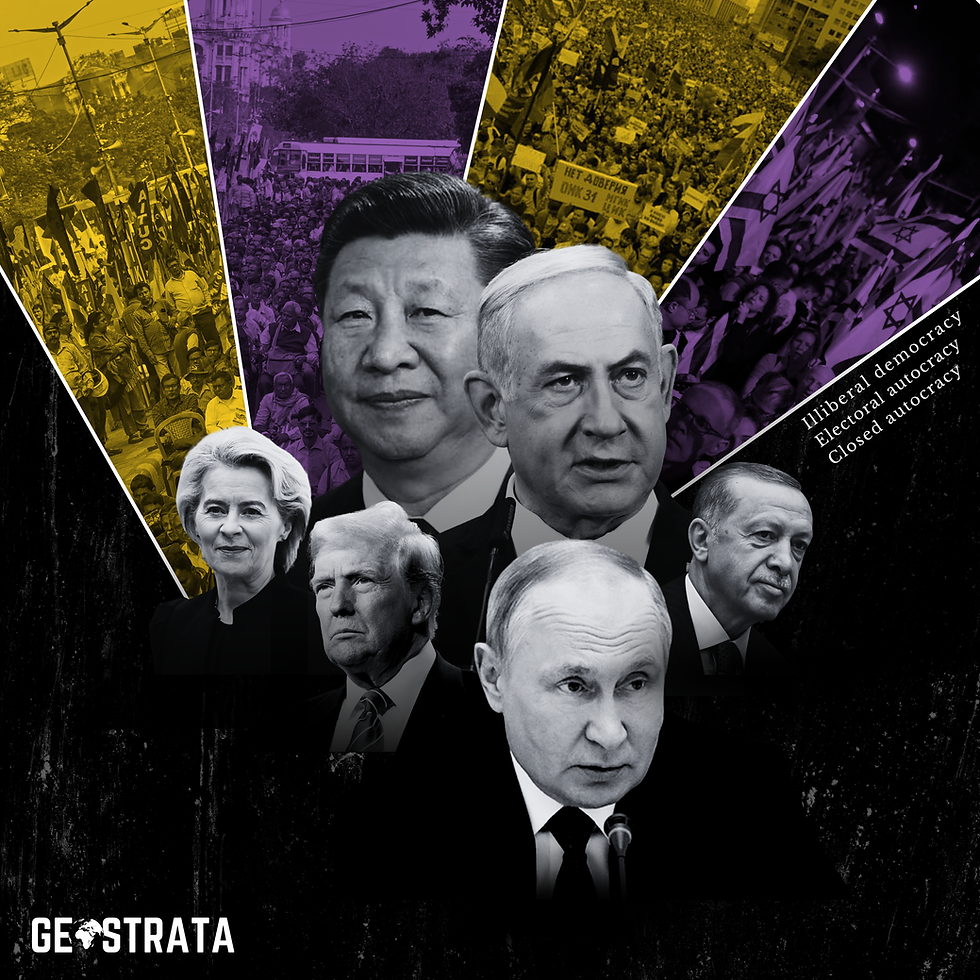
Illustration by The Geostrata
The true essence of these terms in the real world goes far beyond their literal meanings. It's essential to comprehend the innate spirit of these nerdish terms, which continue to define and gauge the nature of contemporary governments in an increasingly nebulous geopolitical space. In this article, we focus on “pseudo-democracy”, a variable of autocracy which involves illiberal democracy, electoral autocracy, and closed autocracy.
THE EMERGENCE OF PSEUDO-DEMOCRACIES
Autocracy stems from Greek words ‘autós’ meaning ‘self’ and ‘krátos’ meaning power, which translates to ‘rule by oneself’, a system of government by one person or a group of people with absolute power. Whereas Democracy originates from Greek words ‘dêmos’ and ‘krátos’, translating directly to ‘rule by the people’.In modern times, what we see is the emergence of masked democratic states.
A layman perception says that autocracies do not elect their leaders, and while that is often the case, autocratic leaders do use democratic means to gain power. Autocratic and democratic methods are blended creating democratic grey areas.
Politicians use democratic means, the very obvious one- “elections”, to enter power and then gradually erode democratic principles subtly, taking the avatar of autocracy. Modern autocracies or pseudo-democracies attempt to borrow legitimacy through the establishment of non-autocratic institutions, based on doctrines of popular rule, like parliaments, assemblies, political parties, courts, and legal codes, which are essentially facades for their exercise of power.
ILLIBERAL DEMOCRACY, ELECTORAL AUTOCRACY, AND CLOSED AUTOCRACY
Bypassing the paradigms of democratic constitutionalism and counter-democracy, governments have succeeded in altering the political fabric. Illiberal democratic governments come to power through elections but later suppress opposition, undermine constitutional limits, and restrict rights.
Electoral autocracies do conduct elections but fail to reach democratic standards of freedom of fairness. Closed autocracies hold non-competitive elections with only one party or pre-approved candidates, with the intention of maintaining order, gauging public sentiment, and establishing a veneer of international legitimacy.
They engage in cycles of responsiveness before uncontested elections to assure citizens of their competence and raise popular support. The prime examples of closed autocracies are North Korea and China, and others are Cuba and Laos.
Illiberal and electoral autocracies are relatively more subtle as well as treacherous at times than closed autocracies. They can prove to be unscrupulous and oppressive to the very population that has given them the power and authority to govern. These types of governments suppress political opposition, violate the principle of judicial independence, practice corruption, place pressure on the media, foster anemic rule of law, and manipulate electoral processes.
These pronounced faults are more corrosive than flawed democracies in the realms of underdeveloped political culture, low levels of participation in politics, and issues in the functioning of governance. This article further discusses the real embodiments of such pronounced faults.
EUROPEAN UNION IN PERIL OF ILLIBERAL DEMOCRACIES
Democratic backsliding has become a hot topic in the EU, and there have been several talks and numerous examples of democratic erosion in EU Member States – and in the EU itself, with Hungary and Poland being the forerunners. The Fidesz and PiS governments have undertaken political reforms that turn citizens into mere spectators and willing objects of propaganda and disinformation, facilitating the transition to autocracy.
Hungary and Poland continue to use their EU membership for credibility, while rejecting European democratic norms. These dynamics can be described as an ‘authoritarian equilibrium’, where autocratic-leaning governments exploit EU rules, money, and structure without following the EU’s core values with little to no repercussions. Autocratization in Europe affects seven EU member states and two of its main allies – the UK and the USA. It is a paradox the EU has yet to resolve.
TURKEY: A TEXTBOOK EXAMPLE OF HOW COUNTRIES BECOME AUTOCRACIES
President Recep Tayyip Erdoğan and his Justice and Development Party (AKP), which has ruled Turkey since 2002, have become increasingly authoritarian in recent years. In their initial term, they didn’t take significant steps to dismantle the already fragile state of Turkish democracy.
However, in their second term, the AKP gradually began capturing state institutions, stacking courts, and slowly shrinking civic space, through a dominant state led by charismatic figures and supported by constitutional interpreters who have corroborated the misinterpretation of the tenets of the rule of law.
This makes it an Illiberal democracy even if its constitution says that it is a presidential representative democracy.
THE MOST COMMON REGIME TYPE IN THE CONTEMPORARY WORLD
The most common regime type in the world is electoral autocracy. This category spans every continent, from Sub-Saharan Africa to South Asia and parts of Latin America. The prime example of this is Russia under President Vladimir Putin with his loyalist security forces, a subservient judiciary, a controlled media environment, and a legislature consisting of a ruling party and pliable opposition factions.
Democracy is not measured by the rights of a regime’s favored population but by the rights of all people living under its control. Israel exercises absolute authority (and constantly pushes for more control) over millions of Palestinians in the West Bank, East Jerusalem, and Gaza. This makes the world perceive it as an electoral autocracy. Political scientist Steven Levitsky, one of the world's foremost experts on the disintegration of democracies, says, “As an American Jew who wants Israel to be a democracy, it's hard to be optimistic”.
The USA also loses its long-term status as a liberal democracy, for the first time in over 50 years. The derailment of democracy is marked by executive overreach, undermining the rule of law, along with far-reaching suppression and intimidation of the media and dissenting voices under Trump’s presidency.
In the USA, the judicial system – and in the end, the Supreme Court – is likely to be vital in stopping Trump’s administration's autocratic advances.
The assertions made by the V-Dem report, though lacking transparent benchmarks, suggest that the world had 92 autocracies and 87 democracies by the end of 2025. 74% of the world population (6 billion) now live in autocracies. Only 7% of the world population (0.6 billion) live in liberal democracies. The world has never before seen as many countries autocratizing at the same time as during the last few years of the “third wave of autocratization”. Freedom of expression is the hardest hit: 44 countries are witnessing a decline in 2025. Media censorship remains the most common tactic among autocratising governments, with 32 countries (73%) employing it.
INDIAN DEMOCRACY: DISTINCTIVE IN ITS OWN RIGHT
According to biased Western experts, India too is now being considered to be drifting into the realm of “electoral autocracy,” steadily falling lower in democracy indices, confirming the erosion of the country’s democratic credentials since the BJP government took power in 2014. But this perception suffers from a high degree of temporal myopia. India's electorate is a strong safeguard against authoritarian tendencies.
The result of the 2024 general elections supports this- despite expecting an overwhelming majority, the ruling party fell short of it and was required to form a coalition government. Any deviation towards electoral autocracy or any other form of authoritarianism has historically faced an electoral pushback, reinforcing the self-correcting nature of Indian democracy.
Applying Western frameworks to analyze Indian democracy can be misleading, given India's unique socio-political landscape shaped by over 5,000 years of history. A deeper understanding of Indian democracy necessitates a consideration of its indigenous historical and cultural context rather than relying solely on external yardsticks.
BY VEDIKA KAUSHIK DWIVEDI
TEAM GEOSTRATA


Comments