.png)


China's Cognitive Warfare: The War Nobody Sees

When China deploys warships to the Taiwan Strait or when it funds a port in Hambantota or finances a railway through the Sahel, the world notices. But when Beijing rewires how populations think, what they fear, and who they trust, the world largely looks away. This is Cognitive Warfare, the world's most consequential battlefield of the 21st century, the one that's least understood.
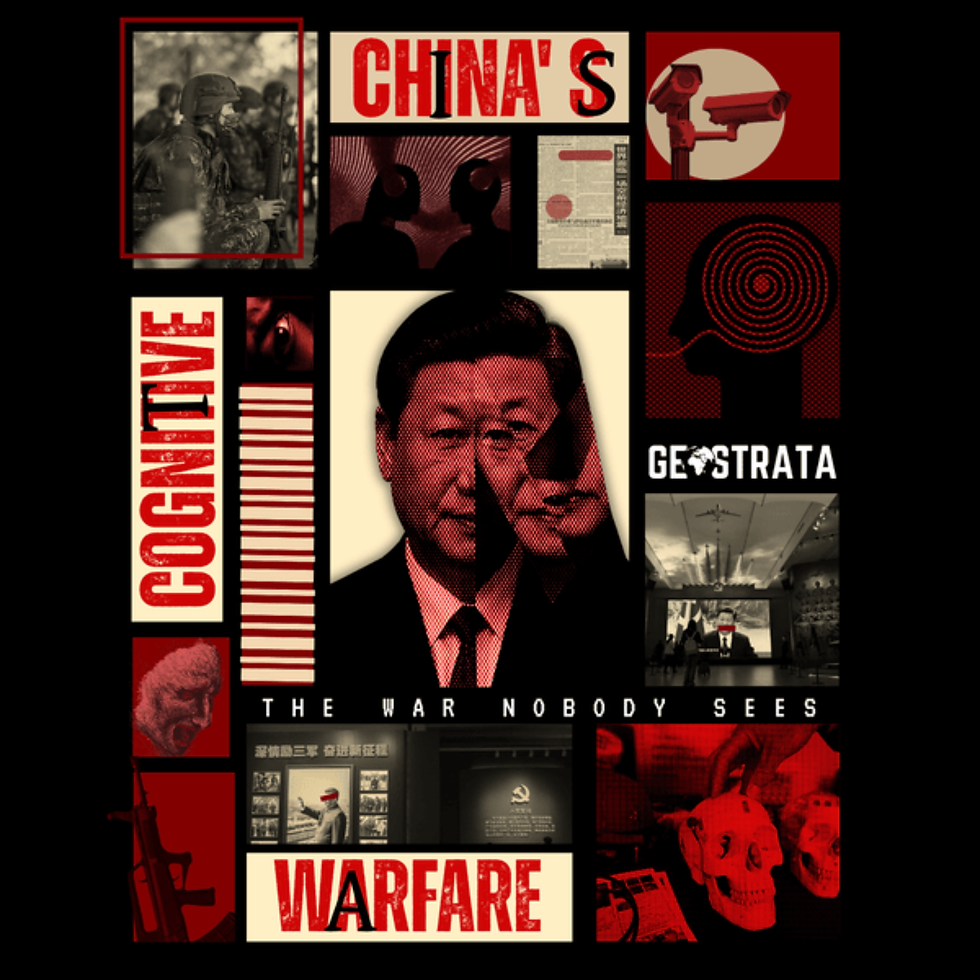
Illustration by The Geostrata
China calls it ‘public opinion warfare,’ which is one of the three warfare doctrines formalised in the 2003 amendment to the People's Liberation Army's Political Work Guidelines, alongside Psychological warfare and Legal warfare. What began as a domestic control mechanism over two decades has evolved into a global instrument of strategic statecraft. The war is already underway, with most of its targets not knowing they're in it.
THE COGNITIVE ARCHITECTURE
China's cognitive warfare ecosystem is not improvised but structured, layered, and well-resourced with the discipline of a long-term state project. At its institutional core sits the United Front Work Department (UFWD), a body that operates with the mandate of shaping perceptions abroad among diaspora communities, foreign political elites, academic institutions, and media ecosystems. The UFWD has substantially expanded its operational footprint under Xi Jinping, absorbing functions previously segregated across the party-state apparatus.
Running parallel to China's global media architecture, CGTN broadcasts in over 140 countries. China Daily distributes supplements through mainstream newspapers across Europe, Africa, and Asia, content that reads like independent journalism but carries no editorial firewall from Beijing. Xinhua's wire dominance in developing regions means that for many newsrooms in the Global South, the first draft of reality on China-related stories is written in Beijing. Then there is the digital layer with the influence operations traced to China-linked networks on platforms like X, Facebook, and YouTube, documented extensively by Meta, Stanford Internet Observatory, and EU DisinfoLab.
Deployment of various methods like astroturfing, hashtag flooding, brigading, and sock puppeting is part of narrative warfare, which shapes perception management to weaponise real grievances for deepening polarisation in targeted societies. The goal is rarely to implant a specific false belief but to create noise, eroding cognitive confidence, and exhausting the capacity for collective truth-finding.
THE SOUTH ASIAN LINK
For India, this is not a non-realistic concern but a proximate and active challenge. Following the Galwan Valley clash of June 2020, a surge in China-linked social media activity targeting Indian platforms amplified anti-government narratives, circulating doctored imagery, and exploited genuine domestic tensions over the government's handling of the standoff. Indian fact-checkers and cybersecurity researchers have identified coordinated networks operating across Facebook and Twitter, having coordination patterns pointing towards external manipulation.
Bangladesh, Nepal, Sri Lanka, and the Maldives are all states in China's Belt and Road orbit that have seen sustained Chinese media investment. CGTN content is carried on the state broadcast channels. Chinese-funded think tanks and "friendship associations" shape local policy discourse. In Nepal, Chinese telecommunications infrastructure has created conditions where network-level data flows are partially subject to Chinese visibility. This is not a conspiracy but the infrastructure. The same fibre-optic cable that delivers cheap internet can, under legal compulsion from Beijing, deliver selective access with surveillance capabilities. Cognitive warfare and technological infrastructure are not separate domains. They are the same project interlinked together.
EFFECTIVENESS OF COGNITIVE WARFARE
China's cognitive warfare succeeds for reasons that are worth separating carefully.
Firstly, it exploits the pre-existing fissures. Beijing will not manufacture discontent in the targeted societies; it just finds, amplifies, and ensures it reaches the audiences who are most likely to act on it. India's internal debates on caste, economic inequalities, and religious identity are sources for leverage. Europe's anxieties over migration and sovereignty become entry points, so the content is local, but the amplification is Chinese.
Secondly, it operates with a threshold of credit. Unlike a missile strike or a cyberattack, which can crash a power grid, cognitive influence operations are designed in a way that can be denied. Proving a trending hashtag orchestrated in Shanghai is much harder than proving a submarine violating territorial waters. So, the plausible deniability is not incidental but modus operandi itself.
Thirdly, it is benefiting from the asymmetric openness. Chinese platforms like WeChat, Weibo, and Douyin are operating behind a firewall that can prevent foreign governments from running equivalent operations inside China. Meanwhile, TikTok's parent ByteDance can navigate Western regulatory environments under persistent questions over data access, with content moderation aligned with Beijing's preferences. There's no level playing field with China's cognitive space getting defended but not by others.
LIMITATIONS OF THE CHINESE MODEL
Yet, Beijing's cognitive warfare has structural limitations that are often underappreciated in alarming accounts. China's messaging, even though well designed and managed, still frequently fails to achieve cultural resonance, as narratives crafted by a party-state that suppresses internal dissent often lack the depth and nuance, resulting in less credibility and failing to achieve genuine persuasion. The “Wolf Warrior” diplomacy of 2020-2022 is marked by an aggressive, often grinding tone that frequently proved counterproductive. In doing so, it alienated audiences in Europe and Southeast Asia that Chinese soft power had spent decades cultivating. In addition, China's cognitive warfare is primarily defensive in its deepest logic, with paramount concern for regime legitimacy in the country. External influence operations serve to protect the domestic narrative to ensure that information from outside China does not destabilise the party's control inside China. This is a constraint as much as a strategy. A power genuinely confident in its global ideological appeal doesn't need to build the world's most sophisticated censorship infrastructure.
WHAT RESILIENCE REQUIRES
The response to cognitive warfare cannot be purely defensive, and it cannot be led by governments alone. Democracies need media ecosystems that are capable of producing credible, local, and resonant information in languages and formats that compete with Chinese state media, not through propaganda, but through genuine editorial independence and international reach. India's English-language foreign policy media has grown impressively, but its regional and vernacular equivalents have not kept pace. Regulatory frameworks for platform transparency should have mandatory disclosure of state-linked advertising, algorithm audits, and coordinated inauthentic behaviour reporting. The EU's Digital Services Act is a beginning towards it. The question is whether democracies in Asia are moving at a comparable speed.
Most critically, cognitive resilience is built through institutional trust. Societies where citizens trust their courts, their press, their public health systems, and their electoral processes are inherently harder to manipulate. The primary target of cognitive warfare is not belief but trust. Wherever that trust is eroded, the scope for the unrest widens.
CONCLUSION
China's cognitive warfare doesn't make noise with rockets or rallies. It arrives in your social media feed, in the framing of a headline, in the think-tank paper whose funding you didn't check, in the slow accumulation of doubt about institutions you once assumed were yours. The war nobody sees is already shaping the political terrain across South Asia, Southeast Asia, Africa, and Europe. Recognising it clearly, without any hysteria and naivety, is the first condition of an adequate response. The second one is building cognitive infrastructure to survive it.
BY PUNEETH
TEAM GEOSTRATA


but on shaping how populations think, react, and interpret reality itself. The article correctly points out that China’s strategy is not simply about propaganda app para remover objetos da foto in the traditional sense, but about creating long-term influence ecosystems through media networks, digital platforms, infrastructure projects, diaspora engagement, and information amplification. In many ways
This article presents a compelling and increasingly relevant argument about how modern conflict is shifting away from purely military confrontation and toward photo un blur the battle for perception, trust, and information control. The idea of “cognitive warfare” is especially important because it focuses not on destroying infrastructure or territory directly