.png)


Breaking Nehru's Record: The Political Legacy of Narendra Modi

On 10 June, Prime Minister Narendra Modi will surpass Pt Nehru as India's longest-serving elected Prime Minister, and when a leader breaks a longevity record, the first temptation is to treat it as a sporting achievement. It represents a significant moment in the history of the world's largest democracy, inviting reflection on the two leaders who shaped India in vastly different eras.

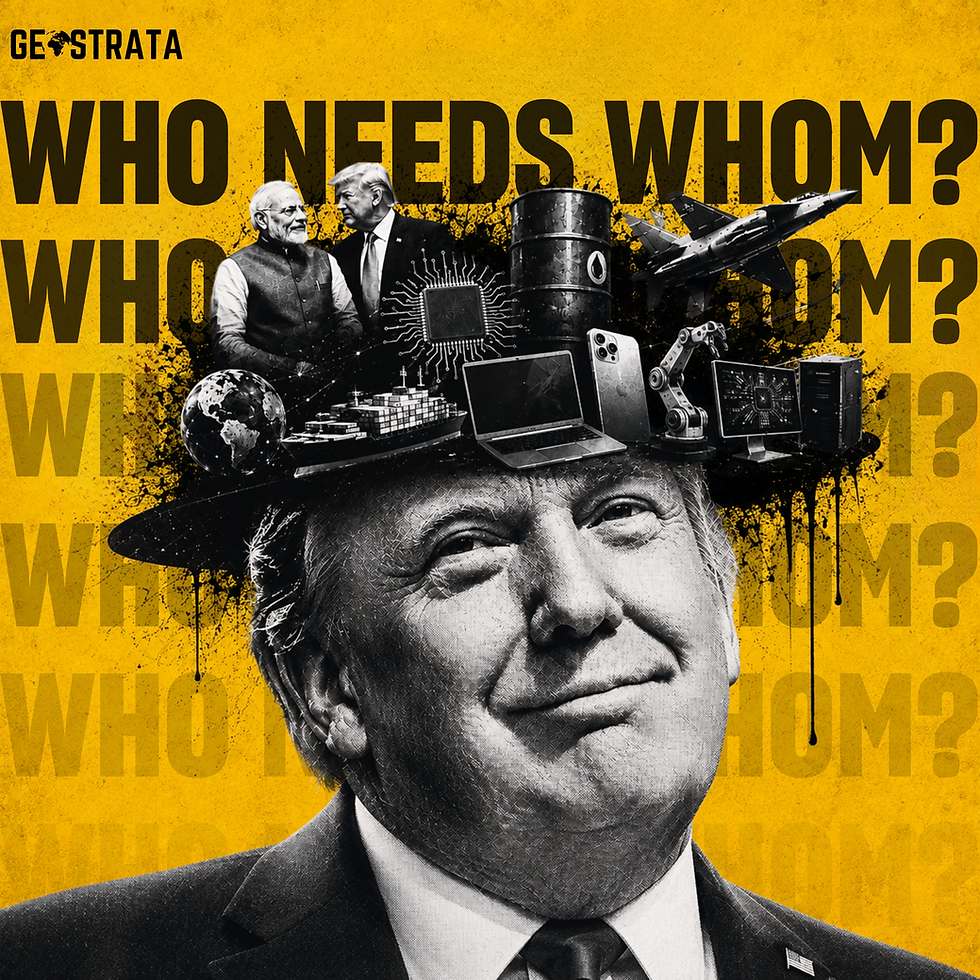
Illustration by The Geostrata
Narendra Modi's emergence as a transformational and charismatic leader after Pt. Jawaharlal Nehru has triggered a comparison between the two. The question before us is therefore not of some arithmetical character or whether Modi has governed India for twelve years or whether he has surpassed Nehru. The more important question is, what kind of India has emerged after these twelve years? Even though each leader brings a distinctive approach to governance, it is difficult to pick one leader. But through multilateral reforms by both Nehru and Modi, we were able to witness two different Indias with different approaches.
Political scientists have long distinguished between leaders who primarily administer existing institutions and those who seek to transform the political order. This distinction can be found in the work of scholars such as James MacGregor Burns on transformational leadership. According to him, most governments administer through existing machinery and inherent institutions, but a few transform and redefine them.
Luckily for us, we were able to witness transformational leadership from independence till now. But on this recent milestone by Modi, we need to welcome this distinct political era whose achievements will lay the foundation of our Viksit Bharat 2047. Therefore, it marks a new pathway for our democracy.
TRANSFORMING THE INDIAN STATE - GOVERNANCE, TECHNOLOGY AND WELFARE DELIVERY
The first dimension of this transformation is related to the Indian state itself. After the British left us, our major challenge was not the absence of policy but the weakness of the delivery mechanism. Governments announced schemes from the Red Fort, but citizens got tangled with intermediaries. The distance between entitlement, delivery, and access was often vast. But with the gradual effort of Nehru’s government, citizens were able to witness governance as their own.
Henceforth, Modi’s government is also keeping up the legacy of service for, by, and to the people. The most significant achievement of the Modi government may lie in narrowing this distance through technology. The integration of Jan Dhan accounts, Aadhaar, and mobile connectivity created a new architecture of service delivery mechanisms. Welfare schemes became increasingly direct. Subsidies, pensions, and benefits could move from government to citizens with minimal human intervention. The spread of digital payments through UPI further expanded this transformation. What emerged was not simply a technological innovation but a new and equal relationship between the citizen and the Indian state.
This achievement deserves recognition because it addresses the structural lacunae in Indian governance and what was once infamously called "functional anarchy" by US Ambassador to India John Kenneth Galbraith. Now, our governance has become a model for the world to learn from India. Hence, it also approves “Indianisation of Development.”
ECONOMIC TRANSFORMATION - GROWTH AND CHALLENGES
Moving forward, the Indian economy went through a transformational shift under the present regime. The Modi government has stood tall in the context of the economy's upturns and downturns. From struggling with slow and stagnated growth and battling with inflation to Covid-19, Modi’s government has shielded our economy from recession to depression periods. It responded with a developmental strategy, or, per se, it acted as our safety valve.
Highways, airports, dedicated freight corridors, railway modernisation, and multi-modal logistics hubs became visible symbols of aspirational and growing India. Also, we see a gradual improvement in our physical infrastructure from the Nehru era till now.
Today, India’s remarkable economic expansion highlights a robust foundation where strategic infrastructure developments are successfully driving long-term, high-speed growth.
As macroeconomic indicators continue to reach impressive new heights, they actively pave the way for sustainable livelihood generation and rising income levels. Also at the same time, optimizing the labor force and expansion of the manufacturing ecosystem remain ongoing areas of active development; this dynamic progress reflects an economy steadily building the vital resilience needed to transform national security into widespread, everyday prosperity.
RESHAPING AND REDEFINING NATIONAL IDENTITY
The third and perhaps most profound transformation has occurred in Indian politics itself. For nearly three decades before 2014, India lived in the age of coalitions. Political authority was fragmented, fractured, and dispersed. The Modi era reversed this trend. The Bharatiya Janata Party emerged not merely as a successful electoral machinery but as the central pole around which national politics presently revolves.
This development resembles, in some respects, the dominance once enjoyed by the Congress under Nehru. Yet the comparison should not be stretched too far. The social foundations, ideological priorities, and institutional mechanisms are entirely different. What matters is that India appears to have entered a new political phase where one party sets the terms of national debate and compels all others to respond to it.
No assessment of the Modi era can ignore the question of national identity. Globally, every transformative leader attempts to redefine the story a nation tells about itself to the outer world. Nehru sought to define India in the language of secular citizenship, scientific temper, and developmental modernity. Modi's project has been different. The government seeks to place civilisational consciousness as the central value of national self-understanding. While Nehru laid the foundation of a modern, scientifically-driven republic, Modi's project shifts the focus toward cultural heritage, effectively redefining India’s national identity from a strictly civic construct into a deeply rooted civilisational state.
Foreign policy offers another arena where change is evidently visible. India today speaks with greater confidence and stakes in international forums. The language of non-alignment has gradually given way to the pragmatism of multi-alignment. India engages simultaneously with the United States, Russia, Europe, the Gulf, and the Global South without allowing any single relationship to define its strategic choices.
This shift reflects a broader change in self-perception. India increasingly sees itself not merely as a participant in global affairs but as a power aspiring to play a decisive role in shaping the world. Surely, India’s ambition is matched by material capabilities and economic power.
INSTITUTIONS, DEMOCRACY, AND THE HISTORICAL VERDICT - THE UNRESOLVED DEBATE
Modi’s 12 years of governance must also engage concerns about institutions. Democracies require more than effective governments. It requires autonomous institutions capable of pragmatic usage of power. Hence, with so many glorious years of people’s rule, we were able to witness neutral institutions that are providing effective services from cradle to grave. Therefore, strong leadership is necessary to overcome decades of drift and indecisiveness, but democracy and constitutional values remain sacrosanct.
The propensity to draw stark comparisons is infallible but must be approached with caution. The two leaders confronted different historical challenges and operated in different contexts. Nehru's task was nation-building after independence. Modi's task has been state transformation in a mature democracy. History will judge both the leaders not by their intentions but by the results they produced.
The most defensible conclusion, therefore, is neither celebratory nor condemnatory. Twelve years after 2014, India is undeniably different. Governance is more digital. Welfare delivery is more direct. Infrastructure is more visible. The political landscape has been restructured. National identity is being debated in new ways. India's global profile has expanded. Hence, these changes strengthen India's democratic promise and redefine its contours.
Therefore, Narendra Modi's tenure represents a distinct and defining chapter in India's political history, presenting scholars with a significant opportunity for objective and holistic analysis. Rather than viewing this era through a lens of praise or criticism, researchers can focus on understanding its structural impacts, policy evolutions, and long-term contributions to the nation's governance.
BY NISHESH SHARMA
COVERING PRIME MINISTER
TEAM GEOSTRATA


I wasn't expecting much from eggy car, but the balance mechanics are genuinely fun. It’s the kind of game that makes you say "one more try" over and over.