.png)


Apollo to Artemis: Humans Return to the Moon After Five Decades

THE LAUNCH: A NEW DAWN IN SPACE EXPLORATION
On April 1, 2026, at 6:35:12 PM EDT, NASA’s new Space Launch System (SLS) rocket launched off - Launch Complex 39B at the Kennedy Space Center in Florida. Ending a 53-year streak, as humankind set off towards our natural satellite.Carrying the Orion spacecraft and Integrity module with 4 astronauts on board. Artemis II is the first crewed lunar mission in over 50 years.
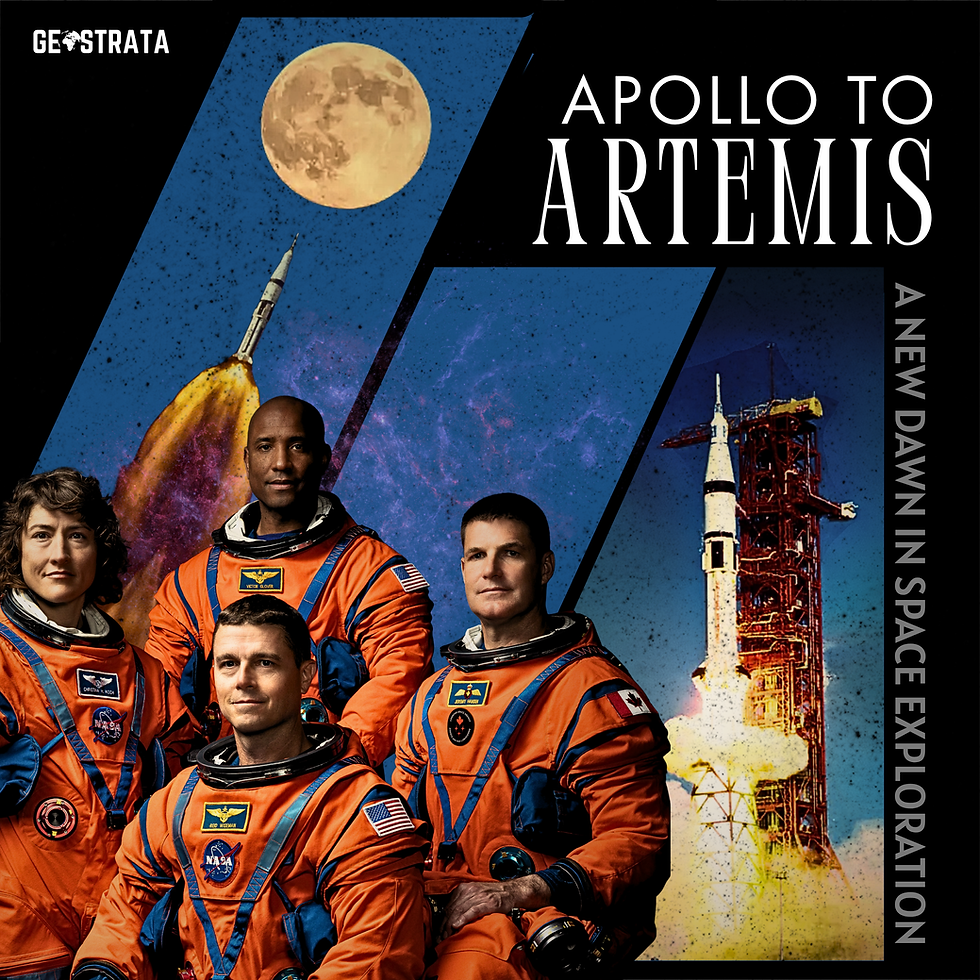
Illustration by The Geostrata
NASA Administrator Jared Isaacman says it was “a defining moment” as we returned to the Moon and “the start of something bigger than any one mission.” The Artemis 2 mission is a 10-day Lunar Flyby, taking humans the farthest we have ever been from home. The mission will test Orion’s life support, communication, and navigation systems with humans aboard, setting the stage and groundwork for a future lunar landing and ultimately a mission to Mars.
APOLLO'S LEGACY AND LUNAR SCIENCE
Artemis II picks up where Apollo had left off. The last human mission, which was Apollo 17 (Dec 1972) was also the final lunar landing and the first with a scientist-astronaut on it, had touched down in Taurus-Littrow Valley to collect rock samples from ancient and younger terrains, bringing back over 100kg of lunar material.
Those Apollo samples have kept scientists busy for decades - recent analysis of Apollo 17 lunar rocks helped pin down a colossal lunar impact that shaped the Moon’s evolution. Over the past decade, robotic missions (like LRO and LCROSS) have revealed substantial water ice in permanently shadowed craters at the lunar poles. Artemis now aims to take the next step: sending people back to explore and eventually utilize those resources.
FOUR ASTRONAUTS, MANY FIRSTS
The Artemis II crew is historic. Reid Wiseman - Commander, and Christina Hammock Koch - Mission Specialist, both have served as NASA astronauts in the past. Victor Glover - Pilot, will be the first person of color to fly to the Moon, and Jeremy Hansen - Canadian Space Agency, will be the first non-American (and first Canadian) to fly on a mission to the Moon. Koch will also be the first woman to travel outside of low Earth orbit and fly around the Moon. The crew has been training for this for years, and NASA even held a “Send Your Name to the Moon” campaign, in which over a million people submitted their names to ride on Orion’s data plate and join them on this spacecraft.
Orion was launched on the new heavy-lift rocket SLS Block 1. The spacecraft deployed its solar panels within an hour and was already orbiting Earth. Orion is using the Interim Cryogenic Propulsion Stage (ICPS) for translunar injection burns (MTLI) to get Orion around the Moon and is equipped with life-support and radiation-shielding technologies that have been tested in space to ensure humans can survive far from Earth.
MISSION PROFILE AND MILESTONES
While the mission and pathway remain unclear to many across the globe, it certainly is not to the carefully chosen astronauts and project managers for Artemis II, who lay them out with precision,
Earth Orbits & System Checks: After launch, Orion will orbit Earth twice to check all systems with the crew on board. The astronauts will fly into an “elliptical” orbit (tens of thousands of kilometers out) and practice manual piloting, exercise, and maintenance tasks (e.g., toilet checks, life support checks). Engineers on the ground will check Orion’s life support, navigation, and communications systems.
Translunar Injection: Approximately 25 hours after launch, Orion’s service module engines fired at perigee to give the spacecraft one last push to the Moon. This burn is sending them on a free-return trajectory that will loop around the Moon and return to Earth without further major maneuvering, much like Apollo 13’s abort trajectory.
Lunar Flyby: On Day 6 or so, Orion will circle the far side of the Moon, the furthest humans have ever traveled. While in this orbit, the crew will be without radio contact for 30–50 minutes while being directly behind the moon. They will test Orion’s laser communication system (deep-space optical communications) and collect scientific data. They will also capture images of the mysterious far side of the Moon, probably for the first time.
Return to Earth: After the gravitational slingshot, Orion will coast back to Earth over the next few days. The astronauts will continue to monitor the experiments, including biological tests of radiation impact.
Reentry and Splashdown: On Day 10, Orion will break free of its service module and reenter Earth’s atmosphere at over 25,000 mph (about 40,000 km/h), the fastest crewed reentry in history. Orion’s heat shield will glow with heat (up to 3000°F), and after about 10 minutes of engulfing plasma, Orion’s main parachutes deploy and slow it down enough to safely splash down in the Pacific.
ARTEMIS III & IV: THE BIRTH OF AN INTERPLANETARY CIVILIZATION
Artemis II, at the end, is indeed a test flight. Success on this opens the door to the next giant leap. Artemis III aimed to land astronauts on the Moon near the South Pole, where they will prospect for water-ice deposits, and establish the foundations for establishing a permanent lunar base. However, this seemed to have been pushed back to Artemis IV temporarily, and Artemis III was repurposed to a lander mission, such as Apollo 9.
As Jared Isaacman commented at launch, “Artemis II builds... our return to the Moon, not just to visit, but to eventually stay on our Moon Base.” This is NASA’s long-range plan: a Gateway space station on the Moon, a polar base camp on the Moon, and crewed Mars missions in the 2030s.
This comes on the back of renewed global competition: As China battles to put taikonauts on the Moon by 2030 in order to establish its own lunar base. India, for instance, has launched the Chandrayaan spacecraft that reached polar orbit and soft-landed on the moon at just a fraction of the cost of NASA’s. Japan and the UAE have announced their own lunar landings. Artemis is about nationalism as much as leadership, economic, and scientific. It shows the U.S. commitment to cooperative exploration with the onboarding of a Canadian, as well as competition with others. Building up to a new age of Space-Race.
A PALE BLUE DOT, REACHING BEYOND ITSELF
Artemis II is an incredibly personal journey for the astronauts. Commander Reid Wiseman and his crew will witness an Earthrise like Apollo 8 in 1968. As one of the astronauts put it, this mission is “for everyone” on earth. When Orion crashes down near San Diego after 10 days, it will not just complete its flight path, but also complete humanity’s return to deep space.
This mission reminds us how small we are and just how vast the universe is - Just a blue grain on a Sun-sized desert. The tiny fraction we have explored cannot be denoted in numbers. Yet humans continue to explore the cosmos because that is what we do - question, scale, expand, dominate. Re-starting the space journey, we may be able to test our capabilities around the Moon today, visit Mars tomorrow, look for life on the moons of Jupiter, and maybe, just maybe, truly understand what Einstein meant by “The most incomprehensible thing about the world is that it is comprehensible.”
BY CHIRAG JOSHI
TEAM GEOSTRATA


“wordle today uk free” is a common search for people who enjoy solving the daily Wordle puzzle in the UK, as it’s a fun and quick way to test vocabulary skills and start the day with a challenge.
I’ve been looking for a minimalist yet challenging racing game, and I stumbled upon poly track online game for free The physics-based mechanics are surprisingly smooth, and the built-in track editor is a game-changer for creativity. It’s rare to find a browser-based game with this much depth. If you enjoy time-attack challenges and building custom stunts, this is definitely worth a bookmark.
I really liked how clearly everything was explained. The content flow makes it easy for new users to understand fairdeal and the features of fairdeal live without confusion. One of the most informative posts I’ve read recently. Great work by the feardeals.games india team.
Must-read