.png)


A New Chapter in Hungary-EU Relations: The End of Viktor Orbán’s Tenure

On 12 April 2026, Hungary, for the first time in sixteen long years, welcomed a new government to the seat of power. In a watershed moment in Hungarian politics, around 79.5% of Hungary’s electorate turned out to vote in a monumental exercise of democracy. Viktor Orbán, the man who had dominated the seat of power since 2010, was defeated by Peter Magyar by a landslide margin of 138-55.
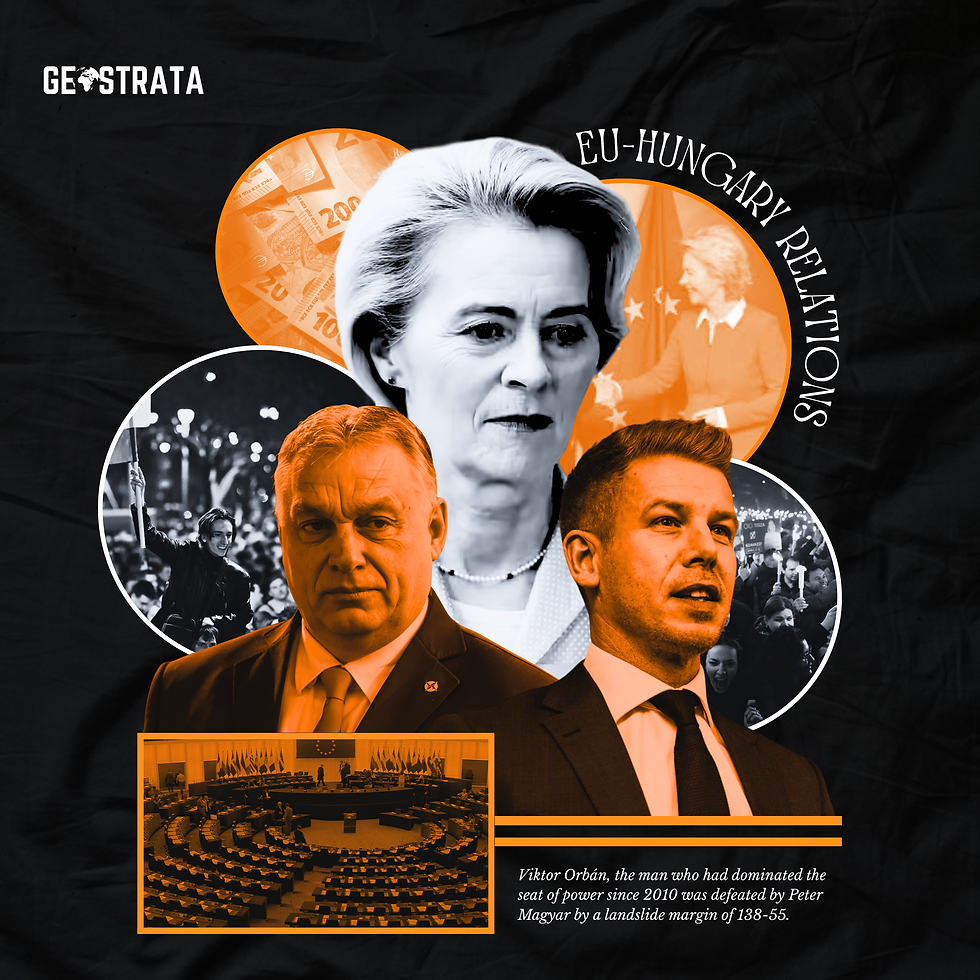
Illustration by The Geostrata
This change in governments is not a mere change in ruling parties, but rather a signal to the initiation of an altogether new chapter in Hungary. Orbán’s rule was marked by rampant corruption, fiscal mismanagement, facilitation of crony capitalism, and unregulated state control. Furthermore, Orbán challenged, opposed, and disobeyed the European Union on many junctures throughout his tenure, all of them culminating in the subsequent souring of Hungary-EU relations.
ORBÁN, DEMOCRACY, AND THE EU
Orbán’s tenure was noted by many to be a bastion of conservative values in Hungary. His policies have severed EU-Hungary ties, and his policies, be it of public welfare, or of fiscal and economic management, were ruinous. It was precisely the impact of these policies on not only the population, but also on the broader tangent of Hungary as a part of the EU, which led the latter to initiate procedures of taking strict, reinforcing actions against his rule.
Often described by many critics as a cautionary tale of what an unrestrained executive with a strong central authority is capable of doing, Orbán’s tenure was characterised by his vision of transforming Hungary into an ‘illiberal democracy.’ His disagreed with the commonly understood notion of a liberal society, one which encourages individuals to exercise liberty only until it is harming other individuals made notion of what Hungary should be entailed the substitution of individual liberty with state intervention, further stating that the state should have the power to control society and to take better care of its citizens.
This policy of Orbán’s led to the crumbling of fundamental pillars which were essential to the healthy-functioning of society. For instance, media under Orbán was highly restricted and regulated by his Fidesz party. Around 80% of the news outlets in Hungary were at one point owned by close associates of Orbán’s, further marginalising independent journalists and causing an indelible impact on the freedom of speech in the state.
Democracy further crumbled with Orbán engaging in rampant gerrymandering. For purposes of elections to benefit his cause, he has changed the boundaries of constituencies in a way which would suit his party’s votebank.
He is known for having used his political power to change laws as well. The extent of this is such that in 2011, he replaced the 1949 constitution of Hungary with a whole new set of laws, namely the Fundamental Law. This new constitution draws its legitimacy from the maintenance of conservative values and nationalism, two ideas which have proven to be the cornerstone of Orbán’s vision of himself as a leader.
Furthermore, to deepen the trenches of already-existing chaos internally, Orbán on many occasions has given contracts of EU-funded infrastructural projects to industrialists and businessmen in his inner circle. This overt engagement with crony capitalism further exasperated the common public, and led to the EU subsequently freezing funds to Hungary.
INTERNAL DYNAMICS AND ITS ROLE IN STRAINED HUNGARY-EU RELATIONS
With the rule of law, integrity of institutions, and the overall gist of democracy faltering, Hungary found itself at odds with the EU, for it stood for everything no other EU member wished to stand for. In 2019, democracy watchdog ‘Freedom House’ scaled down Hungary by 20 points on a 100-point scale about freedom.
This drop in points resulted in Hungary being reclassified as ‘partly-free’ from previously being ‘free,’ hence becoming the only country in the EU to be ‘partly-free.’ Alongside this, in April 2026, Orbán blocked 90 billion euros in aid to Ukraine, further requesting the EU to reverse sanctions on Moscow.
This is the fifth consecutive year in which Orbán has proven to be the thorn which refuses to let the EU facilitate aid to the war-affected Ukraine.
Orbán has attempted to utilise his blocking of funds to Ukraine as a way of releasing frozen EU funds. Orbán’s continued defiance of the EU has led to the Fidesz party being suspended from the European People’s Party grouping in 2019, with its formal membership being terminated in 2021. Orbán viewed Brussels as a bureaucratic obstacle which stopped him from pursuing political power the way he pleased.
MAGYAR AND EU: A POTENTIAL SCOPE FOR HOPE?
As noted, furtherance of Orbán’s own agendas has led to a critical severance of EU-Hungary relations. Now, with the onset of a new government led by Tisza leader Peter Magyar, a new floor for discussion opens. For many, especially the EU, the end of Orbán’s tenure is a wave of fresh air, undoubtedly.
Although, does that equate Magyar's ascension to be the easiest solution to remedy all Hungary-EU ties? Not necessarily. Over the coming periods of his tenure, Magyar is expected to face critical challenges in the restoration of ties, especially owing to the degree of damages done by Orbán. Magyar definitely has the incentive to start fresh with the EU, but it will prove to be a rather time-consuming affair, as Orbán’s ‘Brussels is evil’ rhetoric needs to be undone. Underscored strongly in his agenda is how he plans on normalising relations with the EU in order to release Hungary’s frozen funds.
Moreover for proper integration into the EU, he has arrived with fresh plans for Euro adoption as well. He also aims to address the rampant cronyism and corruption that was instituted by his predecessor in his sixteen-year tenure.
Pertaining to EU-Hungary relations and how they might be of global interest, Magyar’s biggest diplomatic test will be illustrated in how he chooses to navigate the Russian-Ukraine war. He has indicated a rapprochement with Ukraine as a part of larger efforts to smoothen relations with the EU and NATO.
Furthermore, Magyar has also voiced his discontent with Orbán’s veto on the 90 billion Euro aid to Ukraine, previously advising him to lift it as well. But, simultaneously, he has stated that Hungary will continue importing energy from Russia till 2035, further enunciating that any possibility of Ukrainian membership in the EU will be addressed by him through a referendum.
Whether we are presently standing at a true point of inflexion or at a mere change in political parties is a question whose answer will reveal itself in the coming period of time. However, the public’s verdict was loud and clear: Magyar won their support. Now, the decisions he makes in his tenure address issues not just in a domestic sense, as the stakes officially extend beyond boundaries.
BY VIJAYLAXMI
THE GEOSTRATA


Seeing that 79.5% turnout and the 138-55 landslide really made me pause—it’s rare to witness such a decisive democratic moment after sixteen years of Orbán’s rule. I appreciate how the post frames it as more than a simple party change, especially with the corruption and fiscal mismanagement you mention. By the way, I keep a free AI prompt library and generator I like to share: https://nanoprompts.net/
thnaks for this love it nice such an amazing article also sharing this with friends on wa gb pro
Excellent analysis of Hungary’s political transition and EU relations. anguila de la 9 highlights how informed discussions encourage readers to better understand democracy, leadership, and global affairs.
“watermark remover ai video tools are really useful for cleaning up footage, helping create more polished and professional-looking videos with the assistance of AI technology.”
Interesting read on how Hungary’s new leadership might reshape its EU ties—makes me think about planning for change, just like when I use a roofing calculator to figure out materials before a big project. Thanks for the insight!