.png)


The Indian Ocean is Not Neutral: The Strategic Importance of The Indian Ocean Region

The Indian Ocean is not merely a body of water; it is an amphitheater of trade, commerce, and geopolitical flashpoints. Two thousand years ago, taxes on Indian trade alone accounted for roughly one-third of the total revenue of the entire Roman Empire. The Ocean has never been a background feature; it has always been the main event. And in 2026, with chokepoints under strain, submarine cables contested, and sea beds mapped for their minerals, the Indian Ocean is more contested, more consequential, and more dangerous than at any point since the colonial era.

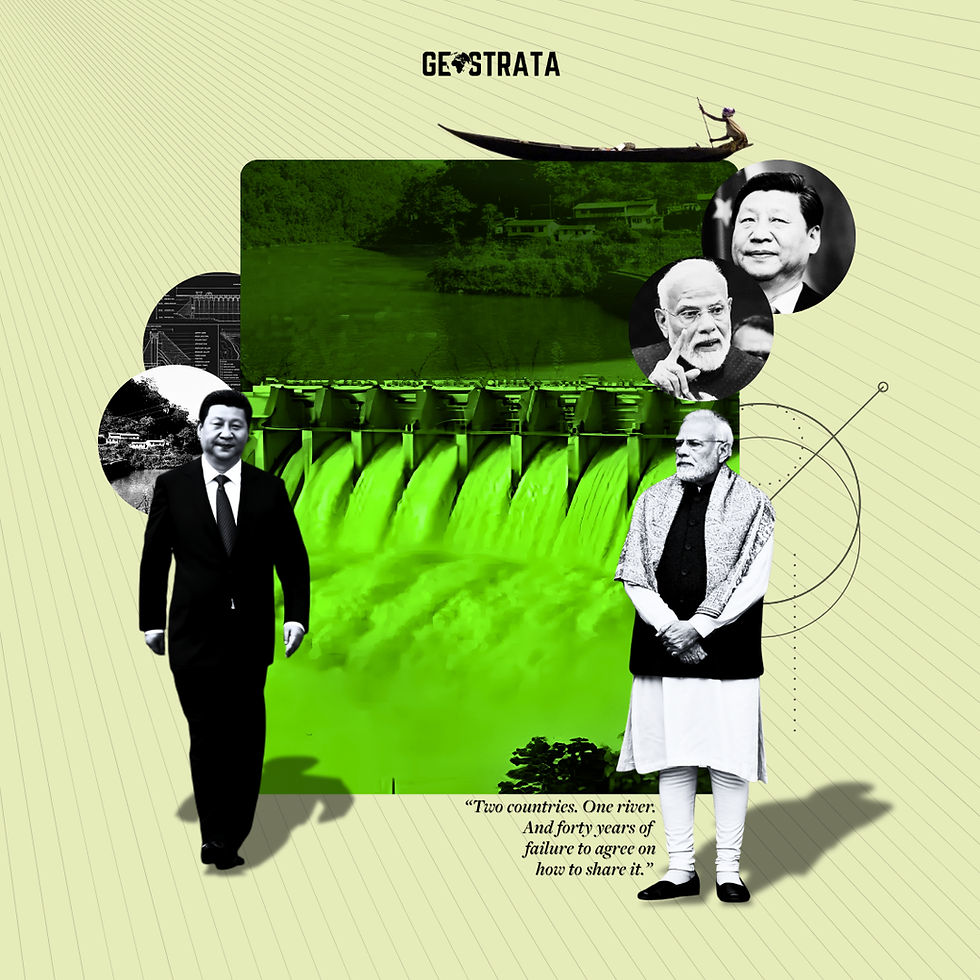
Illustration by The Geostrata
The ocean carries a staggering share of the world’s weight. Over $5 trillion in trade transits annually, roughly 80% of global seaborne oil passes through its waters, and 95% of the world’s internet traffic runs through undersea fibre-optic cables that cross its floor. For India specifically, 95% of its trade by volume and 68% by value moves through the Indian Ocean. A single disruption at one of its three main chokepoints does not create a regional problem. It creates a global one.
What are those chokepoints, and what does disrupting them actually mean? How can India strategically respond to a certain nation that uses the language of commerce to build military architecture across the ocean? And what role can the middle powers, such as Japan, Australia, France, and the UAE, play in an ocean that no single country can secure alone?
THE CHOKEPOINTS
The Indian Ocean’s strategic geography comes down to three straits, each of which, if blocked, would send immediate shockwaves across global food, fuel, and goods supply chains.
The globe realized the importance of these narrow passages when the Strait of Hormuz, located at the mouth of the Persian Gulf, was identified as the only maritime exit for five of the world’s top ten oil producers, and handles 34% of global seaborne oil exports, and the passage of naval vessels was restricted in February 2026. India imports 85% of its oil through the Indian Ocean, the majority originating from the Gulf. For India, the Strait of Hormuz is not an abstract geopolitical concern. It is the pipeline that keeps its economy running.
The Bab-el-Mandeb Strait at the southern entrance to the Red Sea connects the Indian Ocean to the Suez Canal and onward to Europe. It handles 8.7% of global seaborne trade worth over $2 trillion annually. When Houthi attacks disrupted it in late 2023, traffic through the Suez Canal fell by over 50% by mid-2024, and global consumer prices were projected to rise by 0.6% by the end of 2025 from the sustained disruption alone. Fertilizer, rice, and wheat shipments were caught in the bottleneck, worsening food insecurity across Africa and the Middle East.
The Strait of Malacca, at the ocean’s eastern end, is the busiest shipping lane on earth, carrying $3.5 trillion of trade annually and 80% of China’s oil imports. It is also the chokepoint over which India holds the most natural geographic leverage, with the Andaman and Nicobar Islands sitting directly at its western entrance. Beneath the surface of these trade routes lies a second layer of vulnerability that receives far less attention: the submarine cable network.
Approximately 95% of the world’s international internet traffic runs through undersea fibre-optic cables, the majority of which transit the Indian Ocean floor. India has 17 international submarine cable landings; moreover, these cables carry financial transactions, government communications, and civilian internet access.
THE DRAGON'S PLAYBOOK: PORTS AND THE FORUM WITHOUT INDIA
The “Middle Kingdom” describes its Indian Ocean port investments as purely commercial. The pattern of where those ports are located narrates a completely different story. Gwadar in Pakistan, 70 kilometers from the Strait of Hormuz. Hambantota in Sri Lanka, on a 99-year lease. The Doraleh Multipurpose Port in Djibouti, where China opened its first overseas military base in 2017. Lamu Port in Kenya. Along with other Infrastructure investments in the Maldives and Myanmar. This is the String of port access rights, energy corridors, and security agreements that encircle India and extend logistical reach from the South China Sea to the Persian Gulf without requiring a single formal naval base.
The diplomatic dimension of this strategy was solidified in November 2022 when China convened the China-Indian Ocean Region Forum in Kunming, under the theme of the Blue Economy. Here, representatives of 19 countries attended, including Pakistan, Sri Lanka, Bangladesh, the Maldives, Djibouti, Kenya, Mozambique, Tanzania, and Australia. India was not invited, and the ocean named after India was being discussed without it. China proposed a new Marine Disaster Prevention and Mitigation Cooperation Mechanism, offering financial, material, and technical support to member states. The message was clear: China was not merely building ports; it was building new diplomatic relations and solidifying its presence.
THE DIMENSIONS OF INDIA'S RESPONSE
The cooperative nature of India’s approach is 'IOS Sagar'. This was launched by the Indian Navy in the Indian Ocean from its Karwar naval base in April 2025. It is a joint task force of the Indian Ocean Rim countries. It was initiated by renaming the INS Sunayna as the Indian Ocean Ship Sagar (I-OSS) and setting off on its voyage on April 1, 2025. India launched the second edition of the Indian Ocean Sagar (IOS) in 2026. It covers the South-Eastern Indian Ocean from 16 nations, including the UAE, with an aim to promote practical interoperability through shared sea time, beyond political consultations.
The covert face of India’s outreach to the Indian Ocean is the nuclear submarine base code-named INS Varsha. It is a part of Project Varsha being constructed at Rambilli village, 50 km south of Visakhapatnam on the east coast.
The INS Varsha submarine base is strategically located close to BARC’s nuclear engineering complex, giving it the capability to carry out repairs of submerged reactors. This underground strategic defense installation has twin tunnels and docks for the secret and safe deployment of submarines into the Bay of Bengal. The INS Varsha can cater to 10-12 submarines at a time. India’s new naval fleet will have the capability of going underwater, striking from undersea, on land, and from above. With the addition of the third nuclear submarine INS Aridhaman, India now has a sea-based leg of its nuclear triad.
Besides the high-profile programs of India’s outreach to the Indian Ocean, another significant project is the Great Nicobar project. It is India’s most ambitious maritime development project with an estimated cost of over ₹81,000 crore. This project aims to make Great Nicobar an integrated logistics and security hub connected to the mainland via a dedicated expressway. It includes the development of a 14.2 million TEU International Container Transshipment Terminal, a dual-runway international airport, a 450 MVA gas-solar power project, and a greenfield township.
The strategic location of the proposed International Container Transshipment Terminal (ICTT) on the East-West shipping lane at 40 nautical miles away from the Strait of Malacca will reduce India’s dependence on transshipment hubs in Singapore and Colombo. This will provide India with increased strategic reach, security, and depth in the eastern region. India’s IOS SAGAR projects have a cooperative approach, which is the right policy, but requires greater presence. It is time India moved beyond political rhetoric and built an actual presence to back it up.
THE ROLE OF THE MIDDLE POWERS: JAPAN, AUSTRALIA, FRANCE, AND THE UAE
No single country can secure the Indian Ocean, so India must build a network, and the building blocks are already present in the form of middle powers whose interests align with keeping the ocean open, rules-based, and free from any single dominant military presence.
Japan’s interest is structural. 40% of Japan’s maritime trade passes through the Strait of Malacca, which is why it has invested heavily in maritime domain awareness capacity-building across Southeast Asia and the Indian Ocean rim. Japan’s 2022 defense build-up, which committed to doubling defense spending to 2% of GDP, explicitly named the Indian Ocean as a zone of strategic interest.
Australia brings the Quad partnership’s southern anchor, substantial signals intelligence capability across the Southern Indian Ocean, and the AUKUS framework’s nuclear submarine programme, which will eventually add SSN capacity to allied Indian Ocean operations. France, which controls Reunion Island and has a permanent naval presence in the Indian Ocean, offers basing rights and intelligence sharing that India has not fully leveraged.
The UAE, as IOS Sagar 2026’s newest participant, connects India’s maritime strategy to the Gulf’s western chokepoint and provides a logistics hub at the Strait of Hormuz’s entry point. What these partners offer, individually, is useful. What they offer collectively, if coordinated through a multilateral framework rather than a series of bilateral exercises, is transformative.
CONCLUSION
The argument for building a thick web of economic and security integration in the Indian Ocean, one that reduces dependence on individual chokepoints by making the entire ocean a shared governance space, is not idealistic. Trade that moves between Colombo and Mombasa, between Mumbai and Muscat, between Perth and Port Louis does not need to pass through a contested strait.
For millennia, the Mediterranean determined the fortunes of empires, transforming the surrounding region into the epicenter of trade, conflict, and political influence. The sea that once generated nearly a third of Rome's revenues is again becoming a strategic crossroads. But this time, it is part of a much broader contest stretching from Europe to the Indo-Pacific, where maritime power is being redefined. The central truth remains unchanged: control of the seas shapes the international order. For the first time in decades, this control no longer remains in the hands of a single dominant power.
BY RAGHAV GUPTA
TEAM GEOSTRATA


Comments